IN DEPTH Interview
Root & branch
Databases, observability, open core and trashed PCs get a mention as Linux Format talks to Percona founder Peter Zaitsev.
Linux Format Tell us a little about yourself, Peter.
Peter Zaitsev I’m now the founder of a few companies in the open source space, Percona being the largest and the most well known of those. I’m also very active in the open source ecosystem. I’m originally from Russia and now live in the US, North Carolina. I also lived for a bit in London and that’s actually where Percona got started back in 2006.
LXF What are your first memories of using a computer?
PZ I got my first computer from a trash can. At the time I was staying for a year in Sweden, my dad was a professor at a university. I think some local company was refreshing their computers, and throwing away perfectly good IBMs. So it had a monochrome display and half a MB of RAM, which I got to use.
That was a fantastic experience, because you don’t have the latest and greatest stuff. It’s kind of slow and you don’t have the resources – you have to figure things out, how to make things work that are not supposed to work, and I think that was wonderful. Comparing that to my own computer right now, you have this wonderful PC with a powerful graphics card. You can run all these fancy games. Why would you want to learn assembly language?
My involvement with open source is interesting. My start was back in Russia when I was 19. I was in university at that time and came to the choice of software to use. It was an interesting time, because open source software was not what it is right now. If you think about the late ’90s, Linux and all that kind of stuff was just starting. It was kind of a joke. It was very cool but not as mature or powerful as it is today.
Especially being in Russia, all software was free software! Nobody would think about such things as licences – you could go to a local store down the street and buy a single CD, which would have everything you ever needed for maybe 50 cents! So, we made a deliberate choice not to use that, but instead take the high road of using Linux, MySQL, PHP – the LAMP stack – and, well, the rest is history.
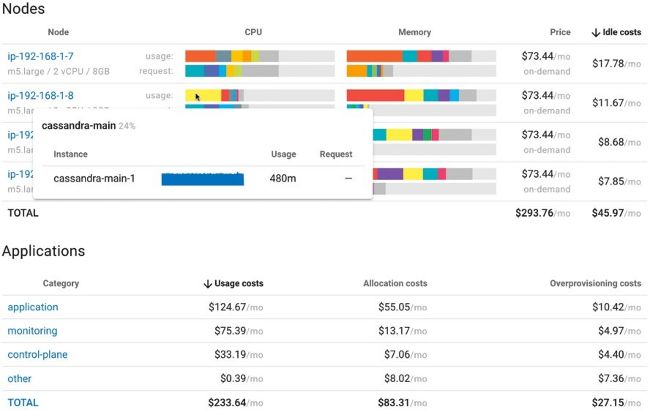
It’s not just performance, Coroot breaks down costs, too.
What was also very interesting for me is that open source is a community. If you’re using Oracle or Windows and you find a bug or you don’t understand something, what are you gonna do? Maybe you call support and you get somebody asking if you’ve tried turning it on and off again.
But if I found some problem with the Linux kernel, I would write to the Linux mailing list and have Linus Torvalds’s response! You can have other people who are senior experts give you their time and attention. That was wonderful being involved so early on.