GET INSIDE OPEN AI!
Long-suspected chatbot Jonni Bidwell invokes all his neural networks to harness the power of open source AI.

CREDIT: Magictorch
Artificial intelligence is all the rage. Whether it’s machine-learning algorithms that decide which
social media posts to show you, online retailers that know what you’re going to buy before you do, or
chatbots telling you how to live better, it’s becoming ever more prominent. Luddites might shun everything to do with AI, and with good reason. The big companies running the subscription-based generative AIs all want your data (and your dollars). But resisting AI entirely is futile. The tech isn’t going anywhere.
So, we’re here with a more realistic approach. We’ll show you how to harness the power of open source AI on your own hardware. Who needs
ChatGPT
when
Llama
can give you all the answers you need? And don’t be scared, you won’t have to write a single line of code thanks to
LM Studio.
In fact, with an appropriate model (like Qwen Coder), it can write code for you. And if you want to generate images, or do anything else with AI, why not try some of the open source apps on Hugging Face (https://huggingface.co)?
We’ll talk you through some AI history, economics, ethics and legalities. We’ll even see what it thinks about some classic
Linux Format
articles. So, join us on this journey deep into the neural networks and see what generative AI can do for you!
AI then and now
A potted history of where all this artificial intelligence stuff came from and how it got to where we are now.
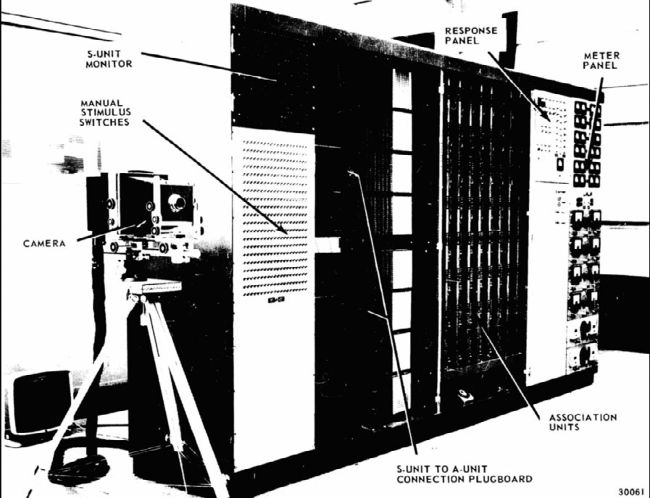
An illustration from the Mark 1 Perceptron’s operators manual. It must have been fun to use.
CREDIT: Cornell Aeronautical Laboratory, Project Para, 1960, Public Domain
There’s no denying that the field of AI is moving fast. Only eight years ago we were thoroughly T impressed (and go aficionados were utterly in awe) when DeepMind (now a subsidiary of Google) demonstrated its AlphaGo program. It managed to destroy world-class players of the board game go (which from a game theory standpoint is several orders of magnitude more complex than chess). Computers playing (and being amazingly good at) board games is nothing new – the Stockfish engine has been better than human opponents at chess for many years.
Indeed, if we go back a little further, we can see that what we considered to be artificial intelligence has changed radically. For example, the baddies in Doom (1993), Quake (1996) and both Half-Life games (1998 and 2004) were all considered to be intelligent in their times. But today their feeble attempts at stealth and their robotic pathfinding algorithms are entirely clunky. Going back to the late ’50s, we find Frank Rosenblatt’s Perceptron Mark 1 machine. This could classify images, and was perhaps the beginning of practical AI.
The Perceptron, and the algorithm that underlies it, was meant to mimic how its inventor thought human visual perception operated. This ties in with a common definition of AI – the simulation of human intelligence. But perhaps a more flexible definition (since human intelligence is limited) would be “getting computers to do things they didn’t used to be able to do”. A shining example of this is the Turing Test, proposed by Alan Turing in 1949. He proposed that if a machine could carry out a conversation with a human in such a way that was indistinguishable from human conversation, then that machine could be considered to be thinking.
Today when people talk about AI, they often refer to large language models (LLMs), such as OpenAI’s ChatGPT (https://chatgpt.com). Thanks to advances in natural language processing and the ability to train on massive data sets, LLMs have smashed the Turing Test. And while you’ll find the occasional oddball who thinks these models are sentient, we’ll weigh in heavily to the contrary. These systems might produce output that looks human, indeed some of their copy is better than that of lots of writers [say what now? – ed], but that’s just what you get when you combine enough blocks of dumb computing power in a clever way.
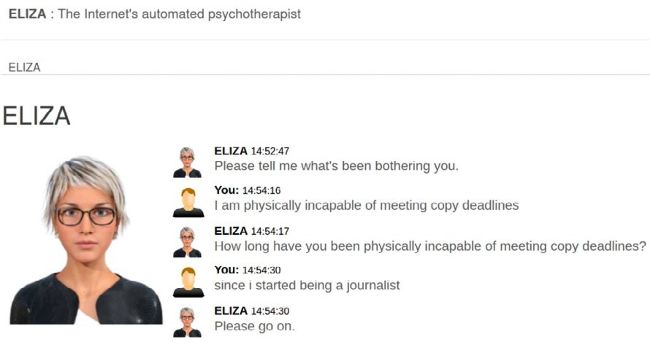
One of the first chatbots was Eliza, way back in 1966. Chat about that World Cup at
http://eliza.
botlibre.com.
LLMs are also capable of coding, so systems like GitHub’s CoPilot can assist you with your project, or Claude (a chatbot trained on real-time data) can write the whole darn project on its own. But it’s not just LLMs that give humans a run for their money. Midjourney can generate images based on text prompts. Other systems can generate music and video. But most are proprietary, subscription-based systems. We’re going to see what we can do for free, with open source tools.