DO YOU NEED AN M1 MAX?
Apple’s latest MacBook Pros come with two powerful versions of its M1 chip — but which do you need?
WRITTEN BY MATT HANSON
Late last year, Apple announced the MacBook Pro 16–inch and the MacBook Pro 14–inch with a pair of new chips inside, the M1 Pro and M1 Max. Both of these are substantial upgrades over Apple’s original M1 chip (which powers the latest MacBook Air and MacBook Pro 13–inch), with the M1 Max–powered MacBook Pro being by far the most powerful laptop Apple has ever made. The kind of performance the M1 Max provides comes at a price, however, with the 14–inch model starting at $2,899.
With that kind of investment, you need to make sure you’re getting your money’s worth, and for most people, the M1 Max is overkill. The good news? The M1 Pro is a more affordable, brilliant performer. As for the M1 Max, if you’re going to be doing some serious creative work, such as complex 3D modelling, then it’ll be worth investing in a MBP that packs it. Read on to find out whether you should get an M1 Max–powered MacBook.
What’s inside the M1 Max?
A
EFFICIENCY CORES The CPU of the M1 Max is made up of 10 cores; two efficiency cores and eight performance cores. When you’re browsing the web and don’t need a lot of CPU power, the M1 Max will use the efficiency cores to preserve battery life.
B
NEURAL ENGINE The 16–core Neural Engine handles the chip’s machine learning (ML) duties, like computional photography. The Neural Engine in the M1 Max helps deliver 11.5x faster ML performance when tracking moving objects in Final Cut Pro.
C
GPU This is the GPU of the M1 Max. Coming in both 28–core and 32–core configurations, this particular part of the chip is much larger than the M1 Pro. It allows the M1 Max to offer more graphical performance.
D
PERFORMANCE CORES While the efficiency cores are used for low–power tasks, the CPU switches to the performance cores when you’re performing more intensive tasks.
E
SYSTEM LEVEL CACHE There are also four blocks of SLC (system level cache), and on the M1 Max there’s 48MB of it, which is a big leap over the original M1’s SLC capabilities.
F
MEDIA ENGINES The M1 Max’s media engines handle video encoding and decoding duties (including ProRes and ProRes RAW content), while maximizing battery life.
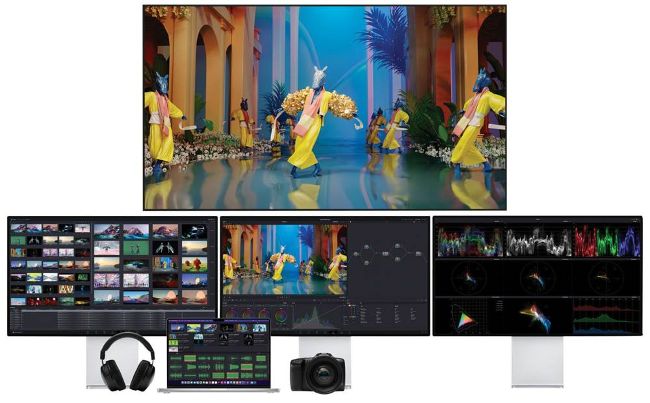
While the M1 Pro 16in MBP offers 2.5 times the graphic performance of the previous model, the M1 Max version offers four times the graphics performance.