HIS GRACE UNDER PRESSURE
In the spring of 1974, DAVID BOWIE arrived in the United States by boat. By the time he left in the spring of 1976, his marriage was ending, his cocaine addiction was spiralling, and he'd become obsessed with Nazis. He'd also made another masterpiece: Station To Station. "We went days without sleeping," his valiant co-conspirators tell GRAYSON HAVER CURRIN. "Inhibitions were out the window."
Portrait by STEVESCHAPIRO.
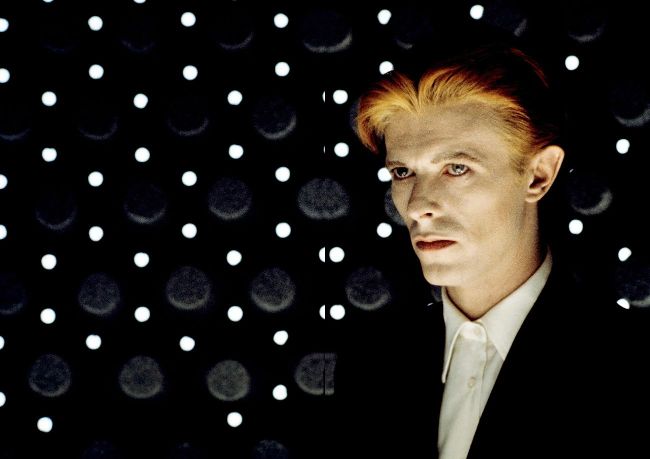
Stranger in a strange land: David Bowie as Thomas Jerome Newton in The Man Who Fell To Earth, 1975, the visual avatar of 1976’s
Station To Station
.
Steve Schapiro/Corbis via Getty
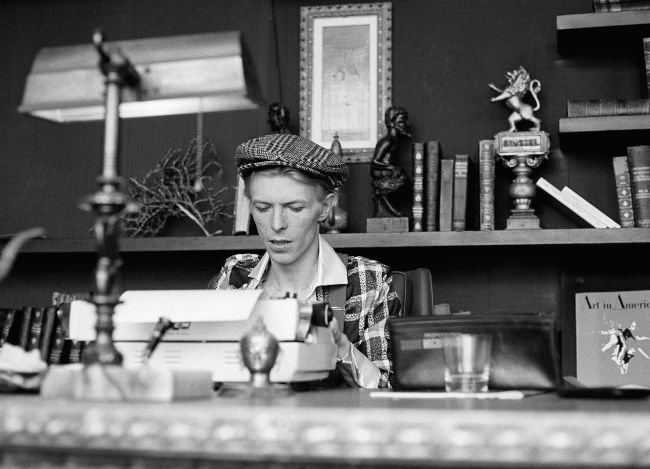
Senses working overtime: Bowie at home in Los Angeles, 1975; (opposite page, clockwise from top left) Bowie and Earl Slick at Boston Music Hall on the Diamond Dogs tour, November 15, 1974; Bowie’s favoured transatlantic vehicle SS France in New York; Sherry-Netherland Hotel, Bowie’s NYC abode on arrival in April 1974; Bowie pal Glenn Hughes; Bowie with son Duncan, AKA Zowie, on-set for The Man Who Fell To Earth, 1975; Bowie as Thomas Jerome Newton; Rod Stewart looks after the Blue Nun, Madison Square Garden, February 24, 1975; David and Angie Bowie on Good Morning America, February 1976.
Steve Schapiro/Corbis via Getty
EARL SLICK DIDN’T HAVE MUCH TRADITIONAL USE FOR A MUSIC stand when he was cutting Station To Station in the autumn of 1975. The New York-born guitarist, who adored the attitude and image of Keith Richards, couldn’t really read music when he’d joined David Bowie’s band a year earlier.
And ensconced in Cherokee Studios – a state-of-the-art Los Angeles spot that had previously been the MGM space where Frank Sinatra loved to record strings – the band didn’t really need music stands, either. Sure, Bowie had some ideas for his anxious songs about aging and the occult, about love arriving and leaving, but he mostly wanted to hear how these musicians responded.
“The music stands in the studio would turn flat, right? So we’d lay them down, and they all had mounds of coke on them,” Slick, 73 now, tells MOJO from his home in upstate New York, sporting a fedora and Ray-Bans at 11am. “David and I were the deep-enders, too. But without cocaine, it wouldn’t have been Station To Station.”
Bowie and his band began working in Los Angeles that autumn just as his American profile reached new heights. In September Fame, his ingenious and accidental studio rendezvous with John Lennon, had reached Number 1 in the States – his first US chart-topper, and his last for nearly a decade. His life in the States had seemed a spree of rock star indulgence: cavorting with Lennon during his lost weekend; carousing with Deep Purple’s Glenn Hughes; trying and failing to impress both Bob Dylan and Paul McCartney. And he arrived at Cherokee soon after wrapping his first starring role in a film, spending more than a month in the New Mexico desert shooting The Man Who Fell To Earth.
But teetering at the edge of 30, Bowie also seemed to be falling apart. After five years, his famously open marriage to Angie Bowie was collapsing in a string of betrayals, broken promises and orgies. Three years earlier, he’d conspired with manager Tony Defries to create a new company, MainMan, with an expansive roster including Bowie chums Iggy Pop and Lou Reed. But that arrangement was disintegrating too, Bowie’s celebrity having largely bankrolled a company that left him with far less cash than expected. He was toying with managing himself, even asking Mick Jagger for financial advice. And the cocaine – so much cocaine that he hallucinated angels, worried that the long-dead Manson family would murder him, and almost died several times – seemed to be fuelling all of it.
“What year is it now? ’76? I’ve been knocking on heaven’s door for about 11 years now with one sort of high or another,” Bowie told Cameron Crowe in Playboy after the tour for Station To Station finally ended. “I hate sleep. I would much prefer staying up, just working, all the time.”
The uppers, anxiety, and exhaustion, though, culminated in a mind on fire at Cherokee and, in turn, Station To Station, a masterpiece that not only reinvented Bowie’s persona as the Thin White Duke, but reimagined the expansive terrain that Bowie could navigate in the course of just six songs. An opener so menacing it challenged Slick to reconsider his guitar, funk so sizzling Bowie performed it on Soul Train, a closing cover so austere it prompted bassist George Murray to reconsider what beautiful music could mean – that was the stuff Bowie and his band truly took off those music stands. It would also mark the end of a crucial but tumultuous American sojourn for Bowie.
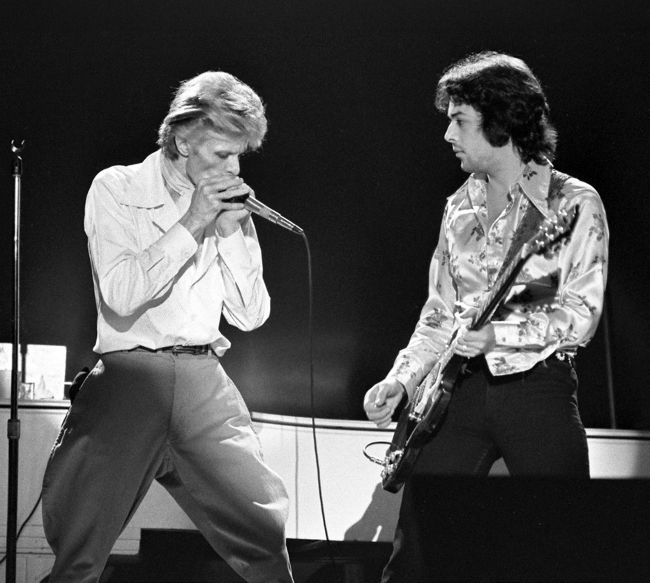
Fin Costello/Redferns/Getty, Screen Archives/Getty, StudioCanal Films Ltd/Alamy
Station To Station remains such a chimera that even its two very different guitarists remember it differently, almost 50 years to the day after they finished it. “Station To Station is always promoted as this gigantic experimental thing, but you’ve got two soul songs, two pop songs, and only two experimental songs,” opines Carlos Alomar. “It’s really not true.”
Slick disagrees: “It was really weird, almost avant-garde,” he says. “Take the title track alone and compare it to everything else coming out. It was groundbreaking.”
OWIE ALMOST MISSED THE BOAT TO New York, when it was set to sail from Cannes in early April 1974. He had booked a suite along the French Riviera, at the palatial Carlton Cannes, for three days with his friend and photographer Geoff MacCormack. They intended to take the SS France, the lavish ocean liner that had hosted many celebrities (including Salvador Dalí and his ocelot, Babou) for transatlantic voyages. It was one of the last legs on a final around-the-world trip for the vessel, and Bowie didn’t care for flying, anyway. But he and MacCormack had partied on the way from Paris and barely made it aboard.