FILTER ALBUMS
Good morning, captain
Fairport maestro sailing once more for sadder shores on nineteenth solo LP.
By Jim Wirth.
Richard Thompson
★★★★
Ship To Shore
NEW WEST. CD/DL/LP
SPIDERING HIS way into the bleakest corner of his first album in six years, Richard Thompson sees through the eyes of a soldier struggling with PTSD on the quietly crushing The Fear Never Leaves You. “Numb is heaven, oblivion wealth,” sings the 75-year-old master of the dark arts in his customary hangdog fashion. “The spring never uncoils itself.”
A folk rock Sisyphus with a guitar that tends to speak its mind infinitely clearer than he ever can, the lugubrious Fairport Convention founder has once more rolled his immense ball of gloom to the top of the hill for Ship To Shore. It is a record about defeat, despair and humiliation delivered with an unsettling avuncular twinkle, and a lingering sense that the moments when his spring is wound at its tightest might also be the ones where Thompson feels the most alive.
If fellow folk rock boomers Neil Young, Joni Mitchell or Paul Simon have roamed genres, striving to update their profiles, Thompson’s mighty reputation rests on an absolute determination not to broaden his horizons. Since the release of his debut solo LP, Henry The Human Fly, in 1972, his model railway-sized musical universe has never really expanded. He likes British folk, pre-Beatles rock’n’roll, a tiny amount of early R&B, Arabic music and psych-pop (he recently told MOJO that the Left Banke’s awesome debut is one of his faves), and rarely ventures far beyond his comfort zone. It’s a small ‘c’ conservatism that he shares with such painfully awkward paradigms of British songwriting as Ray Davies, Bryan Ferry, Robyn Hitchcock, Robert Smith and Morrissey, and one that has helped to bring him perhaps the largest collection of four-star album reviews in pop history.
Ship To Shore does not strive to change that narrative. After such a long break from recording, there was the possibility that this new record might mark a change of tack, a Time Out Of Mind-style reckoning with mortality, maybe. Instead, it’s a collection that finds comfort in more familiar sensations: inertia, existential dread, and romantic disappointments from the mid-1960s. Be reassured: it’s a winning combination every time.
The four horsemen of Thompson’s apocalypse ride into view on the death’s head cèilidh opener, Freeze. “Another day without a dream, without a hope, without a scheme, another day that finds you crawling on your knees,” he mutters, standing by meekly and watching the warmth being sucked out of the world around him.
Spartan and unshowy, The Fear Never Leaves You brings that chill closer to home, Thompson’s guitar jangling like jailer’s keys as he ponders horrors that cannot be unseen. It’s a piece of under-writing on a par with such personal triumphs as Roll Over Vaughan Williams, When The Spell Is Broken or his Iraq War grotesque, Dad’s Gonna Kill Me.
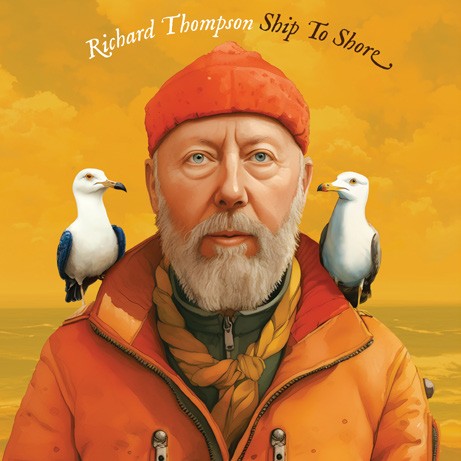
Illustration by Peter Strain.
“Ship To Shore is a record about defeat, despair and humiliation delivered with an unsettling avuncular twinkle.”
The beastly big world keeps scratching at the windows on Ship To Shore. Donald Trump gets caught in Thompson’s crosshairs on Life’s A Bloody Show (“Keep on boasting, pound your chest, you always knew you were the best”), while avaricious predators circle the weak and the dying on his hokey trad song The Old Pack Mule.
Thompson’s sympathy for the vulnerable and the broken is – one suspects – one that comes from bitter experience. However, if his memoir Beeswing, published in 2021, cautiously opened the book on his complicated upbringing and the trauma of losing his girlfriend Jeannie Franklyn in the 1969 road accident that also killed Fairport drummer Martin Lamble, Thompson’s songs on Ship To Shore are a reminder that the great psychic wounds of his life may have been inflicted when he was a tongue-tied teenager in Muswell Hill. Over a rockabilly thump, Trust laments the impossibility of negotiating the tight bends of a romantic relationship without skidding into the fence, but the language he uses is very much that of someone who recently had a paper round. “No one told me love’s so complicated, dreams get so frustrated, romance is over rated.”
Turnstile Casanova confronts more of the agony of love 1964-style, as Thompson finds himself being shunned in favour of what seems to be a leather-jacketed Lothario at the local Gaumont. “This ain’t right, crying all night my mind’s broken all to pieces,” he laments. “She says she will, then she says she won’t, my confusion just increases.”
The sense of rejection is more profound on the Forever Change-ling The Day That I Give In (“you don’t want me, you think I’m something tainted”), but Thompson is a glutton for emotional punishment. Another ex from the id emerges on the dreamworldly Lost In The Crowd; as major chords spin into minor ones, Thompson hears the “it’s not you, it’s me” speech once more. She begs him not to follow, but he does anyway only to find her dissolving into thin air.
There is only one real love song on Ship To Shore, and even that is a slightly wary one. Thompson has said that Singapore Sadie is a stylised portrait of his third wife Zara Phillips (who also features in his backing band here). As seafaring violins scrape in the background, Thompson depicts his dream girl as granite-hard and invulnerable, an impassive power source to be revered – feared even. It is messy psycho-sexual terrain, but pretty much standard for Thompson. The world his songs depict can feel forbidding and grim, but that feeling of hostile elements shivering Thompson’s timbers is something reassuring here.
He signs off with the cheer y plod of We Roll, a hymn to his musical life on the open road. “Must be crazy but I’m doing it again, suitcase living since I don’t know when,” he sings, but Ship To Shore underlines that there’s comfort to be had in familiar discomforts. It is steady and sturdy, watchfully buttoned-up, most of the messy emotional stuff happening a long way below the surface. Thompson’s extraordinary, lyrical guitar playing squirts out in occasional Day-Glo flashes, but the magic remains in his ability to keep his little microcosmos tightly marshalled. Bleak midwinter 4 EVA; spring forever unsprung.
Amanda Bergman
★★★★
Your Hand Forever Checking On My Fever
GAMLESTANS GRAMMOFON. CD/DL/LP
Swedish singer time slips into the 1980s on her second album.
Somewhere between the release of her Docks debut in 2016 and now, Amanda Bergman (also of Swedish yacht rockers Amason) moved from orchestral indie folk manoeuvres into smooth ’80s balladeering. The results land between Christine McVie’s contributions to Fleetwood Mac’s Tango In The Night and Rosie Vela’s Steely Danassisted 1986 album Zazu, while Wild Geese Wild Love sounds like Kim Carnes’ 1981 drivetime hit Bette Davis Eyes motoring through rural Sweden. The eight-year gap between albums involved a period of serious mental health issues for Bergman, followed by the death of her father. These experiences run through the songs – along with the challenges of motherhood in Day 2000 Awake and relationship schisms in the Court And Spark-like piano ballad Poor Symmetry – but ultimately never drag them down. Instead, a quietly entrancing atmosphere is sustained throughout.
Tom Doyle
The Decemberists
★★★
As It Ever Was, So It Will Be Again
YABB. CD/DL/LP
After six years, Portland’s renaissance band return with a double album.

At the time of The Decemberists’ 2018 LP I’ll Be Your Girl, Donald Trump’s America was weighing heavy on Colin Meloy and his band, resulting in a song called Everything Is Awful. There’s not exactly been a glorious global turnaround since, but their ninth record proves their distinctive spirit is still unbroken. The mood is knowingly mordant – “Contract malaria/Meet at the burial ground,” sings Meloy on the hand-whittled Sloop John B opening track, Burial Ground. America Made Me sets its jaunty fur cap at the protest song, while the clapboard-and-whalebone tavern-folk of William Fitzwilliam and Don’t Go To The Woods tap into their Marie Celeste house-band tendencies. Mike Mills and The Shins’ James Mercer guest, but the most attention-grabbing moment – or 19 minutes – is Joan In The Garden. Inspired by Joan Of Arc’s angelic visions, it has fun clanking about the doom-rock/prog intersection, the sound of a band whose idiosyncrasies are happily undimmed.
Victoria Segal
Bernard Butler
★★★★
Good Grief
355. CD/DL/LP
First solo album in quarter of a century by former Suede guitarist and busy producer.
In the years since his second solo album, 1999’s Friends And Lovers, Bernard Butler has concentrated on collaborating with such diverse artists as Duffy, Tricky, Mark Eitzel and The Libertines. Good Grief is the result of his slow return to the spotlight, its songs workshopped alone in a London rehearsal room and then aired at small acoustic gigs. The most surprising thing is how Butler’s voice has dropped more than an octave, his formerly boyish croon taking on a sand-and-glue quality that is equal parts Nick Cave and Ian Hunter. The arrangements here are built from tasteful acoustic and electric guitars, adorned with violin, and in Camber Sands, a slow-building song about escape to an East Sussex beach, Mariachi horns. But it’s the confessional aspect that makes this compelling stuff, whether relating mid-life disappointment in Living The Dream or detailing a life reset in the delicately chiming Clean.
Tom Doyle
Willie Nelson
★★★★
The Border
LEGACY RECORDINGS. CD/DL/LP
Willie’s 75th solo album and 152nd overall.
Last year, in his nineties, country music's best advertisement for weed released two new albums, one all covers and one originals (I Don’t Know A Thing About Love; Bluegrass). His latest, appearing a handful of days after his 91st birthday, offers 10 new songs – six covers, four originals. Willie co-wrote the latter with Buddy Cannon, his close collaborator and co-author this past decade or so. Fine producer too; Nelson, backed by a band of country pros, sounds in great shape. There are some upbeat moments (good ol’ boy Made In Texas) but mostly it’s on the slow side, a tempo in which Willie excels. Best of the new originals: nostalgic Once Upon A Yesterday. As for the covers, the out-and-out winner is Rodney Crowell for co-writing midtempo Many A Long And Lonesome Highway (with Will Jennings), but especially the brilliant title track (co-written with Allen Shamblin) which Nelson does proud.