NO STRANGER AM I
DUSTY SPRINGFIELD sang some of the 1960s' most luminous sides but struggled, like many, in an era that refused to accept or even acknowledge her sexuality. In a chapter from his new book about the profound influence of LGBTQ people on music and culture, from Little Richard to Sylvester, JON SAVAGE tracks her trials, and her triumphs. "I want to sing songs that are real," she said. "This is my hard fight."
David Magnus,/Shutterstock
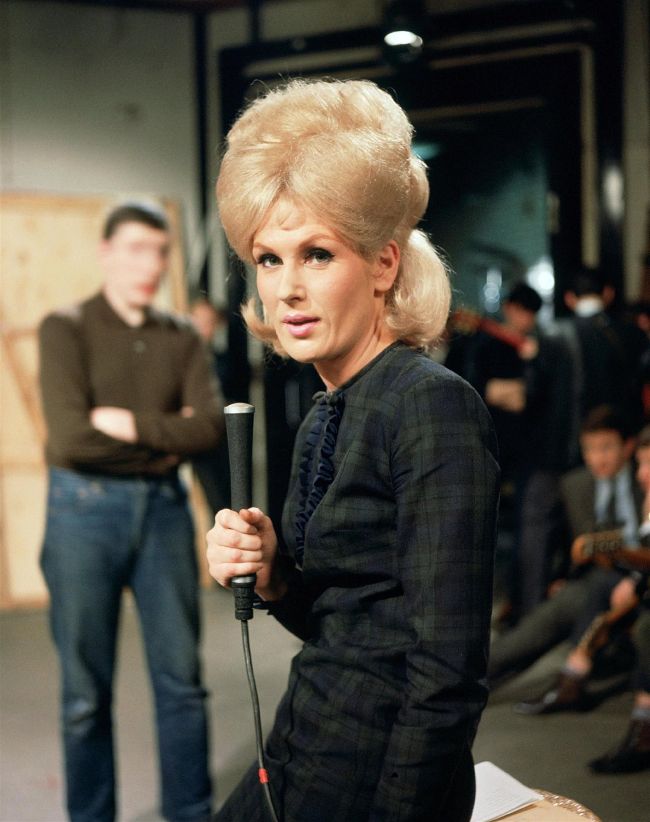
A star is born: Dusty Springfield prepares to perform her first hit, I Only Want To Be With You, 1963.
ON JUNE 16, 1967, DUSTY SPRINGFIELD’S thirteenth US single was reviewed in Billboard. Give Me Time was ranked among the records tipped for the Top 20 of the Hot 100 chart. The review, while short, nevertheless got to the heart of the problem: a big blowsy ballad with a full orchestra, Give Me Time was very much in the shadow of Springfield’s huge, cathartic, summer 1966 hit You Don’t Have To Say You Love Me, which went to Number 4 in the US and topped the UK charts. Despite the impeccable vocal, the treatment felt formulaic. In the UK, Give Me Time was already stalling in the mid-20s by the middle of June. The comparative failure of the single marked a crisis for Britain’s premier female artist. After a banner year in 1966 – four Top 20 hits in the UK, including three Top 10s and one Number 1 – Springfield was struggling to maintain her position in a fast-moving marketplace. Despite being voted Britain’s top World Female Singer in the NME poll of 1967 and a well-received appearance at the NME Poll Winners Concert, her first single of 1967, I’ll Try Anything, stalled outside the Top 10.
As the first of the new generation of British female singers, Springfield had benefited from the unitary nature of the British pop scene created by The Beatles, a broad church in which it seemed as though all kinds of records and attitudes could coexist in the Top 40. Springfield was a regular on the key weekly pop show Ready Steady Go!, where her friend Vicki Wickham was the editor. Dusty acted as a female compère and swapped barbs with The Beatles.
After autumn 1966, however, with the disappearance of The Beatles after their turbulent summer tour, this illusion of unity was no longer possible. In the first few months of 1967, the UK singles chart was temporarily dominated by what were called ‘mums and dads’ records: big ballads like Engelbert Humperdinck’s Release Me. At the same time, the absence of The Beatles had coincided with the first beginnings of rock, a more aggressive, initially male form of music that espoused volume and countercultural values – which, in this period, meant psychedelics as the gateway to a new consciousness.
DUSTY SPRINGFIELD WAS CAUGHT IN THE middle. At 28, she was reaching the upper limit of the age range that, at the time, could automatically sell to teenagers. Since the middle of 1966, she had the accolade of her own BBC TV series – a sure sign of showbiz acceptance. Meanwhile, her image was changing. Since the first days of her solo career, it had always been heavily constructed, with piled-up beehive wigs and bottles of black eye make-up. “I overdid a lot of things,” she later recalled. “It was a good thing to hide behind. Without the face I was a quivering wreck. I was terribly shy.”
From the beginning, she had presented herself as a musician. The November 1963 Melody Maker cover that announced the success of I Only Want To Be With You – “Solo Star Born” – ran a cover photo of Springfield in the studio with a guitar. In another shot from the same time, she is shown tackling a drum kit in a nightclub. This was at a time when female musicians in pop groups were unusual. The Honeycombs would make great play of their drummer, Honey Lantree, almost as if she were a gimmick.