FILTER ALBUMS
Blue Planet
New Orleans wanderer goes into their head to make sense of the world.
By Victoria Segal.
Hurray For The Riff Raff
★★★★
Life On Earth
NONESUCH. CD/DL/LP
THERE WAS a moment during the recording of Hurray For The Riff Raff’s seventh album when Alynda Segarra realised that they might not be able to save the world. As the pandemic raged and the US elections tumbled into Capitol-trashing anarchy, the singer looked out from the joyful creativity of producer Brad Cook’s North Carolina studio and had a revelation. “I just felt, I’m an artist and I’m in the exact place I’m supposed to be, doing exactly what I should do,” Segarra tells MOJO. “I think I needed to be humbled –I was taking on a little too much and was trying to save the world in my own way… I’m just another little human doing my thing and this is what I have to offer.” Even more significantly, given the profoundly personal nature of Life On Earth, they started to understand the fit-your-ownoxygen-mask-first theory of activism – that they didn’t need to feel guilty or selfish for taking a break, for living their own life. After all, laughs Segarra, “you only get this one.”
As a result, Life On Earth is a remarkably tender, delicate record – you might even call it an act of self-care, albeit one that can be generously handed on to the listener. It’s full of gentle empathy, of lines that ring with the truth of shared experience – “it’s been a terrible news week,” on Saga, for example, is a masterpiece of conversational concision. Even the most explicitly political song on the record, Precious Cargo, feels intimate rather than lofty or grand.
Warm synths (a trace of Segarra’s love of Beverly Glenn-Copeland); low trip-hop beats; the spoken testimony of one of the men Segarra used to visit in an ICE facility when working with campaigners Freedom For Immigrants: it all turns a news story over there into a f lesh-andblood, face-to-face encounter right here.
BACK STORY: PRECIOUS CARGO
● Before the pandemic, Segarra visited two men in Louisiana ICE detention centres, one of whom speaks on Precious Cargo (“We came here to save our lives”). He is now “living his life”, but has the situation improved? “Definitely what we were promised I do not see has been delivered,” says Segarra. “There are still thousands of people in detention. A lot of these places are for profit – there are concepts that are way beyond my expertise but I know the way we are dealing with immigration in this country is still very cruel.”
“Life On Earth is a delicate, tender record full of gentle empathy, of lines that ring with the truth of shared experience.”
For a “little human”, Segarra has never been afraid of the big picture – unsurprisingly, perhaps, for somebody who left New York at 17 to jump trains across America, winding up playing jazz and blues with New Orleans’ rich community of street musicians. Hurray For The Riff Raff’s application of punk ethics to Americana, the sound that emerges when you grow up loving Kathleen Hanna, Lou Reed and Woody Guthrie – resulted in music that was both in tune with the old ways and committed to shaking them at the roots. On 2014’s Small Town Heroes, for example, The Body Electric called out the murder ballad, its misogyny fixed by the seemingly indelible varnish of tradition – “well, Delia’s gone but I’m settling the score”. 2017’s The Navigator, meanwhile, illuminated Segarra’s Puerto Rican heritage, a fable of belonging told through the eyes of a teenage Nuyorican wanderer called Navita.
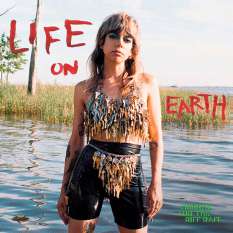
At a time when so many people have been forced to live without their usual distractions and coping mechanisms, however, Life On Earth feels like a record that turns its gaze back inwards. There is space for break-up songs (Rosemary Tears) and self-lacerating love songs (nightqueen, featuring writer Ocean Vuong), but, most of all, these songs ref lect what happens when there’s no escaping your thoughts, the internal fight that occurs when physical flight is no longer an option.
It begins with Wolves, a song that sounds like a beautiful electro-gospel lullaby yet declares, “it’s not safe at home any more… run babe/ You know how to run”. It’s Born To Run with post-traumatic stress, a feeling that runs through Pierced Arrows (“I keep on running for the blue/I duck my head and travel through”) and Pointed At The Sun (“I’m needing just to sit still/I know there’s nowhere to run”). This is not frenetic, hurtling music: Jupiter’s Dance or nightqueen are airy electronic pop, a long evolutionary trip from the band’s early boxcar sway – yet it complements this sense of emotion sickness, of being forced to turn over issues inside your head because there’s nowhere else to take them.
Even the consolations are double-edged. Rhododendron, written with My Morning Jacket’s Jim James, pays tribute to the plant life they see around them – “Morning glory/Naked boys” (the latter is a folk name for meadow saffron, apparently) – finding comfort in the thought of being reclaimed by vegetation. It is, by contrast, the most obviously urban song on the record, a gumsnapping Roadrunner delivered with impeccably snarling attitude. Even then, it trails into sadness – “Everything I have is gone/And I don’t know what it’ll take to carry on”, the f lowers turning out to be foxglove and deadly nightshade. (The list of plant life chimes ominously with Precious Cargo’s list of Louisiana detention centres). The title track, meanwhile, with its weary tangled clarinet, sounds like an endless funeral procession, humanity heading off into the climate-changed desert in one wavering line: “Life on earth is long”.
It’s Saga that best catches the combination of despair and resilience that marbles Life On Earth, however. Written while Professor Christine Blasey Ford was giving her testimony against US Supreme Court nominee Brett Kavanaugh, it echoes another song of running and escape – Hounds Of Love – yet it refuses to be felled by memories of past trauma. “I’ll just make it through this week,” sings Segarra. It’s a modest aim, but sometimes, they imply, that’s all you can do. Day by day, step by step.
Life On Earth ends with a field recording of Segarra’s favourite pandemic tree, an oak adorned with wind chimes in a New Orleans park. It’s a touching reminder that some things do endure, that survival is possible. Hurray For The Riff Raff might not be able to save the world, but Life On Earth is a compassionate, humane record at a time when it can only be a gift. Little humans everywhere, just doing what they can, will be grateful.
ALYNDA SPEAKS! CLASH AND THE JOY OF GARDENING... EGARRA ON ASYLUM SEEKERS, THE
Alamy
Boris
★★★★
W
SACRED BONES. CD/DL/LP
Japanese noise trio swap face-melting for brow-stroking.

From a mid- ’90s grounding in stonerhardcore doom-metal, Boris have routinely diversified, embracing art-noise, shoegaze, Floydiana and even contemporary pop-rock (on 2011’s anomalous New Album), with feedback hymnals a speciality. But after the barely relenting heaviosity of June’s No LP, W feels like a peace offering – signalling wildly to listeners previously kept at bay by the cult vibes and the racket. Beyond a token remnant of the latter in the sludge riffing of The Fallen, this is a record of delicately sculpted nuages, all wispily sung by guitar/keyboardplayer Wata. Standouts include the disembodied My Bloody Valentine of I Want To Go To The Side Where You Can Touch…, the opiated Cocteau Twins of Icelina and, best of all, Drowning By Numbers, a swirling black hole of eerie, visceral crypto-funk. In the gorgeous Invitation, Wata sings what translates into English as, “The noise is listening to you” – as if it’s making allowances. Maybe, this time, it is.
Danny Eccleston
Cate Le Bon
★★★★
Pompeii
MEXICAN SUMMER. CD/DL/LP/MC
John Grant and Deerhunter producer goes with her own distinctive flow on sixth LP.
You might expect a record born in solitude to represent a newly intense distillation of its creator’s sound. Pompeii, Cate Le Bon’s follow-up to 2019’s Reward, initially suggests the opposite is true: isolation leads to a damping of overt quirks and flourishes and a greyscale wash of synths and introspection. Yet while the bright volatile reds and oranges of Le Bon’s earlier records (not to mention Drinks, her hairtrigger collaboration with Tim Presley) have cooled to something darker, she still presses a wild array of musical patterns and textures into Pompeii’s surfaces. Imaginary Euro-pop hit French Boys, the title track’s delicate John Caleat-the-circus whirl, Dirt On The Bed’s experimental-theatre sax: the corners of these songs might not snag quite as dangerously as before, but there’s no blunting of the fascination Le Bon’s songwriting so expertly exerts.
Victoria Segal
Erin Rae
★★★★
Lighten Up
THIRTY TIGERS. CD/DL/LP