FILTER BOOKS
Urban legends
Tower blocks, art rock and the temptations of stadium-filling Big Music: Simple Minds re-examined.
By Tom Doyle.
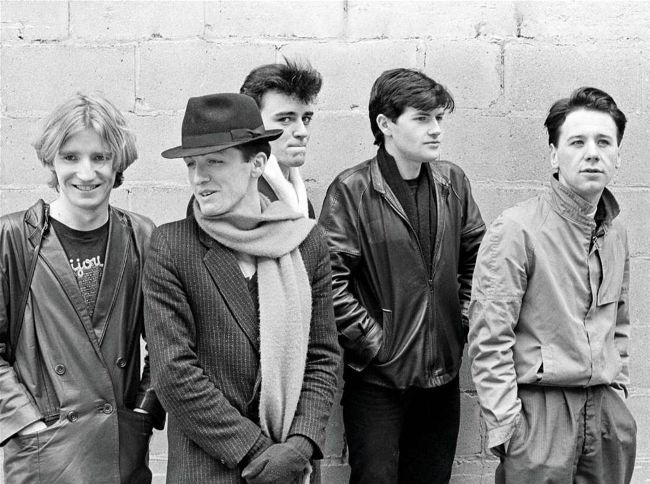
A Glittering career: Simple Minds’ (from left) Derek Forbes, Brian McGee, Mick MacNeil, Charlie Burchill and Jim Kerr in 1981.
Peter Noble/Getty
Themes For Great Cities – A New History Of Simple Minds
★★★★
Graeme Thomson
CONSTABLE. £20
NOVEMBER 1982 and Simple Minds are performing on Channel 4’s live-to-air Friday teatime music show, The Tube. In a four-song set, the standout being the unrelenting Neu! groove and fast-fingered synth shapes of New Gold Dream (81-82-83-84) – the title track of their fifth album released two months before – they come across as a mysterious and faultlessly cool, post-punk-meets-Krautrock outfit. As the decade will progress, however, and as their sound turns to straighter-edged Big Music rock designed to fill arenas and stadiums, their magic and myster y will slowly evaporate.
“Ultimately, it’s the story of the singer and guitarist’s enduring friendship.”
In this 345-page, band-endorsed biography, author Graeme Thomson states that while he doesn’t want to use their “young brilliance as a stick with which to beat them”, his mission here is to “remystify” Simple Minds. It’s a wholly successful endeavour and a speedy tale, both in terms of the intoxicants that the band used to fuel the all-night jam sessions that were the crucible of their music, and the white-knuckle pace of their rise from working-class Scots living in Glasgow tower blocks to the stage at Top Of The Pops.
Thomson’s enthusiasm for tracing the cultural and geographical roots of Simple Minds is infectious, and the result shines a bright light into the forgotten corners of the band’s stor y. Singer Jim Kerr and guitarist Charlie Burchill begin as art-headed teenagers, in thrall to Can and Roxy Music, discovering European experimental theatre in the Gorbals and, in their first band, Biba-Rom!, playing The Velvet Underground’s Heroin at a children’s party held in the local social club. Their great epiphany comes ahead of a 1977 gig by their punk troupe Johnny & The Self Abusers at a “heavy” Glaswegian disco called Terminal 1 – where some club-goers would smuggle in ice skates to use as weapons – when the DJ plays the 12-inch of Donna Summer’s I Feel Love. Kerr and Burchill are instantly struck by the realisation that synths are the future, propelling them through their first five, brilliantly inventive albums made between ’79 and ’82.