REAL GONE
The Rhythm Killer
Jamaican bass supremo Robbie Shakespeare left us on December 8.
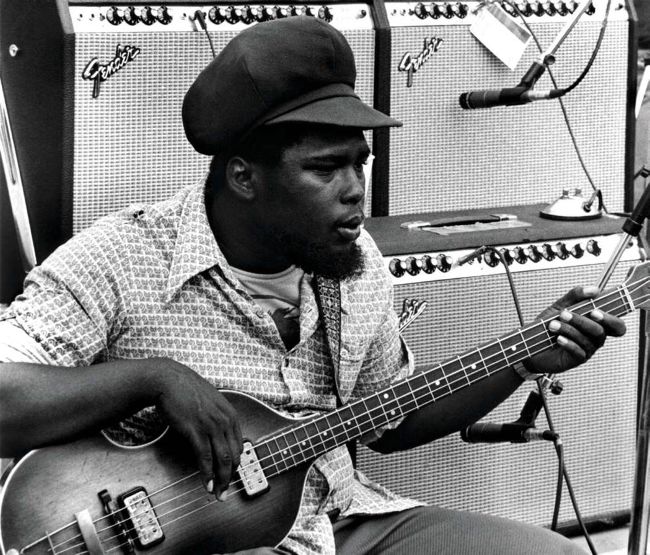
Noble kinsman: Robbie Shakespeare plays his Höfner ‘Beatle bass’ in 1978.
© Adrian Boot/
Urbanimage.tv REGGAE’S DEFINITIVE bassist, Robbie Shakespeare’s brawny, melodic and spacious basslines evidenced a broad and effortless grasp of musical styles. Over a career spanning more than 40 years, he and ‘Riddim Twins’ drum partner Sly Dunbar would back every Jamaican star of note, bring Grace Jones to mainstream success, and be called on by stars including Bob Dylan, Mick Jagger, Jackson Browne, Serge Gainsbourg, Joe Cocker and Ian Dury.
“If an artist is a singer, an instrumentalist, or whatever, we’re going to play the music to match that specific sound,” Shakespeare told me in 2005. “We weren’t just listening to one type of music, we were listening to James Brown, Marty Robbins, Diana Ross, a little rock’n’roll…”
Born on September 27 1953, and raised in the down-at-heel district of Vineyard Town in east Kingston, Shakespeare taught himself to play acoustic guitar after his brother joined the
Emotions harmony group, who rehearsed at the family home.
“He was a man definitely not to be trifled with.”
Future Wailers bassist Aston ‘Family Man’ Barrett joined them and duly mentored Shakespeare, even giving him a Höfner ‘Beatle bass’.
Shakespeare put it to good use on his debut recording, backing Errol Dunkley’s languid adaptation of The Emotions’ I’ll Be Back in 1972.
Shakespeare went on to play bass on The Wailers’ Concrete Jungle (also 1972) and Burning Spear’s Marcus Garvey (1975). By then, he and Dunbar had met while playing rival clubs on Kingston’s Red Hills Road, becoming better acquainted at studios including Channel One, and when playing sessions for Bunny Lee in the Aggrovators band. The two would bond as the rhythmic anchor of Peter Tosh’s touring band in 1976. As producers, they helmed two LPs for Tosh’s New Jersey-born backing singer Gwen Guthrie in the early ’80s; other co-productions included hits on their Taxi label with Gregory Isaacs, Dennis Brown and Ini Kamoze, and the blending of reggae, funk and disco which began with Grace Jones’ breakthrough Nightclubbing in 1981. Sly & Robbie also helped Black Uhuru to score the first reggae Grammy with 1984’s Anthem, having worked closely with the group since the late 1970s. In 1987, they scored a UK Top 20 single as a duo with the mutoid Boops (Here To Go).
THE LEGACY
The Album: Sly & Robbie A Dub Experience (ISLAND, 1985)
The Sound: Featuring dubs of Black Uhuru’s Chill Out, The Tamlins’ version of Randy Newman’s Baltimore and more, this set fully emphasises the cruciality of Robbie’s bass. The jazz, funk, and rock elements underpinning his lines are revealed with subtle pauses, grooving neck slides and forceful chorded notes, with drummer Dunbar his symbiotic other half.
A hulking figure with a forceful personality, Shakespeare was a man definitely not to be trifled with.
Unfazed by working with rock icons, he famously locked horns with James Brown on a Compass Point project that remains unreleased.
In later years he was plagued by serious health issues, including debilitating diabetes. Yet, where music was concerned, Shakespeare played until the end, and continued to innovate: his later projects including an ambient collaboration with trip-hop producer Howie B, a reggae covers set with Sinéad O’Connor, and an acclaimed jazz-dub hybrid with Norwegian trumpeter Nils Petter Molvær.