Enter the Dragon
It entered with a roar and left with barely any fire in its belly, but there’s no doubt Dragon’s computers ought to be celebrated, as David Crookes explains
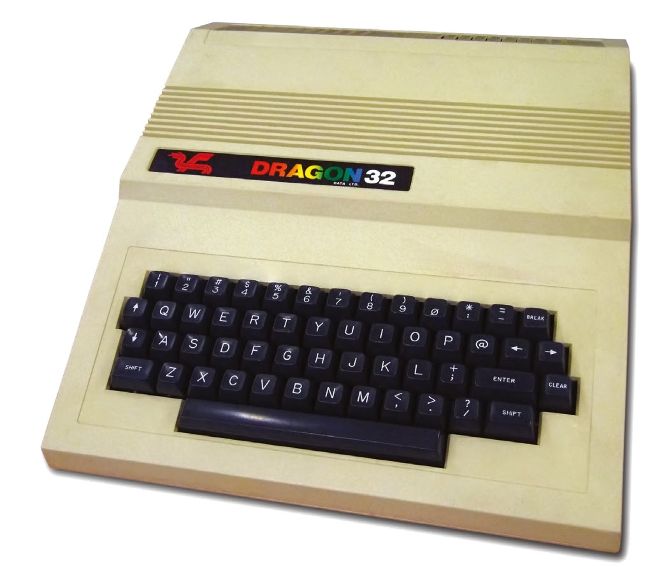
LEFT
The Dragon 32 was a striking-looking machine with a Motorola 6809E processor
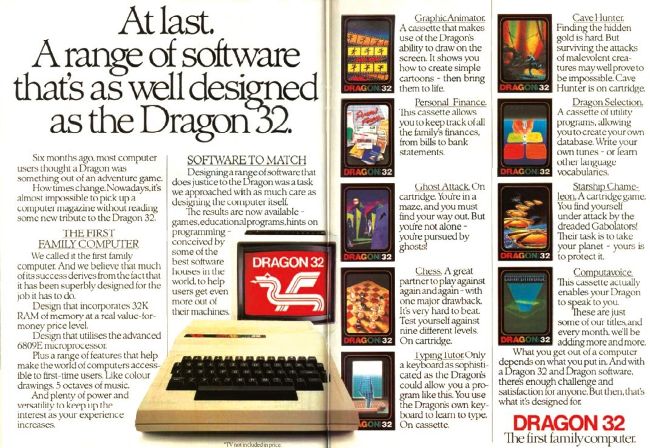
BELOW
Mettoy spent a lot of time sourcing software for the Dragon 32
Images: By Liftarn, Editing by: Bill Bertram (Pixel8), CC BY-SA 2.0, Wikimedia Commons
Playground wars centred around 8-bit computers were commonplace in the 1980s. One side comprised those who would hear no wrong about their beloved ZX Spectrums. The other side supported the Commodore 64. And both seldom found common ground, except for a mutual disdain of those who owned an Amstrad CPC 464.
But there was also a group of kids who didn’t even get that reaction – a small number whose parents bought computers made by Dragon Data. There was no pity, no laughter, just a shrug. And that was because the machine came and went so quickly it barely had time to ignite its fire, never mind burn rivals that arrived before and after it.
Yet to ignore the Dragon 32 and its successor the Dragon 64 overlooks an important part of Britain’s computing history. For these machines, created in Wales, were technically great and, with more luck and a sounder financial footing, the company behind them could easily have made a huge impact on the tech industry.
That was certainly the aim of Tony Clarke, an enthusiastic and successful businessman who, as managing director at a Swansea-based toy company called Mettoy, had spotted the potential offered by the fledgling home computer market.
Mettoy was best known for making Corgi die-cast models, but Clarke sensed that the toy industry was set to suffer as children, particularly those over the age of nine, began to favour electronic goods. Clarke’s background as a management consultant and electrical engineer put him in a good position to exploit a new opportunity, and he believed Mettoy had a distinct advantage over its rivals.
“Mettoy is a strange animal,” he told Popular Computing Weekly in November 1982. “It has enormous resources – machine tool making, plastic moulding, high-volume manufacturing capacity and marketing skills. All the things in fact that infant computer manufacturers lack.”
Even so, Clarke – who enlisted the help of an ex-Mettoy employer called Gerry Quick – still needed to work hard to persuade Mettoy’s board to take the leap, and he did so in the best possible way, by taking them to the Personal Computer World Show trade fair in London in 1981. The company’s top brass could see hundreds of children were attracted to the bright lights and potential of computers, so they gave Clarke the go-ahead to build a prototype.