THEPROINTERVIEW
CLEMENT KIRAGU
Kenya is famous for its abundant and vibrant wildlife, and few people know the animals better than Clement Kiragu. Keith Wilson speaks to the award-winning photographer about his journey from fine art student to photo safari tour leader…
TO MANY followers of his photo work, Clement Kiragu is better known as Clement Wild, one of Kenya’s bestknown wildlife photo safari operators. Based in Nairobi, Clement worked in advertising for ten years as an art director before choosing to devote his life to photographing the wildlife of his beautiful homeland. In a normal year, Clement would be leading multiple tours of eager photographers from overseas across the open grasslands of the fabled Maasai Mara, where lions, leopards and cheetah prey on zebras, gazelle and wildebeest. Instead, COVID-19 means safaris have ground to a halt, but that’s not enough to stop Clement moving – in fact, he’s moving house! It might feel like this interview is being randomly scheduled somewhere between the practicalities of unpacking boxes marked ‘kitchen’, ‘living room’ and ‘study’, but the reality is that he answers my questions with the same sense of care shown when handling the fastest tele lenses or the latest Canon cameras.
01 ON THE PROWL
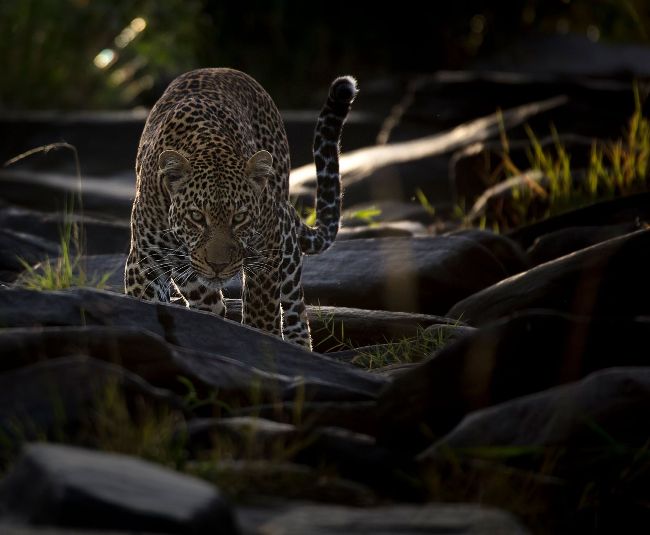
Leopards are the most stealthy and secretive of the big cats, and usually nocturnal, so Clement was lucky here
Lens Sigma 150-600mm f/5-6.3 DG OS HSM Sports
Exposure 1/800 sec, f/6.3, ISO800
02
Clement has always loved the arts, and even before he took up photography, he saw a future in this field, especially while studying fine art at college in Nairobi. Photography may not have been on his creative horizon in his student days, but today Clement can reflect on an enviable education and hard experience that has provided many of the guiding principles for his rapid rise in the crowded world of wildlife photography…
What was the most important thing you learnt at college that has gone on to influence your photography?
I went to Buruburu Institute of Fine Arts in Nairobi, and the most important take from my course is that I learnt art, the principles, the elements, the storytelling, and coming up with concepts, before I ever knew photography. That helps me understand the responsibility I carry as an artist. Pressing the shutter button is only one of the final steps of storytelling.
It’s a big decision to step away from a successful career in advertising to become a wildlife photographer, so why did you make the jump?