ADVICE
Fishkeeping Answers
Got afishkeeping question? PFK’s crack team of aquatics experts are on hand to answer whatever you need to know... questions@practicalfishkeeping.co.uk
THE EXPERTS
DR PETER BURGESS
Peter is our disease expert. Send questions his way if you have pathogen problems.
BOB MEHEN
Bob is a master of fishkeeping general knowledge and community tanks.
JEREMY GAY
Jeremy is more than adept when it comes to cichlids, goldfish and marine species.
NATHAN HILL
Nathan is the go-to for compatibility queries and aquatic ethical conundrums.
MAX PEDLEY
Max is like a living, breathing search engine. Cichlids are his speciality.
NEALE MONKS
He loves brackish fish, too. Neale is the man for your technical queries.
DAVE HULSE
Dave is a consultant for the Tetra Advisory Board and a research fellow at Keele University.
TROPICAL
How do I keep these hybrid cichlids?
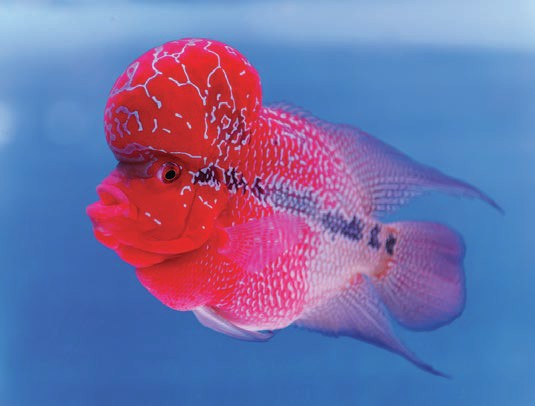
Flowerhorn cichlids are hybrids.
SHUTTERSTOCK
My local shop has some Flowerhorn cichlids for sale. The guy at the shop said they are hybrids but that he wasn’t sure what the parents were.
I’d love to keep one (or two if space allows) and I wondered if you could tell me what sort of set-up they need and
what they are a cross between, as obviously that
will make a difference to their size and the size of tank I’d need. Do they breed or are they sterile, being hybrids?
ROB, VIA EMAIL
Did You Know?
In parts of Asia, the Flowerhorn is thought by many to bring good luck as well as good Feng Shui. The bigger the hump, the luckier the fi sh is considered to be, and some of the most highly prized specimens have a six-fi gure price tag.
Win
The Question of the Month gets a Tetra goodie box!
JEREMY SAYS: Flowerhorn cichlids are indeed hybrids, originally made by crossing Amphilophus trimaculatus with numerous other Central American cichlid species. They grow large, to about 30cm, and become very aggressive and territorial as they mature, so they’re a one-fi sh-to-atank kind of cichlid. They’re unbothered about pH but like the temperature on the warmer side at 25-30°C. In Southeast Asia the fi sh with the best pattern and biggest heads are highly prized and expensive. There they keep them in comparatively small, bare glass tanks, but if you want to do the best by these fi sh you should provide a 180x60x60cm aquarium with external canister fi lters, a gravel base, with wood and rocks as decor. Live plants will be destroyed, and plastic plants will be moved about, but by allowing them to dig it will provide these intelligent fi sh with a degree of environmental enrichment when kept alone. Feed on cichlid sticks and pellets. They can be bred and will also cross with other Central American species. The females are generally smaller, with smaller nuchal humps, but pairing them is not easy as the hyper-aggressive males will beat up and kill any female that isn’t ready to breed with him in his tank there and then, so a divider and constant supervision would be necessary. You probably wouldn’t get any showstopping offspring from the spawning either, with generations of fry reverting back more to the wild type. These are real character fi sh, and the show specimens also make striking pets, but with a typical lifespan of over a decade, they are a long-term commitment.
TROPICAL
Will this shrimp be okay with my catfish?
I have been wanting to keep a Blue armoured shrimp for a while now but was unsure as to whether it would be compatible with my whiptail catfish. I’m not entirely certain as to what species of whiptail it is but I think it’s a Planiloricaria — I’ve included a picture of the fish from when it was first purchased. Since the catfish buries itself throughout the day and swims about at night, I wondered if perhaps this would lead to them either bumping into each other or problems between them. The whiptail is quite placid and doesn't seem to mind other catfish lying on top of it, but I’m unsure whether it would be harmed if the shrimp walked across it.