SPECIES SHOWCASE
THE AFRICAN EARTHEATER
Tylochromis
We usually picture South American cichlids as the only ones that sift through substrates. Michel Keijman introduces a rare fish from Africa that particles before spitting it out again, but they also bear a has its own ‘earth eating’ strategy.
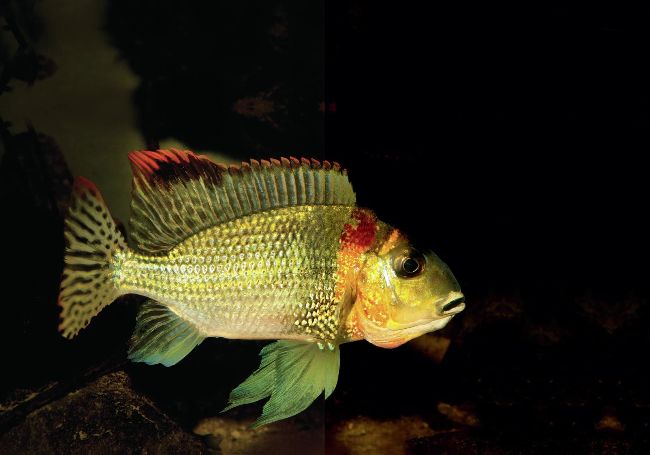
Adult male Tylochromis lateralis flaring.
MCW KEIJMAN
MICHEL KEIJMAN
Michel is a cichlid expert who has spent considerable time collecting African fish in their natural habitats.
MANY AQUARISTS will already be aware of the South and Central American eartheaters, cichlids of Amphilophus and Geophagus. But did you know that there are also African eartheaters? These not only behave like their American counterparts, sifting through sand for edible particles before spitting it out again, but they also bear a striking resemblance to the fi shes of Geophagus. Meet the African eartheaters of Tylochromis. Alas, these are hardly known within the hobby, in part due to their scant availability, but also because of the bland and silvery plumage of the juveniles. This latter point is a shame, as the adults carry stunning colours, but you need to be patient — the true markings don’t become apparent until the fi sh reach around 20cm. Worse still, that can easily take two or three years to achieve — Tylochromis are slow growers!
Tylochromis history
Until the beginning of the 20th century only a few of these fish were described, originally placed in the genera of Paratilapia/Pelmatochromis. It was not until 1920 that the ichthyologist Charles Tate Regan placed several species into an independent genus, Tylochromis.
For a long time, neither the hobby nor science paid any attention to Tylochromis. This changed in 1990 when ichthyologist Melanie Stiassny took up the genus and revised it, at the same time describing nine new species. This brought the genus up to 18 valid species, but there will almost certainly be more — since the time of the revision, a number of new species have been discovered in the Congo. However, since 1990 nothing has changed in the status of the species or in the genus Tylochromis. This has to do with the poor availability of species in general, but also with the lack of interest in this genus among ichthyologists.