Fishkeeping Know-how
SETTING UP ABOVE THE WATERLINE
As paludariums become more popular in the hobby, we ask Gabor Horvath to identify how you can go about setting one up.
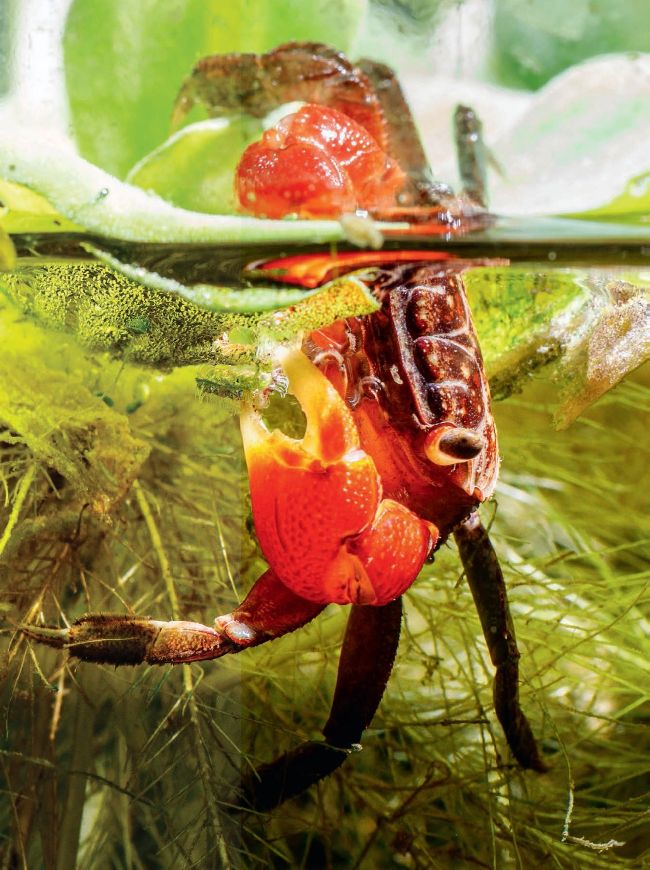
Red crabs love dry land.
SHUTTERSTOCK
HAVING A fish tank is an excellent way to bring a slice of nature into our lives. Some of us are happy to have just a few random plants in our aquariums, and as long as our fish are content, we are happy. Other aquarists might strive to be ‘picture perfect’, trying to replicate the most natural environment they can for their creatures, using authentic (looking, at least) plants and decorations.
Their amazing creations sometimes have a capacity for vicarious transportation, making you feel like you are really in the frame, immersed amongst tetras in the Amazonian jungle or crawling through some fast-flowing river somewhere in Asia.
These tanks present a captivating underwater experience, but out in the wilderness there’s plenty going on above the water’s surface as well. A perfect replication of a biotope wouldn’t end at the water level - it would continue vertically.
I have seen many brilliant open-top tanks embracing this idea, with various plants growing out of them.
These ‘ripariums’ mimic the shallow coastal (riparian) zones you might find around the shorelines of lakes and rivers. Using a mixture of aquatic and wetland plants with both submersed (underwater) and emersed (above water) growth, the riparium brings a set-up that shade closer to replicating nature than everyday ‘closed’ aquariums do.
Before committing to one you should consider a couple of potential issues. To start, think about the hazards of an open top - that means more evaporation, as well as a higher risk of fish jumping out. Lowering the water level can help with the jumping issue, but it also reduces the available living space for keeping fish.
Another issue with a riparium is that if you want to keep creatures requiring some ‘dry’ land - as many crabs do - these water-only setups aren’t the way forward.
Make a water closet
This is where paludariums come into the picture. But what actually is a paludarium?
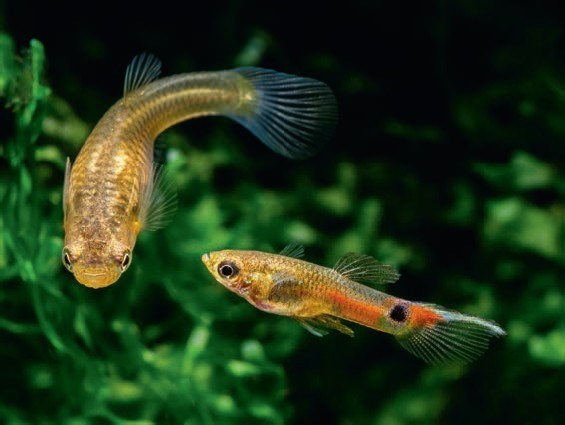
Wild guppies are less showy.
The word has Latin roots and in the same way that ‘aquarium’ can be translated into ‘water place’, so paludarium is a literal translation of ‘marsh place’.