CICHLIDS Ocellated kribensis
The Colour Shifters
Dwarf cichlids are often popular but not always easy to source. Michel Keijman presents a colour changing delight you’ll want to keep your eyes open for.
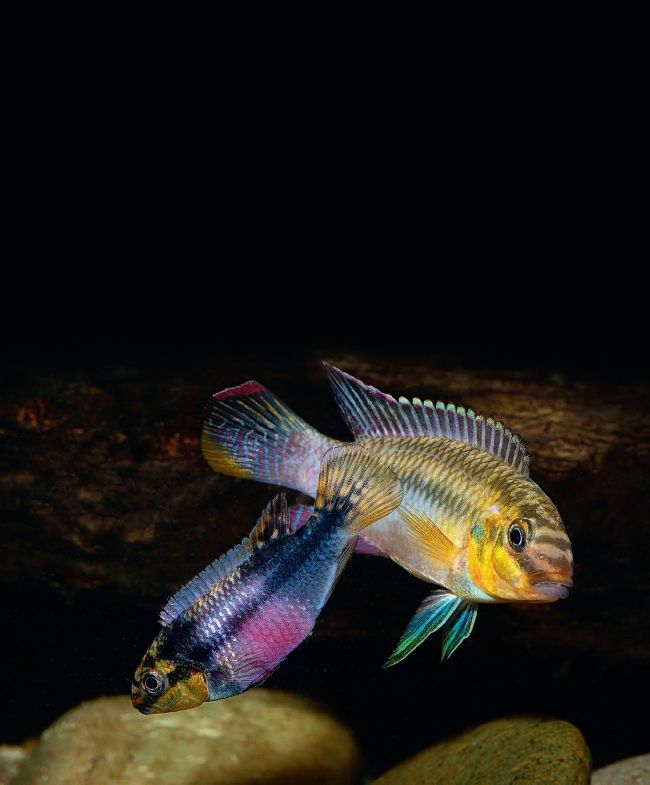
PHOTOGRAPHY: MICHEL KEIJMAN
MICHEL KEIJMAN
A Dutch aquarist and author with over 40 years keeping experience, mainly with cichlids.
THE PELVICACHROMIS genus has long been popularised by one species, the Kribensis, Pelvicachromis pulcher. But the genus is larger than this fish alone, containing eight species in total: P. drachenfelsi, P. kribensis, P. pulcher, P. roloffi , P. sacrimontis, P. subocellatus, P. sylviae and P. taeniatus. Most of these have received more than their fair share of magazine and online coverage with the exception of the Ocellated kribensis, P. subocellatus - little is known of this fish and less written about it. So let’s change that now.
The subocellatus trail starts back in 1872, when German Ichthyologist Albert C.L.G. Günther wrote his ‘Report on several collections of fishes recently obtained for the British Museum’. In it, he mentions a species called Hemichromis subocellatus, describing it on the strength of three specimens originating from Gaboon (now Gabon). It was later reclassified as Pelmatochromis subocellatus by Thys van den Audenaerde in 1968, before being later resolved earlier this century as Pelvicachromis.
The maximum length for an adult P. subocellatus is 8cm for males and 6cm for females, making it a true dwarf of the cichlid world, and it has the slender body and round head so typical of this genus. Physically it appears stretched, with a rhombic tail in adult males.
The male’s body is light brown with a fine black edge to each scale, giving it a ‘chain-link fence’ appearance. The throat and gills are golden-yellow, and the anal and tail fins are red with a fine drawing of blue dots. In the middle, and mood dependent, there is a visible horizontal stripe. Additionally, males possess bright blue ventral fins with black stripes.