TWELVE MILLION AND COUNTING: Aqualung At 50!
Half a century on and Aqualung is as relevant as ever. Jethro Tull’s career-defining album explored themes of homelessness, prostitution and religion, yet the band never considered it to be a conceptual release. This year, it celebrates its 50th anniversary, and Ian Anderson and Martin Barre look back on the making of a classic that even caught Jimmy Page’s attention.
Sitting On A Park Bench: Malcolm Dome Images: Michael Putland/Getty Images
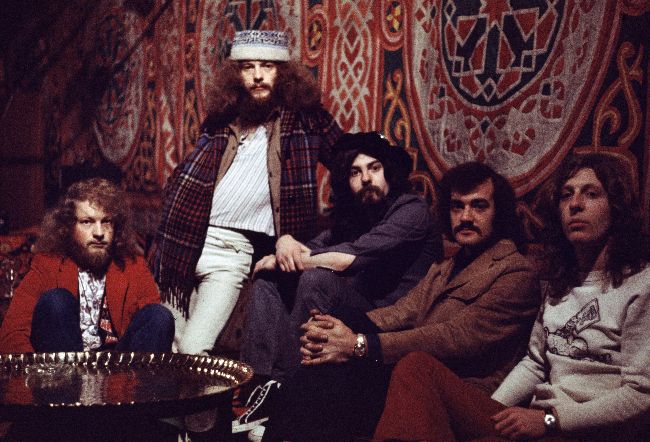
Jethro Tull in London, March 11, 1971.
R
eaders might have thought that after talking about Aqualung for half a century, Ian Anderson would be fed up with yet more questions about the album. But that’s not so.
“I’m happy to talk about anything,” he says in a calmly positive manner. “Of course, I get asked the same questions over and over again. But it’s no problem, because there are always different ways to answer these. Besides, it’s a compliment that an album recorded so long ago still holds a fascination for many people. And I am grateful for what Aqualung did for Jethro Tull.”
Former guitarist Martin Barre is equally enthused.
“How can I ever get fed up with talking about this album? Both historically and musically, it was so important for the band. I can listen to it now from start to finish, and there’s not one weak song. I’ll admit some of our other albums do have the occasional track that’s not held up well. But Aqualung flows from start to finish.”
At the moment, both Anderson and Barre are having to deal with the consequences of the pandemic and its devastating effects on the music scene.
“I have to accept that doing live shows before 2022 will not be possible,” says the former with a sigh. “Of course, I’m not alone in facing this prospect, but that means losing two years of my professional life and at my age I may not have many left. This is the new realism we as musicians are coming to terms with.”
“We had no interest in being rock stars. We didn’t want to fly around in private planes and have groupies and drug dealers waiting for us everywhere we went. None of us were bothered with all that nonsense.”
Martin Barre
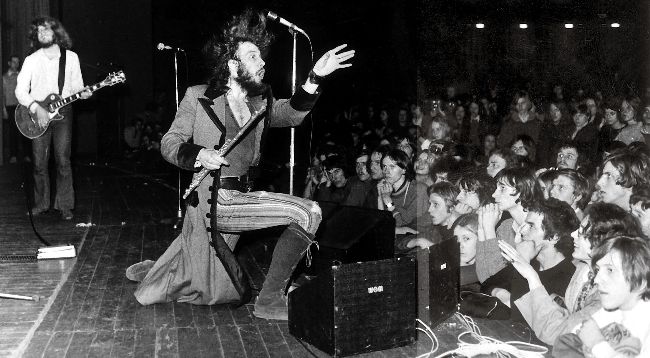
The album cover by Burton Silverman.
ULLSTEIN BILD/GETTY IMAGES
“I had so many plans for live shows in 2020,” adds the latter. “To celebrate my 50 years as a professional musician. All that was cancelled. However, I have to be philosophical about the situation, and when I’m finally able to get back on the road, I intend to perform Aqualung in its entirety.”
Realism is something that pervades the lyrics on Aqualung and these marked out Jethro Tull as a little different from many of their contemporaries.
Anderson chose to write about things he’d observed, and he did this in such a way that the songs became mini social documentaries in their own right.
“The world was full of pop stars who wore their hearts on the sleeves. Singers who went on about love, and would only talk about ‘me, me, me’.
Now, I am not going to knock what they did, because it was perfectly valid. But I wanted to use what I’d seen and knew about, turning these into stories and interpreting life this way.”
“Still one of my favourites.” – Aqualung and me.
NEAL MORSE
“When I was 11 or 12 years old, someone brought the Aqualung album over to our house in suburban Southern California (as was very common in those days, my friends and I were always bringing our favourite albums over and listening to them over and over) and we listened to the second side first.
“I remember my friend saying, ‘Wait for it… Check this out!’ setting up the moment when the guitars and the band kick in for My God after Ian Anderson sings: ‘With his plastic crucifix.’ What a killer moment! I was hooked from there on out. I learned to play Hymn 43 on the piano, and played it a lot in my early teens. When Mike Portnoy suggested that we record a cover version recently I jumped at the chance.
“Side One is great of course, but I always preferred Side Two having not been raised with any sort of religion or spiritual direction I’d hardly thought about God at the time. So I found the lyrics really interesting and compelling as well.
“Still one of my favourites, I found a used vinyl copy in good shape at a thrift store in Southern Oregon while I was on vacation last summer, and bought it once again. A classic!”
In some respects, Anderson’s lyrical approach reflects what celebrated British moviemakers Michael Powell and Emeric Pressburger were doing in the 1940s through such classics as Black Narcissus, A Matter Of Life And Death and The Red Shoes, in that they reflected reality through a prism that offered neither heroes nor villains.
Anderson accepts this connection with a comfortable ease.
“A lot of the lyrics I wrote for the album came from visual images. For instance, the person who inspired the title track was a real homeless person. As a photographer, I love walking around taking pictures of interesting people I see or meet. And even when I don’t have actual photos of them, I can see these figures in my mind and that’s projected into the lyrics.
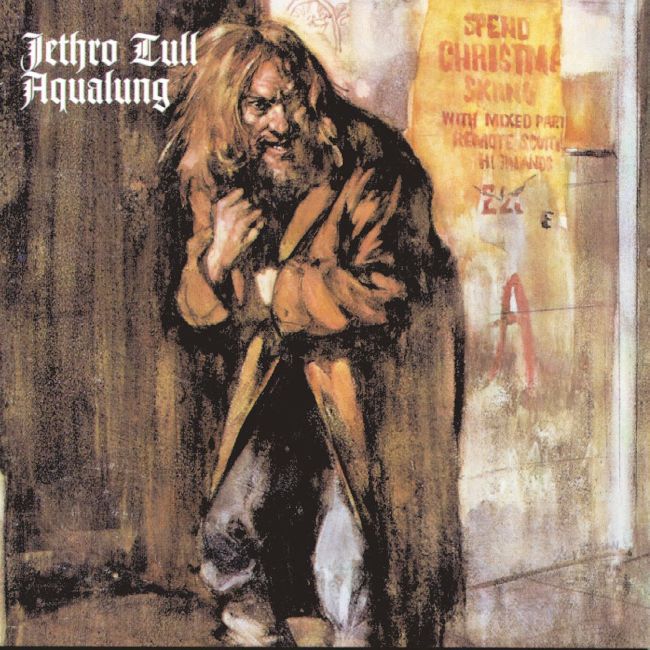
The Pied Piper and his followers: Ian Anderson onstage in 1971.
“Tull reached their zenith” – Aqualung and me.
DEREK SHULMAN (GENTLE GIANT)
“In my opinion Jethro Tull reached their zenith in both creativity and entertainment with Aqualung. Together with Thick As A Brick, Ian and band were unique in their flawless ability to fuse blues, folk, rock and quasi-classical music wrapped up in a magical period in their career.
“Gentle Giant toured both Europe and North America in 1972 with Tull, and the cheer that went up when Martin Barre played the opening riff to Aqualung was always deafening! This still remains one of my favourite prog albums of all time.
“The band’s stagecraft was also at its peak during this period, in that rather than appearing like pompous over-practised classical musicians they had fun onstage. This was reflected back from an audience that smiled, laughed and cheered together with, and for, the band.”
progmagazine.com 31
“What I was observing in the songs for Aqualung were not heroes or villains. It’s not black and white like that. This is not the way life works, where you divide people into these categories. So, from that point of view, yes my lyricism here did have a relationship to the way certain filmmakers operated.”
For Barre this is the album that showed Anderson had emerged as the de facto leader of Jethro Tull.
“Ian had changed a little in the way he drove himself. He was so focused and intense on the songwriting side, and had become a major force. Because of him, this record was a lot more planned-out than our previous three.”
Anderson tackled some very contentious issues on this album, and none more so than teenage prostitution on Cross-Eyed Mary. Yet, while the subject of a schoolgirl reduced to such circumstances could easily have been a sordid tale, somehow Anderson gives it a sense of innocence.