Heavy Mellow
Never one to follow trends, Jane Weaver has mixed things up on her dreamy new album, Love In Constant Spectacle. She’s taken a modern approach to the cut-up technique of lyric-writing and even travelled to Rockfield to record with a producer for the very first time. She reflects on the experience, talks touring plans, and explains why simpler can sometimes be better.
Words: Julian Marszalek Images: Nic Chapman
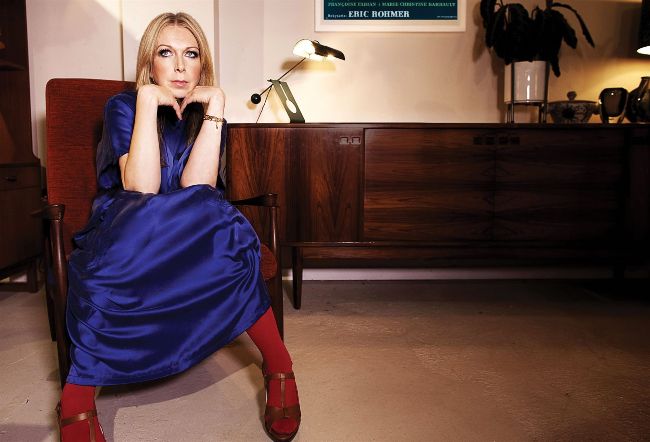
Jane Weaver: in a genre of her own.
“I tend to write about different characters, so it feels like it’s not really about me. This is more of an emotional, in-touch record.”
Those lesser talents who hitched their horses to the psychedelic bandwagon of the last decade might be feeling the strain after just a few releases, but Jane Weaver is showing absolutely no signs of losing any interest in her art. Indeed, she’s now reached the point where her music is instantly recognisable thanks to an ever-evolving solo career that stretches back to the start of the millennium. Her fusion of hauntology via vintage analogue synths, with a love of pop’s melodicism at its most insistent and the more psychedelic end of krautrock, all garnished with mysticism and the occult, has ensured a steady of stream of releases that could be by no one else but Jane Weaver. Hell’s teeth, she could be a genre of her own.
And, while it would be easy for Weaver to stay in the comfort zone of her Mancunian base and immediate creative circle, complacency hasn’t been an option. Looking back at her more immediate trail of releases, forward has been the only way to go in the composition and creation of her latest album, Love In Constant Spectacle.
“I wanted to do something a little bit different,” she tells Prog as she considers her more recent trajectory. “I think with this record, for instance, it’s not particularly conceptual, like some of the other albums. The Silver Globe was conceptual and Modern Kosmology was inspired by [pioneering Swedish abstract artist] Hilma af Klint. The Fallen By Watch Bird [in 2010] was when I started getting more experimental and started exploring Germanic fairy tales and folklore and stuff like that. Flock was a bit more immediate, because it was a collection of pop songs that were back to back. For this one, it’s a little bit more heavy, mellow and downbeat. And a little bit more honest, maybe.” She’s not wrong. Love In Constant Spectacle is a beautifully layered album that reveals more of itself with each subsequent listen. What becomes immediately apparent as the pumping synths usher in opener Perfect Storm is that Weaver is moving at a more considered pace and that there’s a story to be told. ‘Don’t blame me/It’s the universe that’s wrong,’ she laments with no little chutzpah on the delicate Univers, before giving way to a shimmering coda that tugs at the heartstrings, as elsewhere, in the spacious surroundings of the title track where her voice trades moves with punctuating instrumentation, she sighs, ‘I won’t hear when you call me.’