PENDRAGON
A kick up the 90s? Neo-prog torchbearers’ standout album from the genre’s anni horribiles gets a welcome reissue.
Words: Johnny Sharp
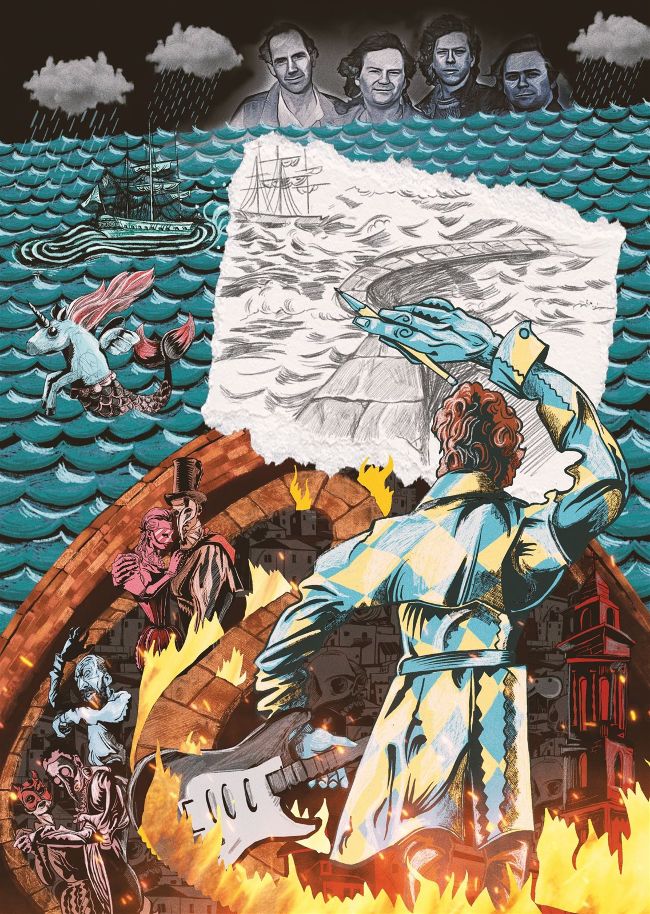
Illustration: Mark Leary
If there was a year when prog reached its nadir of unfashionability, 1996 was it.
Britpop was riding the zeitgeist, while the rock scene was still under the lingering influence of grunge, keeping rock on the straight and rather too narrow for music lovers with a penchant for something more expansive. Not that anybody had told Pendragon. As this reissue of the Gloucestershire proggers’ fifth album The Masquerade Overture –now replete with gatefold vinyl packaging with leather effect finish, plus Simon Williams’s intriguing artwork presented on card sleeve inserts – reminds us, there were some UK acts keeping the home fires burning very effectively.
Not that the uninitiated would have realised at the time from the airplay, industry support and media coverage –or lack of it. The neoprog movement of the early 80s that originally spawned Pendragon was a distant memory, with even Marillion struggling after parting company with EMI. But over in Stroud, singerguitarist Nick Barrett and keyboard maestro Clive Nolan had found fresh impetus, making records on their own label Toff, and enjoying enough success to not just survive but expand their fanbase by touring across Europe. The Masquerade Overture would go on to sell over 90,000 copies, making them one of the era’s biggest independent prog acts.
It was the result of Pendragon moving away from the keyboard-heavy soft rock sound they’d dabbled with in the late 80s and returning to their first love: long-form compositions, conceptual narratives and colourful, fantasy-leaning imagery. It didn’t hurt that Barrett seemed to be a late bloomer as a songwriter, with 1991’s The World and 1993’s The Window Of Life cementing a strong new identity. But it was this 1996 release that would come to compete with its successor in their catalogue, 2001 release Not Of This World, as a fan favourite.
Any newcomers to the band’s music won’t take long to understand this record’s cherished status, as alluring melodic flourishes and emotive hooks beckon the listener into the first third of the album. The title track introduces the central concept, touching on how music can allow a social outsider to create new identities, explore fantasies and open up new worlds for themselves and their listeners. The foreshadowing of musical figures that will feature later are dripped into this introductory piece, before a full-blown operatic choir offers grandiose promises of what’s to come. One to turn up loud. As Good As Gold follows, with Barrett sensing, ‘I open my eyes and look up to the skies and I dream… dream that a new life will be born.’ Nolan’s synth flourishes sound like trumpet fanfares and the guitar lines whizz overhead like a Red Arrows display.
The Masquerade Overture
TOFF
Areminder there were prog acts keeping the home fires burning.
Nonetheless, a struggle against the odds is evidently in store as we’re told the protagonist is ‘fighting the laws of gravity’. Equally stirring is the more plaintive picture created by Paintbox: ‘I paint the path I want to take and paint a life of fire,’ our hero sings, as if referring to his own determination to go the artist’s way.
While the primary musical textures recall classic prog –from fizzing, florid synth decoration to skyscraping fretwork redolent of Gilmour, Latimer and Rothery –they are employed with sufficient skill to avoid sounding derivative. Meanwhile, there’s always room for less conventional sounds, such as the penny whistle that accompanies The Pursuit Of Excellence and its romantic vision of previous generations sailing to America to pursue their own dreams.
Inevitably, there are stormy narrative waters to navigate, as found in the latter parts of Guardian Of My Soul, where ‘The demons wake while the mannequin sleeps/And I pray the Lord my soul to keep,’ and we find ‘The Whore Of Babylon waiting in a doorway/To mug you and your pride.’ There’s light at the end of that tunnel, though, as Masters Of Illusion ends the original album with a defiant statement: ‘I’m the master of illusion, a master of disguise/and you won’t fear the world anymore…’
The first of two bonus tracks on this reissue is the seven-minute Schizo, another anthemic affair. ‘Mindblown and schizo, that’s where we are,’ goes the chorus. ‘Climbing hills and popping the pills, has it come this far?’ Gospel-ish backing vocals ease the uncertainty before Barrett drifts away onto the horizon of a yearning guitar solo. It’s followed by King Of The Castle, whose chorus is drawn from the climactic sections of The Shadow on the original LP. Yet here it works as an exploration around that focal point, accompanied by elegant strings and acoustic guitars.
The fact that it’s reprising a key passage from earlier in the set also ensures the whole affair retains a sense of the story coming to a natural conclusion, as Barrett concludes: ‘Free spirit I’ve travelled, so follow me now.’ Long may he roam.
AIRBAG
The Century Of The Self KARISMA
Norse prog notables expand their sonic environment.
Leading lights of the Norwegian progressive rock scene for more than 15 years, Airbag have always had a clear identity. Across their five studio albums to date, their subtly unique strain of post-Floyd melancholy has certainly proved itself to be a malleable thing.
Their 2013 album The Greatest Show On Earth saw Airbag perfect their sound, and every subsequent album has brought new dimensions and textures to the tearful party, while also retaining the essence of their trademark dreamy drift. From the darkly digital paranoia-fest of 2016’s Disconnected to the back-to-basics sumptuousness of 2020’s A Day At The Beach, they have all contributed to a sense that Airbag could tinker at the edges of their sound forever and a day, without ever sacrificing the unfussy, humble power that lies at its heart.
That remains largely true here. The Century Of The Self offers no radical departures or jarring detours, and with the disarming vocal presence of frontman Asle Tostrup dominating the foreground, these songs should slot neatly into the Airbag catalogue. Nonetheless, this is a very different record from its predecessors, if only in sonic terms. Blurring the lines between traditional prog, its modern equivalent and, more surprisingly, mind-expanding space rock, opening epic Dysphoria highlights the new dynamic sensibilities that inform this record. Built on a languid groove, it has much in common with the somnambulant stoner ritualism of bands like King Buffalo and OM, quasi-dub bass line included; but with the expected, bittersweet melodic thrust of the modern prog set, and a slight edge of post-punk grubbiness thrown in.
Where previous albums favoured a more conservative quiet-to-loud aesthetic, here Airbag sound liberated by the sheer enormity of space that their songs have wandered into. On the tense but tumultuous Tyrants And Kings, the backdrop for Tostrup’s pleas for mercy echoes the kohl-eyed vastness of The Cure’s Disintegration, elevating an otherwise straightforward song to a higher level of atmospheric potency. On the gently heart-breaking Awakening, as Tostrup sings, ‘Don’t look down/Keep your head up…’, the background is a masterclass in minimalist elegance, with only drums and strummed acoustic providing an anchor to reality, as Riis wrings slender shards of bluesy wistfulness from his instrument.
The closing Tear It Down embraces Airbag’s newly expansive sonic environs, veering from stripped-down finesse to churning, angular alt rock, and spiralling towards massive, post-rock crescendos. The Century Of The Self is a subtle but effective sideways step.
DOM LAWSON
ACID MOTHERS REYNOLS
Volume 3
VHF
A self-indulgent nightmare that leads to a bad trip.
Collaborations between the more outré of bands always raise the prospect of more bang for one’s buck. The union of Sunn O))) and Ulver produced Satan’s own ambient music in the shape of Terrestrials or the psychedelic onslaught that wrought by the collision of Manchester’s Gnod and New York space-rockers White Hills on Dropout With White Hills II.
Then there are the two albums released by Acid Mothers Reynols, the fusion of Japan’s third-eye rinsers Acid Mothers Temple and Argentinian experimentalists Reynols. While those two releases, Volume 1 and Volume 2, were challenging experiences, there was always a hook to hang a coat on. Unfortunately, this third volume removes not just the hook but also the load-bearing wall that it was nailed to.
The pile of rubble left behind makes for a frustrating search for satisfaction. Across its four tracks, there’s a feeling that the musicians were far more interested in satisfying themselves than anybody else. The meandering Kicking Air Breaks recalls the climax of Laurel & Hardy’s The Music Box while titles such as Multiverse Turtle Reflex prove more interesting than their contents.
JM
AGE OF DISTRACTION
A Game Of Whispers
AGEOFDISTRACTION.BANDCAMP.COM
Ex-This Winter Machine guitarist melds neo-prog and metal on new project.
Guitarist John Cook stepped down from This Winter Machine to embark on a solo project where he could explore styles that wouldn’t have fitted into the Yorkshire outfit’s canon. However, after enlisting Ghost Of The Machine vocalist Charlie Bramald for a guest spot, said project quickly transformed into a band proper, Age Of Distraction.
With assistance from Hats Off Gentlemen It’s Adequate bassist Mark Gatland and This Winter Machine drummer Dom Benison, Age Of Distraction have delivered a texturally rich concept record which draws on a multitude of styles.
On Break My Bones they strike a balance between popping neo-prog colours and metallic gumption, Compromised remains accessible despite its snarling delivery, while Sneak Attack finds Bramald providing light to its contorting instrumental darkness, and Cook’s fretboard burning solo. The lyrical theme of toxic relationships threads through the record, notably on the sparse, acoustic-led Oceans and the string-lavished Take Me Down, the latter courtesy of Stuckfish’s Phil Stuckey. A diverse and enjoying opening salvo.
POW
ALCEST
Les Chants De L’Aurore
NUCLEAR BLAST
French visionaries continue to sew together a multitude of genres to phenomenal effect.
The seventh album from Alcest, their first new music since 2019’s Spiritual Instinct sees the French duo continuing to push their experimental blend of shoegaze, black metal and dream pop with progressive components, blurring genres with little regard for traditional boundaries.
The black metal aspect of Alcest’s sound is more muted here, making it one of their most accessible records yet. Komorebi opens the album with an atmospheric intro before crashing drums contrast starkly against founder/multi-instrumentalist Neige’s soft, lilting vocals. Their heavier elements appear most prominently in Améthyste, whose thunderous racket settles into an eerie drone, where melodic guitars and soft vocals broaden Alcest’s musical spectrum.
Neige states that the intention of the record is to spread “hope” in a time of negativity. Certainly, when L’Envol and Flamme Jumelle intertwine floating tremolos and soft, balladesque vocals with the harsher strands of their sound such as rapturous drums and snarled shouts, the result is an aura of positivity that remains infectious long beyond the final notes of Les Chants De L’Aurore.
CF
ALWANZATAR
Engsyre APOLLON
Eccentric Norwegian electronic adventurer visits the faery folk on sixth album.
Kristoffer Momrak describes the sound of his one-man-band Alwanzatar as “extraterrestrial world music”, and it’s an appropriate description for Engsyre, which could have been made on a spaceship.
Alwanzatar abducts disparate sounds from various regions and eras and hashes them together in otherworldly experiments, with moments of musical nirvana feeling as though they were generated more by chance than design. On Høymole, 90s acid-rave squelches are pressed together with Berber horn ululations and the distinctive tweeting of birds; Tårnhode Med Skyer follows similar terrain with added flute to radiate early Kraftwerk vibes. Fjerdingby Filterbattle flirts with dub, Khan Krums Horn slips in some traditional Chinese music, and so on. It’s an unpredictable concoction, inspiring euphoria one moment and disquiet the next.
The title comes from the Norwegian name for sorrel, with Momrak – who also plays in Tusmørke – promising to take the listener away from the city to find “the faery folk” hiding in the forest. Engsyre is potent in its originality, though sometimes it’s hard to see the wood for the trees.