GB
  
You are currently viewing the United Kingdom version of the site.
Would you like to switch to your local site?
10 MIN READ TIME

Into the vortex

The final volume of Margaret Thatcher’s official biography is a brilliant Westminster drama but misses the European dimension, finds Anthony Teasdale
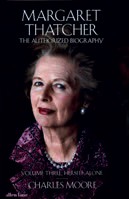
Margaret Thatcher: The Authorised Biography, Volume Three: Herself Alone
by Charles Moore (Allen Lane, £35)

I received a warning, in early 1988, on what was virtually day one of my new job. I had become special adviser to the man who was then Margaret Thatcher’s foreign secretary, would soon be her deputy, and was ultimately her political nemesis: Geoffrey Howe. “There’s one thing you need to know about this government,” my opposite number in another major Whitehall department said: “The prime minster is going mad. Half the people you will meet don’t realise it, and the other half won’t talk about it.”

The late 1980s were interesting times. Herself Alone—the third and final volume of Charles Moore’s official biography— covers the tumultuous years from Thatcher’s third general election victory in June 1987, when she dominated the political scene, to her painful loss of power in November 1990. The book then takes the story through the long, sad years to her death in March 2013.

Moore launched his new volume in the magisterial setting of the Banqueting House, the only surviving component of Whitehall Palace and scene of the execution of Charles I. The event brought together, perhaps for the last time, many of the anciens combattants of the Thatcher revolution. The guest of honour was Boris Johnson, leading a government whose central mission, Brexit, can only be understood in the context of the political battles of 1987-90.

Whether or not one agrees with Johnson’s description of Moore’s book as “the greatest work of modern British history”— written, he joked, with “the almost obsessive lust for accuracy and detail that is the hallmark of all great Daily Telegraph journalists”—it is a remarkable achievement, impressive in ambition, scope and depth.

Moore’s book breaks a lot of new ground, drawing on hundreds of interviews and newly released official and private papers, to complete a trilogy of titanic proportions—a cumulative text of nearly 3,000 pages, the writing of which has consumed more than 20 years of the author’s life.

Read the complete article and many more in this issue of Prospect Magazine
Purchase options below
If you own the issue, Login to read the full article now.
Single Digital Issue December 2019
 
£5.99 / issue
This issue and other back issues are not included in a new subscription. Subscriptions include the latest regular issue and new issues released during your subscription. Prospect Magazine
PRINT SUBSCRIPTION? Available at magazine.co.uk, the best magazine subscription offers online.
 

This article is from...


View Issues
Prospect Magazine
December 2019
VIEW IN STORE

Other Articles in this Issue


Prospect
Editorial
An ugly election
Contributors
Steve Bloomfield is Prospect’s deputy editor.
Letters
Gaby Hinsliff’s article on “The end of the liberal
Inside Left: the meaning of the Corbyn movement
Win or lose the battle in December, a rising generation of socialists is digging in for a long war
What happens if we stop trusting elections?
Britain’s democracy faces its bleak midwinter
Opinions
Whitehall prepares for the unknown
There will be no MPs to tread the corridors of the
Campaign in bad poetry—govern with the consequences
In his 1946 essay “The Constant Symbol,” Robert Frost
I am quitting as an MP—to spend more time on real politics
I never had a major life mission to become an MP. The
Impeachment and the president
It was a smug move by a confident reformer. On 23rd
Putting parliament in its place
In 2019, the study and practice of constitutional law
Parting company
The stark economic choice in the coming election can
Should we scrap Universal Credit?
YESThe conventional view is that Universal Credit (UC)
Essays
Pot-luck democracy
As Britain goes to the polls, the Belgians are experimenting with randomly-chosen representatives. Could they do any better?
The Returnees
Europe’s big idea on immigration is to send migrants home. But what happens when they get there?
Rebel with a cause
Ken Loach’s films about poverty in modern Britain are the most powerful of his career. Now in his eighties, the director is still taking the fight to anyone he sees as the enemy
Digging up the past
Gardening isn’t just a relaxing pastime—it’s a hugely profitable industry with deep roots in English history
Arts and books
Taming the beast
Harvey Weinstein’s fall shows it’s time to stop powerful men behaving badly.
Crafted for contagion
The stories we spread about the economy have the power to shape it— for better or worse—in real life, finds Howard Davies
I dance, you watch
The extravagantly talented Mark Morris has a dashing lack of filter
Late readingwith Clive James
We thought his column had ended but Clive, like Frank Sinatra, can’t resist one more comeback. Here he reflects on M&S puddings, The Wire and getting Wittgenstein wrong
Books in brief
What makes a good prime minister? What does true leadership
Recommends
Emma Crichton-Miller
Prospect life
Prospectlife
Hephzibah Anderson
The wild frontier Wisdom of crowds
Every evening, as dusk soaks the sky, the starlings
In play Unscripted drama
At the end of Brecht’s Threepenny Opera, the robber
The Clapham Omnibus
by Hannah Berry
Classical musing Decoding art
There are lots of weird side benefits in having studied
Getting by The lure of loathing
I’ve never been much of a hater. In any disagreement
Policy report
Policy report: infrastructure
Can we transform Britain’s transport networks?
Economics and investment
The analyst: Duncan Weldon Associate Economics Editor
Endgames
Events
The Prospect Book Club usually meets every third Monday
The generalist by Didymus
Apart from 56A, the Across clues, and also 21 Down
Enigmas & puzzles
A calculated correction
Brief encounter
Brenda Hale
Chat
X
Pocketmags Support