Pot-luck democracy
As Britain goes to the polls, the Belgians are experimenting with randomly-chosen representatives. Could they do any better?
ELIANE GLASER
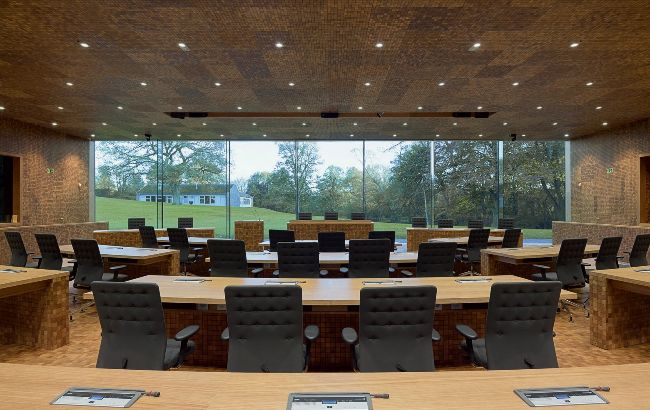
It could be you!—Empty chairs in a new chamber in the Ostbelgien parliament, where citizens chosen by chance will be summoned to have their say
PHOTOGRAPHY © ULRICH SCHWARZ, BERLIN
As the institutions of western liberal democracy crumble, could a remedy be emerging in a sliver of east Belgium? Take the train from Brussels, and the medieval cities of Leuven and Liege give way to maize fields and forested hills. After nearly two hours, you arrive at Eupen, the capital of Belgium’s Germanspeaking community. A picturesque church graces the main square, pavements are lined with bistro tables, and cyclists negotiate the cobbled streets. Even the traffic islands are prettified by quaint tableaux of rustic wagons and hay bales.
This quiet, sedate and fairly prosperous provincial town seems an unlikely host for radical democratic innovation. In Belgium’s mind-boggling political system, which has overlaying territorial and language-based federal elements, the German-speaking community has its own government, with devolved powers comparable to Scotland or Wales. With a population of 76,000 (fewer than the Isle of Man), Ostbelgien is Europe’s smallest federal entity, but it has a real parliament whose remit includes education, culture, energy and social care. And from next year, everyday folk chosen by chance will have the opportunity to shape policy alongside the elected MPs—in the first permanent citizens’ assembly in the world.
Citizens’ assemblies (or citizens’ juries) vary in form, but the basic principle is always to task randomly-selected members of the public to thrash out political issues, often with the help of experts or moderators. They’ve become steadily more fashionable over some years, but the Belgian experiment offers a twist in that it builds them into the structures of governance. But on a long view, even government by citizens selected by chance is nothing new. Its advocates critique parliamentary democracy as outmoded because it hasn’t changed since the 18th century— but then happily hark back to ancient Athens (see “the original democracy” overleaf) as the true pioneer of “sortition.”
Back in the 1990s, British reformers proposed replacing the House of Lords with citizens chosen by lot, and before long New Labour was toying with putting a bunch of ordinary people in a room together to come up with “what works” policies: recall Tony Blair’s “Big Conversation.” If that venture looked like a post-Iraq distraction from a prime minister who’d run out of his own ideas, more recently, a citizens’ assembly in Ireland has achieved more practical success in paving the way for the legalisation of abortion and gay marriage in referendums.
This success has inspired many glowing headlines,as well as politicians from Ed Miliband and Rory Stewart to Emmanuel Macron—who has promised a grand débat national. Assemblies dedicated to specific questions have popped up in Toronto, Madrid and Gdansk. At home, invitations to join a citizens’ assembly on climate change have just landed on the doormats of 30,000 British households—an initiative by a cross-party group of MPs. The political scientists who hold the blueprints are being fêted by desperate governments around the world.
“Populist anger is ‘a gift wrapped in barbed wire. It’s people shouting please let us be involved’”
Prominent among them is the charismatic and eclectic Belgian historian David Van Reybrouck, who warns that a restless public is no longer going to be content to tick a box every five years and then go back to sleep. Voting, he argues, was never designed to give people a meaningful say, but to keep them in their place: the word “elite” originally meant those who are elected.
Along with the earnest and cosmopolitan political scientist Yves Dejaeghere, Van Reybrouck is one of the leading lights of a democracy “platform” called “G1000,” the idea being to convene the masses instead of the handful of leaders at the G7. Eupen had held a pilot citizens’ dialogue in 2017 dedicated to the question of childcare provision. The minister-president was so pleased with the results—though let me come back to exactly what those results were—that he invited the G1000 to establish the “Eupen model.” This autumn, politicians and constitution geeks from as far afield as Australia, Brazil, Bosnia and Peru descended on Eupen for a sortition “summer school” to study Van Reybrouck’s “laboratory for the world.”