The Returnees
Europe’s big idea on immigration is to send migrants home. But what happens when they get there?
DANIEL HOWDEN
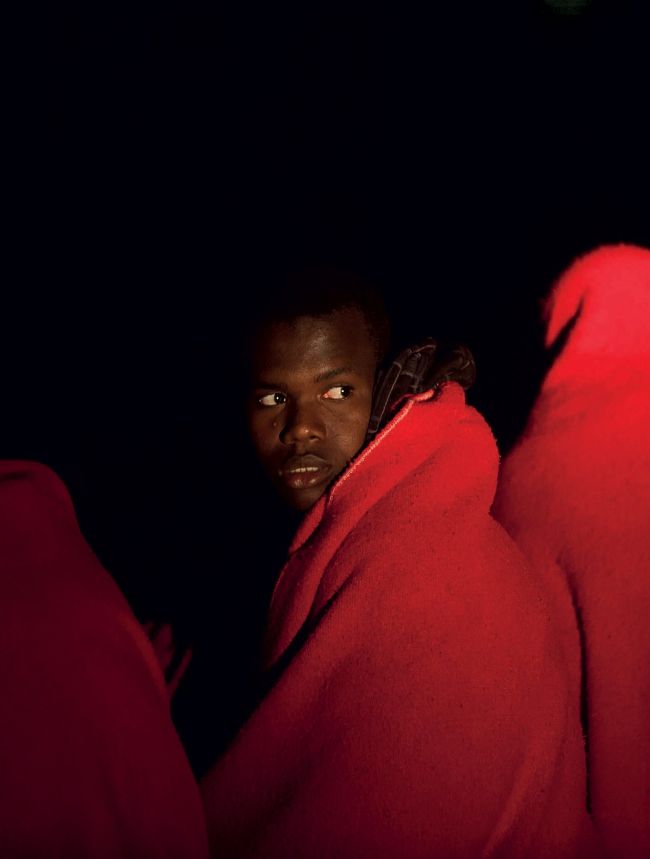
A young man looks back after being rescued from a dinghy near the Malaga coast
© JESUS MERIDA/SOPA IMAGES/LIGHTROCKET VIA GETTY IMAGES
Osita Osemene’s voice commands your attention in the same way a subwoofer does. His sermon has a bass line that washes over you in waves of rhetorical questions. Should his audience falter in their attention, he snaps it back into place with a booming “hello” that reverberates off the plastic pillars and tatty golden curtains of the ballroom of the Zafike Hotel.
Osemene is in the business of “re-engineering your mindset” to get you behaving like “someone who has a future.” This might be considered a reasonable proposition—except for the fact that his audience of around 100 Nigerians have risked their life savings and lives to not be here in the first place. Their problem is not the Zafike, an unlovable dive on the outskirts of Benin City in southern Nigeria, it is that they are only being re-engineered because they left their country in a doomed bid to reach Europe.
Forty-six-year-old Osemene tells his mostly younger compatriots that they have an “old and destructive mindset” for wanting to migrate. And he can sympathise because he once had the same condition. The son of a preacher, whose charisma survives and defies his buttoned-down look of a well-fed IT worker, Osemene had his own road to Damascus moment 15 years ago. It came on the Libyan shore of the Mediterranean where he abandoned a harrowing attempt to reach Europe after seeing the dead bodies of other migrants washed up on the beach.
It took money wired by his sister and three tortuous weeks to unwind his journey and return to Nigeria. Like a true convert, he now lectures recent returnees and produces pamphlets that read like public health circulars about the dangers of an illness called migration. His routine is equal parts Pentecostalism, psychoanalysis and NGO jargon, delivered in the rhythm of a Methodist sermon but peppered with development buzzwords such as “empowerment,” “capacity” and “resilience.” He can sound like a man on a singular mission, but this is no solo effort.
Osemene’s work is paid for by a Who’s Who of European authorities, from the EU to the Swiss and British governments. What they have in common is a shared desire to see fewer Nigerians travel north. Osemene’s sermon was part of a two-day business training course whose reluctant participants had it drilled into them that they must be entrepreneurs. They were tasked with finding teams of at least three people and coming up with a small business plan that international donors would then support in-kind with goods worth roughly £2,500.
For all of Osemene’s soothing rhetoric, the room was inevitably full of confusion and trauma, as well as individuals whose recent experience of gambling and losing was hardly going to help with engendering a start-up mindset. James Monday hung near the back in the instinctive way a cool kid would. His impeccably- worn short dreads are testament to his job as a hairdresser in Lagos, the commercial capital of Nigeria, a five-hour bus ride away. He no longer owns the tin-shack stall where he works—he sold it in early 2017 to fund his attempt to reach Europe.