Bad manners
Politeness is often the veneer that disguises our most barbaric instincts, argues Freya Johnston
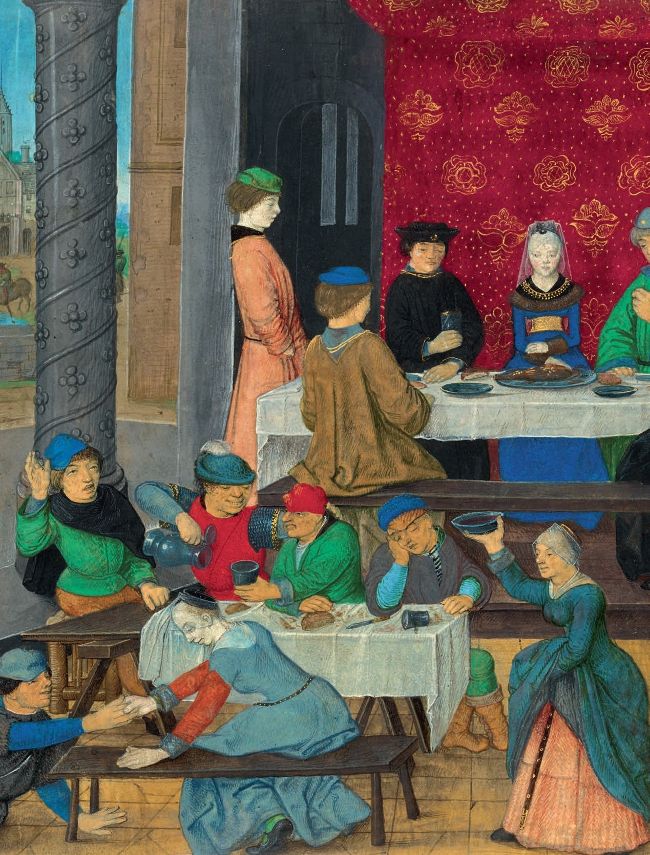
Rude awakening: polished diners ignore the rowdy lowerclasses in a 15th-century Flemish illustration
© J. PAUL GETTY MUSEUM, LOS ANGELES, USA / BRIDGEMAN IMAGES

In Pursuit of Civility: Manners and Civilization in Early Modern England
by Keith Thomas (Yale University Press, £20)
“Never park here,” thunders a sign attached to the railings of one Oxford college. As such communications go, this one has plenty to recommend it—but alas its brevity is far from typical. In recent years there has been a surge in the number of English signs identifying themselves as a “Polite Notice.” These two six-letter words often herald a long message that errs in every other respect on the side of impoliteness: “Stop pissing all over the lavatory like a fucking animal,” to take one recently spotted example. That is, admittedly, an unusual instance of the genre. The majority of polite notices have to do with cars and where not to put them, rather than with toilets and how not to treat them.
“Stop pissing…” adopts a very different tone from that I remember noticing in pub conveniences in the 1970s and 80s: “If you sprinkle when you tinkle, be a sweetie and wipe the seatie.” Could that twee little poem be called a truly polite notice? Well yes, in the sense that it doesn’t unleash a torrent of expletives, nor does it assume that you’re at fault; it tries to flatter you into good behaviour rather than abuse you for your crimes or beastliness. But the chief reason for its superior politeness is that it doesn’t tell you it is being polite in the first place.
The passive-aggressive “Polite Notice” offers a little review of itself before you’ve got to the gist of what it’s ordering you to do—or, typically, what not to do. Don’t get annoyed by what I’m about to say, it suggests: I’m polite, you know. (Giving inanimate objects or vehicles a first-person voice is another curious feature of modern British manners: a bus will sometimes announce to hopeful travellers, “Sorry, I’m not in service”). Polite notices tell you how to respond to them before you’ve even got to the bit that tells you how to behave. They are polite, after all.