Make Bury great again!
England’s towns were once as mighty as its cities. Now, they have fallen on hard times. Can Bury lead the revival? asks Philip Collins
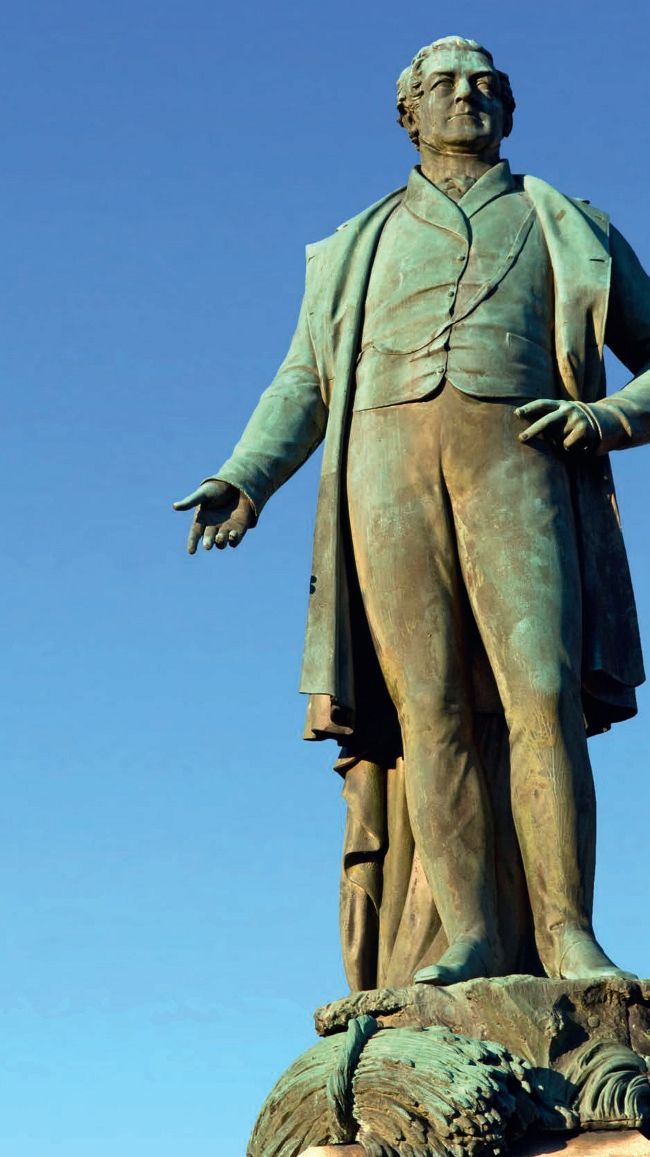
A statue of Sir Robert Peel, erected in the 19th century at the height of Bury’s economic power
© IAN CANHAM/ CARON BADKIN /ALAMY STOCK PHOTO
Britain was once full of glorious towns— regency spas, industrial workshops, market squares, council chambers, grand town halls looked down upon by statues of local dignitaries. This was the very fabric of the nation of England, in particular. It is an intriguing parlour game to take a description like the one that follows, from Mark Girouard’s The English Town: A History Of Urban Life, and wonder to which place it applies: “For a mile or so we drove along a street of palaces— palaces… amazing in the height and power of their mighty stone façades, piled up storey after storey, and row after row of windows. I have never been to Florence, but this, it seemed to me, must be what Florence is like.”
Answer—it’s Huddersfield. For that, town though it is, was his “glorious city” of palaces and façades of high windows. Some of the buildings on the streets leading out from its St George’s Square are indeed splendid, but The English Town was a deeply nostalgic tour of such places even when it was published in 1990. After the passage of a further quarter-century— a quarter century that has, in sequence, seen suburbanisation, out-of-town shopping centres, a financial crash and then internet shopping going mainstream— it sounds like a relic from a lost golden age. The last generation has witnessed a remarkable story of progress in the big cities. Immigration has brought a new energy and diversity—new businesses, foods and fashions. Universities have expanded out of all recognition, bringing a young population that needs to walk, rather than drive, into their centres. Train travel, which had been dying, has become vastly more popular, laptops and then smartphones enabling people to work on the move on their way into the heart of a metropolis. The fashion is increasingly to live in the city, perhaps in one of the endless canal-side former factory conversions where one can hope to meet, work with and date other like-minded sorts.
The cities, then, have undergone a renaissance. Not so the medium-sized settlements in the Huddersfield mould, including the place where I was raised—Bury, so close to Manchester, and yet so vigorously separate from it. How then can the Huddersfields and Burys replicate the successes of the Manchesters? To answer that we first need to understand how and why the paths of towns and cities have diverged so dramatically.