GB
  
You are currently viewing the United Kingdom version of the site.
Would you like to switch to your local site?
20 MIN READ TIME

True blues

Modern Europe was forged and long governed by forces of the moderate right. But now they’re on the slide—and the continent has reason to fear

Since the 2008 financial crash much ink has been spilled on the demise of the centre-left across Europe. Here in Britain it hastened the demise of New Labour, while in Germany it turned the SPD into a perennial junior coalition partner. They were the lucky ones. The once-dominant Pasok has been wiped out in Greece, the Socialist Party of François Mitterrand sunk to fifth at the presidential elections last year, while the Labour Party in the Netherlands slumped from coalition government to an embarrassing seventh.

The avowedly progressive side of the ideological spectrum is, perhaps ironically, always the more given to gloomy introspection. But this time its anguish appeared to be justified. For the best part of a decade after a crisis that exposed much that was rotten in the old order, events appeared to be playing out against those forces that wanted to reform it. That pattern may have seemed surprising to some, but perhaps not to students of Britain’s political history in the 1920s, 1930s or indeed 1980s. Hard times once again appeared to be shoring up the establishment.

Meanwhile, support for the centre-right remained solid. For many years after the crash, the parties that helped forge the post-war “west” and have run it for most of the time since sometimes looked as strong as ever. Angela Merkel was able to increase her vote in 2013, a feat matched by David Cameron in 2015, when he succeeded in swatting the challenge from Ukip out of the way and winning an unexpected overall majority. Other insurgent anti-establishment parties were, on the whole, being held at bay. Given the economic battering western democracies have faced since 2008, the resilience of the old political order was remarkable. But will this last much longer?

In the last year or two, elections—and in the UK a referendum, too—have begun to indicate that the centre-right forces, like their centre-left counterparts, are now on the defensive. In Germany, in France, in the UK and latterly in Italy they have proved unable to command majorities, and seen their core support shrink and with it their ability to form governments. The arrival of the anti-immigration Alternative für Deutschland (AfD) to challenge Merkel is the perfect illustration of what is going on; new parties and movements, particularly from the populist nationalist right, have risen to challenge them across the continent. These paint centre-right parties as part of the cosmopolitan elite, committed to supranationalism and the global market and as much a part of the problem as the rootless centre-left. Some centre-right parties have aped the language and policies of the far-right, others have tried to stand firm for moderation; but almost all have seen their support slip.

Could it be that the solidity of the traditional centre-right was only the creation of specific historical circumstances? Specifically, the destruction of the main fascist regimes in the Second World War; strong nation states with settled borders in its wake; and, on the international stage, the idea of a western alliance. And, if the insurgents continue to make ground, might we see the demise of the forces of moderation and the return to a new era of nationalism and authoritarianism in Europe?
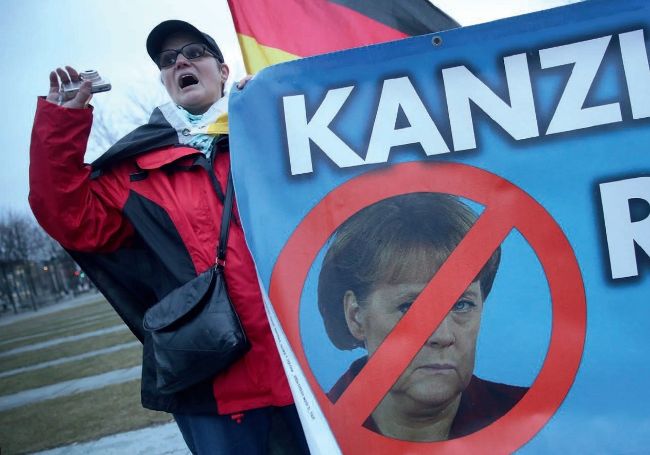
Under pressure: Angela Merkel’s rule in Germany is being challenged by a resurgent extreme right
© SEAN GALLUP/GETTY IMAGES

Rise from the ashes

The centre-right has been the dominant political force in many European countries for much of the last 70 years. Various forms of Christian Democracy proved particularly successful in Germany, Italy, and the Benelux countries, while Gaullism often triumphed in France and the “One Nation” aspect of Conservatism was—in reality— always a huge part of the Tory coalition in Britain, notwithstanding Margaret Thatcher’s insistence that the middle of the road was a good place for getting run over.

Read the complete article and many more in this issue of Prospect Magazine
Purchase options below
If you own the issue, Login to read the full article now.
Single Digital Issue Jul-18
 
£5.99 / issue
This issue and other back issues are not included in a new subscription. Subscriptions include the latest regular issue and new issues released during your subscription. Prospect Magazine
PRINT SUBSCRIPTION? Available at magazine.co.uk, the best magazine subscription offers online.
 

This article is from...


View Issues
Prospect Magazine
Jul-18
VIEW IN STORE

Other Articles in this Issue


Prospect
Right going wrong
Britain is gripped by the theatre of the absurd. The
Letters & opinions
Letters & opinions
David Hannay (“Bordering on contempt,” June) brought
The Farage coup
The true leader of today’s Tory Party has never even won a parliamentary seat
Closing down
The life lessons we’ll lose when the high streets fall
China hasn’t won yet
The rising power is squaring up to the west. But it could still be undone by its top-down model
Pakistan’s Potemkin democracy
Don’t be fooled by elections—the military is still in charge
Agents of our own destruction
A former spy-chief says social media emboldens the far Right
Seventh time lucky
Protests in Jordan have led to a new prime minister—but will reform remain elusive?
Speed data
A permanent emergency
We’re all going to pay for the NHS’s 70th birthday bailout. Before long, it will need another
The Duel
Has test cricket had its day?
YES Test cricket is a bit like democracy. Both are
Features
Can the Tories survive Brexit?
Britain’s “natural party of government” is tearing
Will Brexit break the Conservatives?
They’ve come through war, the end of Empire and not a few spats about Europe. But just occasionally a special sort of row arises, one that truly sinks the Tories
A Conservative vision
How can the right get it right? Conservative MP Lee Rowley—part of the 2015 intake— casts his eyes to the horizon
How to de-radicalise an extremist
Angry young men are the greatest security threat the world faces. Why are we so bad at dealing with them—and how could things change?
Make Bury great again!
England’s towns were once as mighty as its cities. Now, they have fallen on hard times. Can Bury lead the revival? asks Philip Collins
The real deal-maker
While others in the White House have fallen, Mike Pompeo has risen almost without trace. What has he got that the others haven’t? Sam Tanenhaus investigates
Caillte ann an eadar-theangachadh
Gaelic is a dying language. Should it be kept alive?
The way we were
When we actually won
Extracts from memoirs and diaries, chosen by Ian Irvine
Art & books
Bad manners
Politeness is often the veneer that disguises our most barbaric instincts, argues Freya Johnston
Mysteries of the mind
The best neuroscience writing acknowledges just how little we know about the workings of the brain, finds Julian Baggini
Rock the books
The current gang of pop writers are the best we’ve ever had. But are they eulogising a dying art form, asks DJ Taylor
Songs of themselves
A wonderful memoir exposes the reality of the Indian caste system, finds Gaiutra Bahadur
Books in brief
There is a biographical detail about Ben Rhodes, the
Recommends
The UK’s largest contemporary art festival this year
Life
Life
“Daddy, daddy,” your children will one day ask, “what
Policy report: Manufacturing
Britain must do more to boost its manufacturing sector. But what? Should government encourage innovation—or is the real problem the financial sector’s failure to lend? And if Britain were to start churning out huge amounts of high-end manufactured goods, who would buy them all?
Things to do this month
Events
The Prospect Book Club meets every third Monday of the month (excluding bank holidays) at 6.30pm at 2 Queen Anne’s Gate, London, SW1H 9AA. To book tickets please visit prospectmagazine.co.uk/events
Endgames
Endgames
1 Denmark’s national opera of 1906 with libretto by
Brief Encounter
Antonia Fraser
I remember my mother in floods of angry tears over
Chat
X
Pocketmags Support