GB
  
You are currently viewing the United Kingdom version of the site.
Would you like to switch to your local site?
16 MIN READ TIME

The real deal-maker

While others in the White House have fallen, Mike Pompeo has risen almost without trace. What has he got that the others haven’t? Sam Tanenhaus investigates

Prospect Portrait
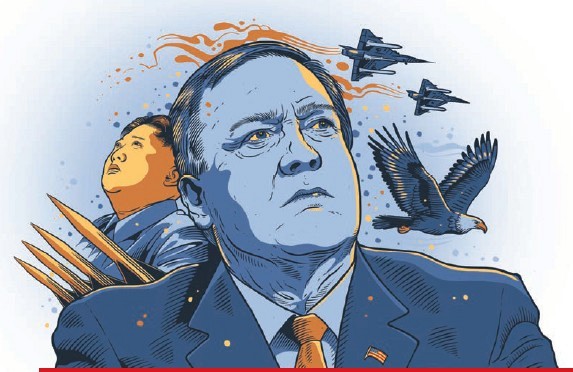
ILLUSTRATION BY TIM MCDONAGH

The quiet tenacity of Mike Pompeo, Donald Trump’s Secretary of State, was never so clear as during the dizzying reversals surrounding the US-North Korea summit. The historic meeting in Singapore on 12th June, which Trump claimed would yield a denuclearised North Korea, was announced by the US president in April. Then in May, Kim Jong Un granted “amnesty” to three Americans who had been detained in North Korea. Two weeks later, foreign journalists were invited to remote Punggye- ri, the country’s only known nuclear test site, to observe the demolition of buildings and tunnels—a deafening spectacle, though possibly just a stunt.

Then, on the train back to Pyongyang, the journalists learned that Trump had sent Kim a letter calling the whole thing off. “The Singapore summit, for the good of both parties, but to the detriment of the world, will not take place,” Trump wrote. “You talk about your nuclear capabilities, but ours are so massive and powerful that I pray to God they will never have to be used.”

Pompeo had set up the summit in two secret meetings with Kim and also secured the release of the American prisoners. It seemed that he had lost out in an internal struggle with John Bolton, the hawkish new National Security Adviser with a long history of urging military strikes against North Korea. But then, a week after Trump cancelled the meeting, Pompeo dined in New York with a North Korean envoy, its former top spy, Kim Yong Chol. The next day the envoy was in the Oval Office with a letter for Trump. Pompeo was in the room—Bolton was not—and the summit was back on. In the event, it took place without a hitch.

It was a typical Pompeo victory, achieved so blandly as to go almost unnoticed. And this is the reason for his success. In a different White House and a different time, Ronald Reagan kept a plaque on his desk on which was inscribed, “There is no limit to what a man can do or where he can go if he does not mind who gets the credit.” It was a variation of a sentiment that Harry Truman also expressed. Under Trump, the calculations are different. The credit always goes to one man, the boss, and the rest try to grab whatever is left over.

Yet in this unpromising environment, Pompeo has prospered. He is a subtly effective facilitator with a steady compass. With each new hurricane, he calmly adjusts and stays on course.

It is curious, then, that the foreign policy views that Pompeo expressed in speeches and chats with right-wing radio hosts before he entered government appear devoid of nuance or any sense of diplomatic awareness. They ranged instead from standard conservative cant to the stuff of paranoia: the attractions of waterboarding, the importance of keeping Guantanamo Bay open, the threat posed to the US by “sharia law.”

Perhaps it is a case of conveniently strong views, weakly held. But is this the man we want in charge of US foreign policy? One sobering answer is that the alternatives could well be much worse.

Read the complete article and many more in this issue of Prospect Magazine
Purchase options below
If you own the issue, Login to read the full article now.
Single Digital Issue Jul-18
 
£5.99 / issue
This issue and other back issues are not included in a new subscription. Subscriptions include the latest regular issue and new issues released during your subscription. Prospect Magazine
PRINT SUBSCRIPTION? Available at magazine.co.uk, the best magazine subscription offers online.
 

This article is from...


View Issues
Prospect Magazine
Jul-18
VIEW IN STORE

Other Articles in this Issue


Prospect
Right going wrong
Britain is gripped by the theatre of the absurd. The
Letters & opinions
Letters & opinions
David Hannay (“Bordering on contempt,” June) brought
The Farage coup
The true leader of today’s Tory Party has never even won a parliamentary seat
Closing down
The life lessons we’ll lose when the high streets fall
China hasn’t won yet
The rising power is squaring up to the west. But it could still be undone by its top-down model
Pakistan’s Potemkin democracy
Don’t be fooled by elections—the military is still in charge
Agents of our own destruction
A former spy-chief says social media emboldens the far Right
Seventh time lucky
Protests in Jordan have led to a new prime minister—but will reform remain elusive?
Speed data
A permanent emergency
We’re all going to pay for the NHS’s 70th birthday bailout. Before long, it will need another
The Duel
Has test cricket had its day?
YES Test cricket is a bit like democracy. Both are
Features
Can the Tories survive Brexit?
Britain’s “natural party of government” is tearing
Will Brexit break the Conservatives?
They’ve come through war, the end of Empire and not a few spats about Europe. But just occasionally a special sort of row arises, one that truly sinks the Tories
True blues
Modern Europe was forged and long governed by forces of the moderate right. But now they’re on the slide—and the continent has reason to fear
A Conservative vision
How can the right get it right? Conservative MP Lee Rowley—part of the 2015 intake— casts his eyes to the horizon
How to de-radicalise an extremist
Angry young men are the greatest security threat the world faces. Why are we so bad at dealing with them—and how could things change?
Make Bury great again!
England’s towns were once as mighty as its cities. Now, they have fallen on hard times. Can Bury lead the revival? asks Philip Collins
Caillte ann an eadar-theangachadh
Gaelic is a dying language. Should it be kept alive?
The way we were
When we actually won
Extracts from memoirs and diaries, chosen by Ian Irvine
Art & books
Bad manners
Politeness is often the veneer that disguises our most barbaric instincts, argues Freya Johnston
Mysteries of the mind
The best neuroscience writing acknowledges just how little we know about the workings of the brain, finds Julian Baggini
Rock the books
The current gang of pop writers are the best we’ve ever had. But are they eulogising a dying art form, asks DJ Taylor
Songs of themselves
A wonderful memoir exposes the reality of the Indian caste system, finds Gaiutra Bahadur
Books in brief
There is a biographical detail about Ben Rhodes, the
Recommends
The UK’s largest contemporary art festival this year
Life
Life
“Daddy, daddy,” your children will one day ask, “what
Policy report: Manufacturing
Britain must do more to boost its manufacturing sector. But what? Should government encourage innovation—or is the real problem the financial sector’s failure to lend? And if Britain were to start churning out huge amounts of high-end manufactured goods, who would buy them all?
Things to do this month
Events
The Prospect Book Club meets every third Monday of the month (excluding bank holidays) at 6.30pm at 2 Queen Anne’s Gate, London, SW1H 9AA. To book tickets please visit prospectmagazine.co.uk/events
Endgames
Endgames
1 Denmark’s national opera of 1906 with libretto by
Brief Encounter
Antonia Fraser
I remember my mother in floods of angry tears over
Chat
X
Pocketmags Support