GB
  
You are currently viewing the United Kingdom version of the site.
Would you like to switch to your local site?
19 MIN READ TIME

ETERNAL VIGILANCE

Where the west ends

Centuries of history have taught Poland to be wary of Russia. Its authoritarian turn may slowly change that—and destroy its relationships with everyone else

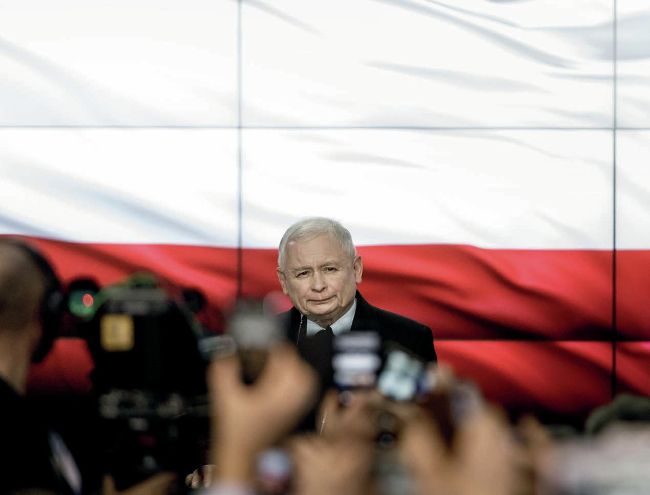
Existential threats: the leader of Poland’s ruling Law and Justice party, Jarosław Kaczyński, speaks to supporters during the 2019 election count
© CARSTEN KOALL/GETTY IMAGES)

In the spring of 2018, I travelled from Warsaw to the town of Montrose, on the east coast of Scotland, to meet a fringe Polish politician who has dedicated his life to overturning Europe’s post-1989 political settlement.

A native of the southeastern Polish city of Lublin, he was the deputy leader of an overtly pro-Russian marginal political party calling for a radical re-orientation in Polish foreign policy. Describing itself as “the first non-American political party in Poland,” it was anti-capitalist, anti-Nato and anti-EU, and had ties both to the global extreme farright and to foreign pro-Russian actors, including the Donbass rebels in eastern Ukraine and proxies for the Assad regime in Syria. This politician (who in this piece I need to keep anonymous) had moved to Scotland after his party’s leader was detained by Polish security services on suspicion of espionage on behalf of Russia and China. A specialist in political entryism, he started a new life in Aberdeen and— intriguingly—reinvented himself as a passionate advocate of Scottish independence.

As we sat over soup in a quiet corner of Montrose’s George Hotel, the politician outlined a radical vision for Poland’s future, one that involved renouncing its “civilisational

choice” to join western political and security institutions after 1989 and instead returning to Russia’s warm embrace. For all you may have heard about the country’s authoritarian turn under the nationalist Law and Justice Party (PiS), this position remains a near-heretical stance. The standard Polish view is that the nation’s western vocation was ordained over a thousand years ago, when the first Polish king, Mieszko I, adopted Roman Catholicism in the year 966.

The conviction that Poland’s destiny lies in the west is rooted in centuries of historical experience. Having developed into mainland Europe’s largest state following royal and political unions between the Kingdom of Poland and the Grand Duchy of Lithuania in the 14th and 16th centuries, the so-called Polish-Lithuanian Commonwealth had been dismantled over the course of the 18th century by neighbouring authoritarian powers: the so-called “Holy Alliance” of Austria, Prussia and Russia. While all three powers suppressed Polish national aspirations to varying degrees, it is harshly autocratic Tsarist Russia, which crushed two Polish uprisings with overwhelming force, that features in the Polish imagination as principal villain and tormentor.

In the 19th century, advocates of Polish restoration juxtaposed the democratic virtues of the freedom-loving, western-oriented Poles with the despotic barbarism of their Russian occupiers. This was not just a question of sympathy for an oppressed nation. If the extinction of Polish statehood had been a pre-condition for the Holy Alliance’s authoritarian hegemony over the continent, the thinking went, then Poland’s restoration must surely be a precondition for Europe’s liberation.

It was for this reason that the Polish Cause attracted passionate supporters ranging from Edmund Burke to—counterintuitively for modern Poles—Karl Marx, who argued in a speech in London in 1867 entitled “Poland’s European Mission” that “there is but one alternative for Europe”: “Either Asiatic Barbarism, under Muscovite direction, will burst around [Europe’s] head like an avalanche, or else it must re-establish Poland, thus putting twenty million heroes between itself and Asia and gaining a breathing spell for the accomplishment of its social regeneration.”

Read the complete article and many more in this issue of Prospect Magazine
Purchase options below
If you own the issue, Login to read the full article now.
Single Digital Issue July 2021
 
£5.99 / issue
This issue and other back issues are not included in a new subscription. Subscriptions include the latest regular issue and new issues released during your subscription. Prospect Magazine
PRINT SUBSCRIPTION? Available at magazine.co.uk, the best magazine subscription offers online.
 

This article is from...


View Issues
Prospect Magazine
July 2021
VIEW IN STORE

Other Articles in this Issue


Editorial
Put out more flags
We learned this spring that a version of
In This Issue
Letters
Altered states Feargal Cochrane’s essay (“Unionism, nationalism and
Up front
The high street
We’ve all got a stake in our battered town centres. So give us all a voice in their future, writes Vidhya Alakeson
Money
Whether it’s bullion or Bitcoin, its value always comes down to trust, explains Ben Chu
In fact
In a poll of 2,000 Britons under 30,
Wasps
Although not as cuddly as their honey-producing cousins, nature needs wasps too, argues Seirian Sumner
Silence from court
When should judges make and unmake law? One
Boos from the crowd
The Olympic authorities and the government in Tokyo have failed to bully Japan’s people into submission, writes Lesley Downer
Capital flight
In search of more space and cleaner air, many residents used the pandemic as an excuse to get away from the big smoke. Could the exodus make a lasting dent on London’s booming population? Tom Clark and David McAllister investigate
Essays
Is space exploration worth it?
YES Marcus Chown NO Deirdre Nansen McCloskey YES
From Hartlepool to the hangman
English nationalists have taken charge of the Tory Party, and they are cleaning up. Flag-waving is all very well, but eventually they will need a new populist cause. A referendum on the death penalty is becoming a frightening possibility
Mapping the new nationalism
If, as Chris Mullin argues, a new nationalist
Europe’s second-rate first lady
Portrait
CONSENT: the dynamite at the heart of the British constitution
Popular sovereignty was always fundamental to our democracy—an old truth the Brexit saga eventually forced us to remember. Forget it again, and we could blow apart the Union
Condemned to be liberal: Why any new British model will struggle to escape the long shadow of hands-off economics
The British economic policy debate feels more open
Do it like Denmark
In her quest for a new social contract, the most diplomatic of technocrats, Minouche Shafik, singles out one nation for special praise— and politely buries the third way
Critical thinking
Replotting the human
Science is getting nearer to producing babies outside the womb. The moral arguments will need to catch up fast
“I know Biden’s cabinet is interested in my writing”
Michael Lewis has made it his life’s work to tell the stories of the people who saw crises coming. He tells Jay Elwes why the US’s shocking failures on Covid-19 could have been avoided
To know and not to know
Jacqueline Rose on the violence we ignore in everyday life—especially against women— and why we need to plumb the depths of our disordered minds to stop it
An immortal jellyfish
The wispy creature has humanity’s most sought-after secret—and it might not even know it
Two minutes to midnight
Fears of an imminent apocalypse have haunted our imaginations for millennia, finds Peter Frankopan
The imitation game
Of all the novelists writing autofictional narratives, Rachel Cusk is the most original and interesting, finds Miranda France
The Brexit illusions
Michel Barnier’s blow-by-blow account of the UK’s divorce from the EU reveals a litany of misunderstandings and missed opportunities, argues Julian King
Books in brief
Go Big: How to Fix Our World by
Recommends
Classical Alexandra Coghlan © DAVID ILIFF /COURTESY OF SUNDANCE INSTITUTE/COURTESY SCIENCE
Policy & Money
Money report: Economics and investment
Meg Greene The analyst Biden’s great experiment Over
Policy report: Cyber security
It’s the new frontline in defending the nation. So how do we protect it?
Advertorial
Would You Like to Play a Game?
Ever since 1983’s WarGames, cyber security attacks have
Where could today’s mis-educational cookie crumble?
Five tell-tale, horrific signs reveal that: today’s school
HOW WE ESTABLISHED A GLOBAL FIRE SAFETY STANDARD
The UN has ratified the International Fire Safety Standard Common Principles, which RICS was instrumental in creating. While it will take time for governments to implement them, the impact should be felt immediately
CAN THE BRITISH HIGH STREET RISE AGAIN?
The pandemic has brought us closer to home—and it might save our local businesses too
And finally...
The generalist by Didymus
ACROSS 11 In Scotland, long-winded or boring (10)
Enigma & puzzles Arithmagic
At Hagwits School, Winnie the witch was teaching
No ctrl
We invented algorithms. But they may soon be shaping us
Brief encounter
ILLUSTRATION BY NICK TAYLOR What is the first
The housing dilemma
PLANNING AHEAD
What the experts think about our housing dilemma
THE HOUSING TRAP
Politicians and industry know we need to build more homes. Why hasn’t it happened?
LET THE MARKET DECIDE
Less red tape and lower taxes will fix the problem
IT’S NOT JUST ABOUT PLANNING
Why the government can’t just leave the free market to sort out our housing crisis
WHAT MODULAR CONSTRUCTION METHODS CAN DO TO HELP BRITAIN TO BUILD MORE HOMES
In the past, modular construction was beset by set backs—but could things be changing?
IN NUMBERS: BRITAIN’S HOUSING
Expensive and exclusive, figures show homeownership remains a remote prospect for many
FUTURE GAZING: WHAT WILL THE REINVENTION OF RETAIL LOOK LIKE?
Even with the successful rollout of vaccines seeming to offer a glimpse of a post-Covid future, intelligent retailers know that there will never be a return to “normal”
LESSONS FROM GRENFELL
Has enough been done by the government on safety since the disaster and if not, why not?
Chat
X
Pocketmags Support