The transformer
Jeanette Winterson’s inventive fiction has always pushed boundaries. She tells AN Devers why her new novel is taking on gender-fluidity and the rise of humanoid robots
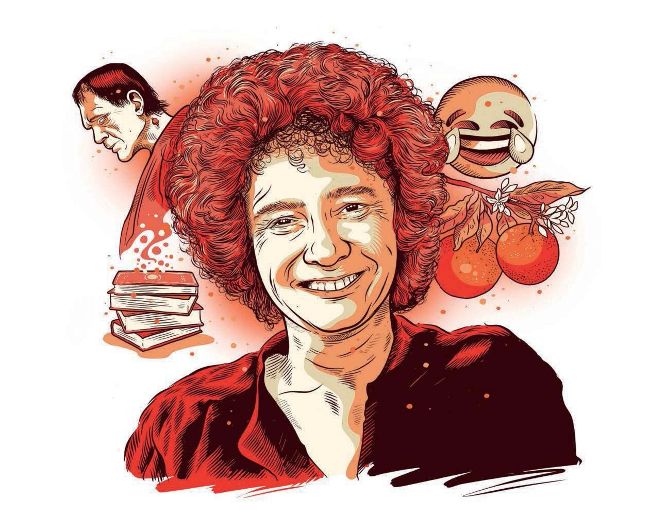
ILLUSTRATION BY TIM MCDONAGH
The world doesn’t yet realise, Jeanette Winterson tells me, that the robots are here— and Artificial Intelligence (AI) is no longer science fiction. Earlier I had mentioned seeing a headline about how Amazon’s Alexa is eavesdropping on its users. “Yeah, it’s really upon us, and people don’t get it,” says Winterson.
“Lots of people haven’t even seen the YouTube videos of Sophia the robot, created by Hanson Robotics.” Sophia is a humanoid apparently capable of 50 facial expressions. “They are astonished when they do see her in person. And they’re not aware of how this new world will change our lives really in a way which will be very hard to turn back. It’s much bigger than anything we’ve seen before.”
Such are the themes investigated in Winterson’s new novel Frankissstein: A Love Story, a dark and playful reanimation of Mary Shelley’s 201-year-old masterpiece. Winterson’s novel explores what she calls “the quintessential story, which is how we relate to one another. Because of the hugeness of our lives and the forces that we can’t manage and the things that happen to us… whether we’re good, whether we’re bad.”
It’s been 34 years since her semi-autobiographical debut novel Oranges Are Not the Only Fruit shook up the literary world, rescuing “gay fiction” (a problematic term we’ll come back to) from the cultish obscurity of bespoke shelves in bookshops in Brighton and Soho, and bringing it into the living rooms of Middle England. Oranges was a fictionalised account of growing up as a lesbian in a northern family of fundamentalist Christians. It won the Whitbread Award for First Novel and was adapted for television by the BBC in 1990—to some controversy over the sex scenes and its portrayal of the Elim Pentecostal Church. Today, though, the novel is a staple on school syllabuses.
Winterson is interested in the possibility— and limits—of transformation. Speaking of our troubled times (Trump, Brexit) she says: “The one thing you can’t change about your life is the time you live in.” She adds: “You can change everything else, including your gender. You can even change the colour of your skin if you’re Michael Jackson. You can movecountry. You can leave everything behind. You can remake yourself continually. But the time that you live in is fixed, and that’s the hand you’re dealt with, and you have to manage it. And ours is turning into the most turbulent and surprising time.”