JUDGES IN THE DOCK
Britain’s courts are more central to politics than ever. But with Boris Johnson seeking to bring them down a peg or two, has the judiciary overplayed its hand?
TOM CLARK AND ALEX DEAN
In mid-October, there was an unusual book launch at the UK Supreme Court. In a crowded room at the top of a grand staircase, leading judges, advocates and legal commentators rubbed shoulders, sipped wine and enjoyed canapés, just as you’d expect. But among them were kids darting around the corridors. For the assembled jurists were not here to celebrate some legal treatise or academic tome but a children’s book. Equal to Everything: Judge Brenda and the Supreme Court by Afua Hirsch tells the story of Lady Hale, the court’s president from 2017 to January 2020, from her childhood in Yorkshire through to the legal profession and eventually the top of the highest court in the land.
Hirsch’s book will have struck a certain type of liberal parent as an ideal Christmas gift, but its real significance was in confirming the arrival of Britain’s first judicial superstar—a judge who is not only known and admired in the legal world, but who cuts a recognisable figure in the wider culture. In the United States, where the Supreme Court has the final say on huge social questions like abortion, there’s no clear line between law and politics. You can buy T-shirts showing the court’s liberal stalwart Ruth Bader Ginsburg with slogans such as “I dissent”—and, yes, a children’s book about “Notorious RBG.” On this side of the Atlantic, by contrast, on the rare occasions when the personality of a judge cuts through to public consciousness, it has normally been because of their archetypal judge-ish-ness—like, say, Jeremiah Harman, who claimed in 1990 that he had no idea what sport England footballer Paul Gascoigne played, and asked if “Gazza” didn’t feature in the title of an operetta. In ordinary times, no judge would have drawn the limelight in the way Hale did. But these are unusual times for the UK judiciary. And away from the cosy atmosphere in the court on that autumn evening, they are frightening times too.
Recent rulings—above all the two so-called “Miller judgments” that punctuated the Brexit saga—have thrust the court and its judges to the centre of the national conversation. After the second of these cases culminated in Boris Johnson’s suspension of parliament being ruled “unlawful, void and of no effect” in September, Hale was suddenly a household name—her spider brooch became a social media icon. The judge did not run for cover, but instead put newspaper headlines about “Spider Woman” on to a PowerPoint slide during an address to a conference, and proudly reclaimed for herself Johnson’s disparaging description of David Cameron— “girly swot.” In late December—while still in post—Hale guest edited the Today programme, and took part in a head-to-head interview alongside Bader Ginsburg.
Although Hale retired as president early this year, the questions this sort of prominence raises for the decade-old Supreme Court and the wider judiciary are bound to weigh heavily on her successor, Lord Reed, her former deputy, and a cautious man whose instinct is likely to be to minimise controversy. Along with his promotion, three new justices will join the court’s bench this year. All will have to reckon with a thorny question: in a democracy, where the ultimate master is supposed to be the people, what should the chief umpire look like?
It is not only populists who worry about top judges stepping too far into the glare; plenty of lawyers and judges we spoke to worry that the Supreme Court has strayed from its proper position in our constitutional landscape. Even Charlie Falconer, the Labour lord chancellor responsible for the creation of the Supreme Court in 2009, told us that Hale “did… overplay her hand” by agreeing to do Today, adding: “I think that it would be better if she had nothing to do with what is the flagship political programme on the radio.” Meanwhile, the former master of the rolls, Lord Dyson, who also overlapped with Hale at the top court, and has previously spoken out against Tory ministers such as Chris Grayling, told Prospect: “maybe I shouldn’t say this but I will. I do think Brenda, who I’m extremely fond of and know very well, I think she’s beginning to see herself as a bit of a media star.” For her to, “while still in post,” start “talking about ‘girly swots,’ it’s not wise…” Lady Hale declined to respond to any of these criticisms.
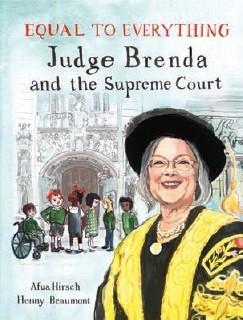
Star of her own story: Lady Hale
Some of the concerns voiced about Hale’s approach are gendered—today’s judges and QCs grew up with an idea of a judge as a man, and simply by being a woman who has worked her way up to the very top, she has done something disruptive.
There are, though, deeper questions to be asked about why Lady Hale—a usually reticent woman, who has confessed to “impostor syndrome”—has become a media favourite. Was it just the constitutional convulsions of Brexit, which should soon pass? Or has the interface between politics and the law become fraught for more enduring reasons? Is the court fated to rule on increasingly political questions, and—if so—can it hope to do so without becoming overtly political? Is it now impossible for the judges to sink back into splendid anonymity?