Passing on the baton
As conductor Marin Alsop shakes up the classical music scene in Vienna, she talks to Suna Erdem about helping other women break the glass ceiling
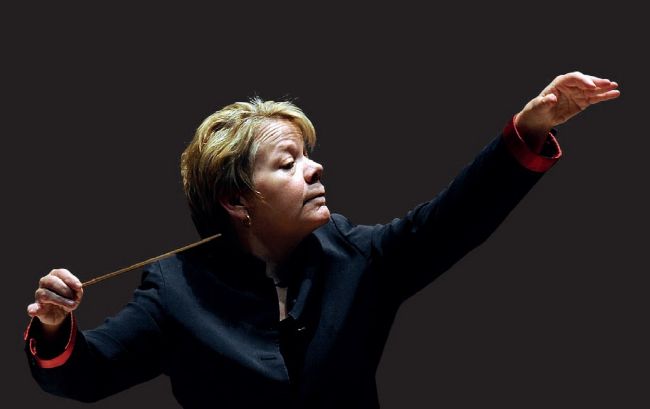
Conducting a revolution: Alsop at work
© ASTRID RIECKEN FOR THE WASHINGTON POST VIA GETTY IMAGES
Marin Alsop raised her hands above her head. “You can’t imagine the conversations that happen up there”, she said, referring to the upper echelons of classical music. “I have musicians who say things like: ‘you know I really think this diversity thing is going to blow over.’” She paused. “Are you kidding me?” She went on to describe how one orchestra she leads objected to her plans to add more women conductors to their concert programme. “One of the musicians said: ‘that’s going to be 13 weeks with women on the podium.’” She shook her head. “Ten of those weeks are with me!”
Alsop was speaking at a panel discussion on gender equality in music in the Joseph Haydn-Saal at Vienna’s University of Performing Arts (MDW). She is something of an expert on the issue. Born in New York in 1956, her parents were professional musicians. Trained by the great Leonard Bernstein, she is the world’s most famous woman conductor— leading institutions in America and Brazil and now Austria— and the first woman to conduct the Last Night of the Proms, in 2013. But her journey has been a long and rocky one. When she told her violin teacher at the age of nine that she wanted to be a conductor, her teacher replied “girls can’t do that”; later she was told by the judge of a conducting competition that women could only conduct light Mozart, not heavy-duty Mahler.
It might come as a surprise that the apparently serene world of symphonies and sonatas is a bastion of macho power play. But that’s exactly the picture that emerges as female musicians have begun to tell of their struggles against discrimination and harassment. The issue goes beyond an old dinosaur claiming that women players are “distracting” or that women conductors are not “my cup of tea.” It is an institutional problem—and one starting to hit the courts. Last year, principal flautist Elizabeth Rowe reached a settlement with the Boston Symphony Orchestra after she claimed she received substantially less pay than her closest male peer.