The green house effect
Can architects solve the climate crisis?
ANDREW DICKSON
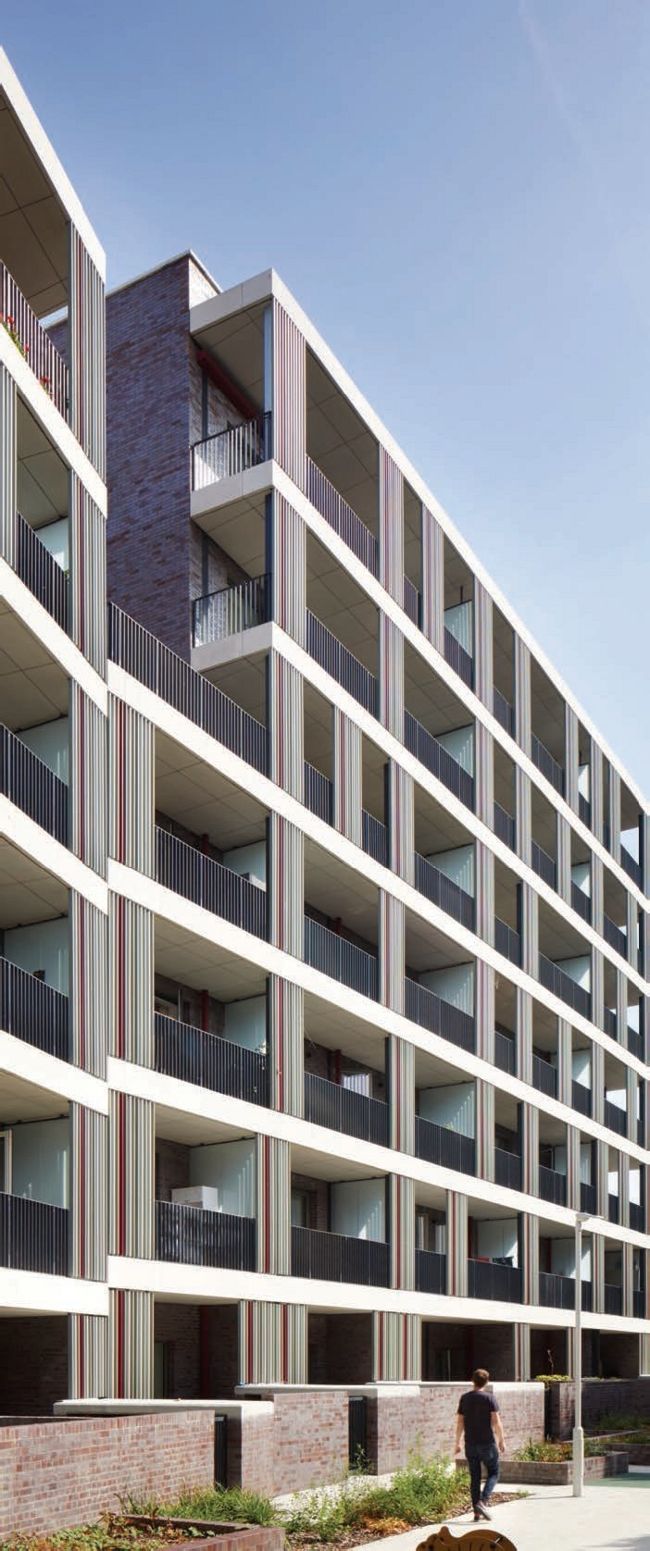
Part of Hawkins\Brown and Architype’s Agar Grove estate in north London. The building’s deep shaded balconies are designed to catch sunlight without overheating
©JACK HOBHOUSE
In May 2019, many of the UK’s leading architecture practices released a statement declaring that humanity was in the midst of a climate emergency, and that architects urgently needed to address the subject. “The twin crises of climate breakdown and biodiversity loss are the most serious issue of our time”, the statement read, responding to the 2018 Intergovernmental Panel on Climate Change (IPCC) report, which declared that humanity had just 12 years before the situation became irreversible.
The group, calling itself “Architects Declare”, published an 11-point manifesto. Its goals ranged from modest ones (minimising construction waste, monitoring energy use) to loftier ambitions such as adopting “regenerative” design and minimising “life-cycle” footprint—from the amount of CO2 it takes to make concrete or quarry stone to the energy expended by demolition. One suggestion, particularly controversial for an industry used to getting rid of old buildings and starting afresh, was that existing structures should be repurposed and retrofitted rather than knocked down.
Initially, 17 firms signed up, among them “starchitects” such as Norman Foster, Richard Rogers, David Chipperfield and the practice founded by the late Zaha Hadid. Within weeks, nearly 500 firms were on board. The Royal Institute of British Architects (Riba) joined, followed by American and Australian firms. In October, the UK’s most prestigious architecture award, the Stirling Prize, went to an unglamorous council house scheme in Norwich built according to a standard known as Passivhaus (literally “Passive House” in German), which encourages ultra-low energy buildings.
One veteran I spoke to couldn’t believe how rapidly things had changed. “For a long time”, she said, “people saw sustainable architecture as bird-watching sanctuaries in Norfolk. Now everyone’s talking about it.”
No one doubts that architects and the construction industry have a lot to answer for. According to the World Green Building Council, the energy required to construct buildings and run them is responsible for nearly 40 per cent of global carbon emissions—far more than all the world’s cars, planes and other vehicles. If the cement industry were a country, it would be the third-largest emitter of CO2 after China and the United States. Concrete, the most widely used human-made material, is astoundingly carbon-intensive—a cubic metre produces enough CO2 to fill a detached house. It is also a so-called “threat multiplier”— worsening flooding, increasing pollution, and smothering biodiversity under a thick crust of grey.
But when the problem is so enormous, where do you start? And given that it often takes years to design buildings, acquire planning permission and construct them—especially in conservation- conscious Britain—the IPCC’s 12-year deadline (which has already fallen to 10) is horrifyingly soon.
For all the bright-eyed idealism of Architects Declare, it hasn’t taken long for accusations to emerge that it is greenwashing or, to borrow an architectural phrase, “reskinning”: reshaping a façade to make a building look more attractive than it is underneath. In November, Zaha Hadid Architects announced that it would be designing a £2.9bn airport in Sydney, a city recently under siege from devastating wildfires. A few days later, Foster + Partners—whose plane-mad founder Norman Foster once declared that his favourite building was the Boeing 747— revealed that it would be building a “sustainable” luxury airport on Saudi Arabia’s Red Sea coast. No irony was apparent.
Part of the problem is that few people agree what “sustainable” architecture actually means. Look up the word in the online design magazine Dezeen and you get a bewildering range of interpretations. The surprise renaissance of an ancient building material called cob (a mixture of soil and straw) is lauded; so too is a luxury hotel in Amsterdam, constructed partly from recycled concrete and with an “intelligent” façade controlling internal temperature. Is a sustainable building one that lives in harmony with its surroundings—local timber, mortar, stone—or one that uses gee-whiz technologies such as solar panels and geothermal heating? Should sustainable buildings aim to be durable, in order to maximise the energy it takes to construct them, or quietly biodegrade once the need for them has passed?