OPERATIONS NEWS
The network’s notable moves
Compiled by Ashley Butlin
Avanti West Coast
HEAVY rain and flooding caused a number of AWC services to be cancelled or terminated mid-way through their journeys on Sunday, July 23. Among the altered services was 1M10, worked by Class 390‘Pendolino’No. 390157, which departed from Glasgow Central at 09.34 bound for London Euston. However, this service only went as far south as Lancaster where it was terminated. The unit later returned to Glasgow as 1Z37, departing from Lancaster at 12.36. It then formed the 1M15 departing from Glasgow at 14.52 for Euston via Birmingham New Street.
West Coast Main Line services were seriously disrupted on Friday, July 28, when Network Rail Stoneblower No. DR80301 working from Crewe PAD to Slateford failed immediately north of Abington Loop. It was rescued by the 4M30/19.07 Grangemouth to Daventry IRFT and pushed into the loop. The rescue train was itself delayed by 70 minutes at Abington while its locomotive was acting as the rescue engine.
As a consequence, the 1S82/16.30 Euston to Glasgow operated by No. 390136 was held at Beattock waiting for the line to clear, while the 9S85/15.16 Euston to Glasgow operated by No. 390039 was held near Lockerbie and the 1S90/17.30 Euston to Glasgow held at Carlisle. Delays of up to 119 minutes were recorded on the Glasgow arrivals.
New Class 805 No. 805002 was delivered from Merchant Park, Newton Aycliffe to Oxley by Class 56 No. 56081 on July 24, followed by No. 805004 hauled by Class 66 No. 66713 on July 31.
Testing of the class continues on a regular basis with No. 805001 running on Tuesday, August 8 from Oxley Depot, Wolverhampton (5Q30/08.08) to Carlisle and back (5Q31/11.51), and again the following day.
LNER
AT 13.45 on July 4, the LNER 1S12 Azuma service from London King’s Cross to Edinburgh was held near Birtley Junction, just south of Newcastle, due to a bridge strike by a lorry. The service resumed at 14.13 after Network Rail engineers inspected the damage. Already running 10 minutes late, arrival at Newcastle was 41 minutes down. Final arrival at Edinburgh was at 15.49, 42 minutes late.
The same journey (from Welwyn North to Edinburgh) was attempted again by our correspondent on July 24 but met with greater disruption due to a fatality at Stevenage. All movements were suspended at 10.00 while the emergency services attended, but although information online indicated services would not resume until 13.00, trains actually began moving around 11.00.
Taking whatever LNER service was available, a change was made at Doncaster for an Edinburgh train but en-route this was terminated at Newcastle due to crew unavailability. The next available LNER train was full and impossible to board, so station staff advised waiting for the following train. This had plenty of seating, and Edinburgh was eventually reached at 17.43, 133 minutes later than planned. It is reported that on Friday, July 14, Azuma No. 800201 ran from Finsbury Park to London Liverpool Street as part of a project to assess feasibility of diverting services during planned disruption or significant engineering works on the operator’s route into King’s Cross. Using diesel power, it left Finsbury Park at 00.27 and ran via Canonbury West Junction onto the North London Line, then to Hackney Wick and passed to the west of Stratford to join the Great Eastern Main Line into Liverpool Street where it arrived at 01.00.
Great Western Railway
CLASS 37 No. 37608 headed north through Flax Bourton on July 26 hauling off-lease set GW11 formed of Nos. 48131+48132+48133+49111 on the 5L46 Plymouth Laira depot to Ely Papworth sidings for storage.
Abellio Scotrail
THE Carmont accident in August 2020 resulted in three fatalities including that of the driver. Following the failure of ScotRail to take action to improve the safety of its HSTs the train drivers’union ASLEF had indicated its drivers were planning to boycott the ScotRail HST sets from the third anniversary of the accident on August 12. Reports indicated that if asked by ASLEF to boycott the ScotRail HSTs, they would all comply. However, it is reported ScotRail has now proposed a form of ‘lifeguard’ to be fitted to the power cars, which is expected to meet ASLEF requirements and those of the drivers it represents. It remains to see if this means the ScotRail HST sets will continue in service for longer.
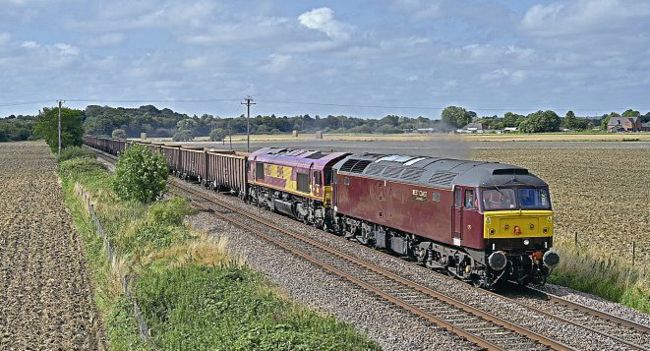
It was WCR to the rescue on August 17 as Type 4 No. 47848 was used to haul DB Cargo’s No. 66183 and the late running 6E64 Ripple Lane to Immingham, which is seen approaching Sanderlings Crossing, Peakirk (north of Peterborough on the GNGE line to Spalding).
JOHN HENNIS
With the threat of the boycott in place, the opportunity was taken by a correspondent to observe and ride on ScotRail Inter7City HST services early in July.
On Wednesday, July 12 two HST sets were noted, from a passing train, at Cadder HST Depot, one top-and-tailed by Nos. 43028 and 43127 and the other by Nos. 43126 and 43168. On the morning of Thursday, July 13, the 1T06/06.53 from Perth was seen arriving at Glasgow Queen Street, headed by No. 43132, with 43130 at the rear. The same set then formed the 1A35/08.41 departure to Aberdeen, on which a journey was made as far as Perth.
Passing Cadder HST Depot Nos. 43028 and 43176 were noted coupled back-to-back, while Nos. 43136 and 43163 top-and-tailed an HST set. The same power cars were noted again in the evening.
Later the same day a journey was made from Aviemore on the 1T88/14.50 from Inverness to Glasgow Queen Street top-and-tailed by Nos. 43177 and 43150.
During the evening the 1T50/15.35 from Aberdeen, formed of Nos. 43134 and 43131 was seen arriving at Glasgow Queen Street. The set then ran empty stock to Cadder HST Depot.
The following day, the 1A35/08.41 from Glasgow Queen Street was used again, this time to Aberdeen, formed of Nos.43127 and 43031. Earlier, the set had arrived at Glasgow Queen Street as the 1T06/06.53 from Perth. Passing Cadder HST Depot Nos. 43136 and 43163 were still present. The ability of the HSTs (and perhaps the slack in the schedule) was shown when having left Stirling on time; arrival at Perth was 13 minutes early. Passing Carmont, a number of sensors were noted from the train. These have presumably been placed to detect any further landslips.