THE HISTORY OF
SCREAMER
THE REIGN OF JAPAN AS THE KING OF ARCADE RACING SEEMED HARD TO CHALLENGE. FROM COIN-OPS TO CONSOLES, IT SEEMED TO ALWAYS BE THE BEST IN THE CATEGORY. BUT SUDDENLY, IN 1995, A NEW CHALLENGER MADE ITS DEBUT: MILESTONE WITH ITS SCREAMER SERIES
WORDS BY DAMIANO GERLI
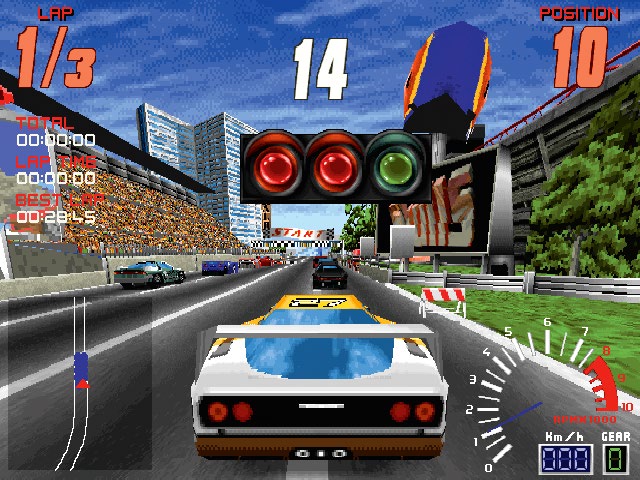
» [PC] Gentlemen, start your engines!

» Antonio Farina started Graffiti (later Milestone) in 1993.

» Ivan Del Duca made C64 games before joining Graffiti.

» Marco Spitoni started at Graffiti as a graphics artist.

» Stefano Lecchi was an early member of Graffiti.
Once upon a time, arcade racing seemed to be very much a genre with a secret recipe which only Japanese developers seemed to have access to. Ever since the Eighties, with classic coin-ops like Pole Position, Out Run and Chase HQ, all the best racers seemed to only come out of Japan. A trend which continued with the jump to 3D and polygonal graphics, thanks to hits like Sega’s Daytona USA and Namco’s Ridge Racer. But by the mid-Nineties, things changed. The new hot series suddenly was Screamer, a newcomer which almost managed to defeat its rivals, at least in the home-computer market.
The first in the series was developed in 1995 by Milan software house Graffiti, a company created by Antonio Farina after leaving his previous job. “Idea Software, where I worked from 1989 to 1992, was not really a software house, rather a single-desk office, mine, where I kept contacts with many developers all over Italy to work on several projects. I acted as a producer while also, sometimes, creating the original ideas for these projects,” remembers Antonio. Indeed, Idea was created by Italian distributor Leader in order to differentiate its market presence, but it did not seem to be a venture it had intention to invest much on. “At the end of 1992,” continues Antonio, “I asked Leader’s management to provide us with more funds, since I wanted to rent a bigger office, and fill it with state-of-the-art computers. My intention was to create an actual studio, like I saw many companies doing all over the world, so that developers could work a nineto-five job. They denied the request, so I had no other choice but to leave.” Idea would close a few months after Antonio’s departure.
In creating this new software house, Antonio’s main objective was competing with the international market. “I was sick of hearing this tired stereotype that a game wasn’t bad, for being made in Italy. We deserved better than that. Either a game was good for everyone all over the world or it just wasn’t.” Instead of resorting to publishing ads in magazines to scout talents, as many other Italian studios used to do at the time, Antonio decided to, instead, directly contact several of the talented programmers and graphic artists he had already worked with. Among the first he phoned up were Ivan Del Duca and Stefano Lecchi.
“I WAS SICK OF HEARING THIS TIRED STEREOTYPE THAT A GAME WASN’T BAD, FOR BEING MADE IN ITALY. WE DESERVED BETTER THAN THAT”
ANTONIO FARINA
Ivan remembers that, in 1993, he already had a bit of a history developing racing games. Together with his friend Antonio Miscellaneo they had worked on a Commodore 64 conversion of top-down racer Warm Up, published by Genias. “As I remember it, Antonio [Farina] called me because he had made a deal with Audiogenic to develop a Super Nintendo game. Since I was familiar with the 6502 architecture of the original Commodore 64, it would have been relatively easy for me to work on Nintendo’s console which shared the same, upgraded, technology.” Stefano, meanwhile, had been working on a 3D engine which would later be used for mech-simulation Iron Assault.