ULTIMATE GUIDE
ROBOCOP
AFTER MAKING MILLIONS AT THE BOX OFFICE, ROBOCOP BECAME A MUST-RENT VIDEOTAPE. OCEAN’S 8-BIT ROBOCOP GAMES WERE RELEASED SIMULTANEOUSLY WITH THE VIDEO, AND HELD THE NUMBER-ONE SPOT ON THE ALL-FORMAT CHART FOR A RECORD 36 WEEKS
WORDS BY RORY MILNE
When Gary Bracey became a director at Ocean Software in 1985, computer-game adaptations of movies were few and far between. With his help, however, Ocean popularised film-to-game adaptations with the likes of Cobra, Top Gun and Platoon. What’s all the more impressive is that Gary would typically assess the potential of forthcoming big-screen attractions purely by reading their scripts. One that caught his eye was Orion Pictures’ RoboCop, a violent slice of gritty sci-fi that he thought had ‘videogame’ written all over it.
Ocean cofounder Jon Woods agreed, and thanks to RoboCop being a relatively low-budget movie his firm was able to secure worldwide videogame rights across all formats for a very reasonable outlay. Of course, given that Ocean was a UK home-computer games publisher, its focus was on developing versions of RoboCop for the popular British micros. It didn’t yet have a presence in the American games market, and it wasn’t involved in arcade development, so an arrangement was made to sub-license the RoboCop coin-op, pinball and certain US computer and console rights to the Japanese arcade developer Data East.
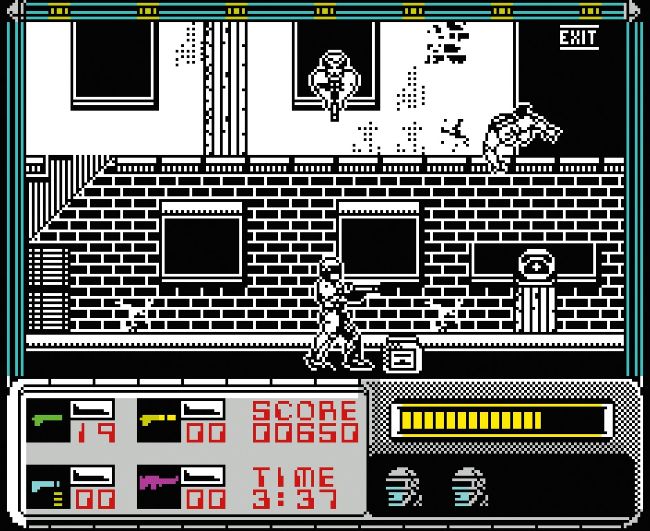
» [ZX Spectrum] In the Spectrum RoboCop you collect jars of baby food to replenish your energy bar.
This unusual arrangement led to Ocean taking an atypical approach when designing its RoboCop titles. Data East’s US operation was a short flight from Hollywood, and it visited the RoboCop movie set to inform the direction it was going to take with its coinop. Ocean, by comparison, had to make do with limited footage shipped over on videotape. Data East clearly had the edge, both in respect of its greater knowledge of the film and in terms of the capabilities of the tech it was designing for, so Ocean decided to use the arcade firm’s coin-op as the basis for its RoboCop computer games.
Hot off of coding a string of popular Z80 arcade conversions for Ocean, Mike Lamb was the obvious choice to design and deliver RoboCop for the ZX Spectrum. Artist Dawn Drake had recently worked with him on Target: Renegade, and Ocean assigned her to create the graphics for his latest project too. But unlike Mike’s previous arcade adaptations, his RoboCop design would only incorporate certain aspects of its coin-op counterpart, while reimagining or dispensing with others, and adding entirely new challenges.