Botryoidal Hematite & Goethite
Exploring New Mexico’s U.S. 60 Mine
STORY BY MARK LEATHERMAN
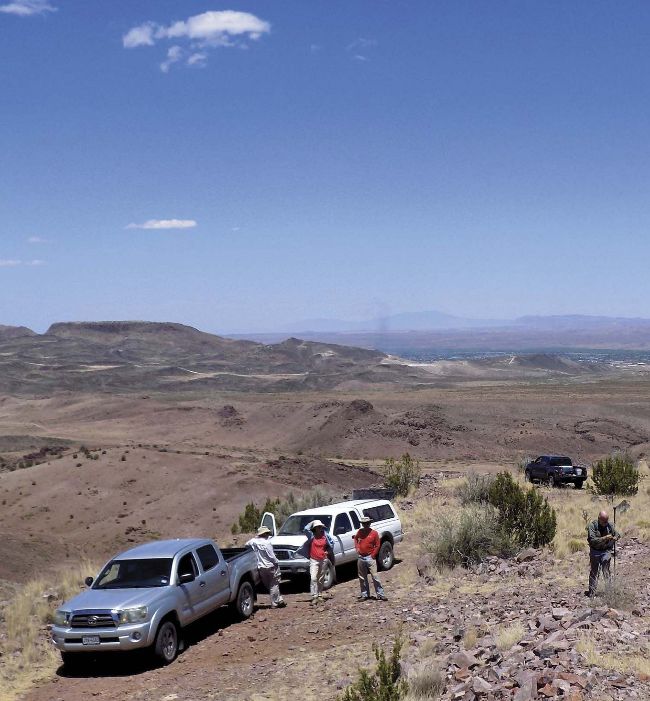
The town of Socorro can be seen in the distance from the elevated pit workings. (MARK LEATHERMAN)
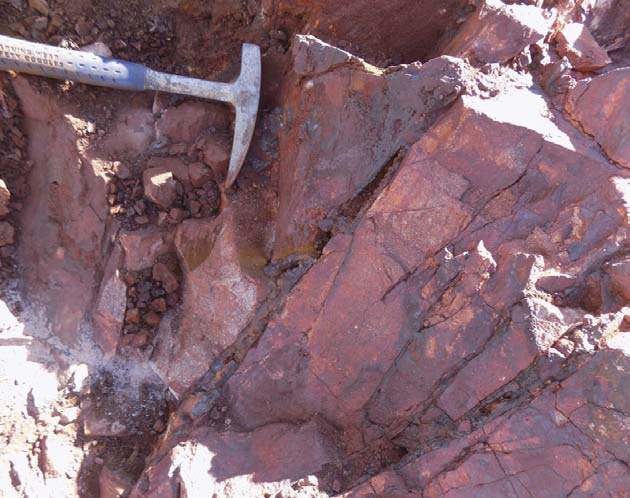
A close-up of a pit wall showing an exposed vein of botryoidal goethite within the large fracture (center of the picture). (MARK LEATHERMAN)
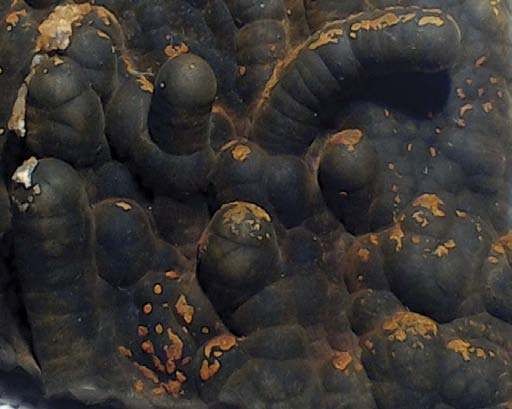
This specimen, owned by Alan Perryman, shows two helictites curving upward in the center of the pic. (ALAN PERRYMAN)
My account of my first major New Mexico rockhounding venture appeared in the November 2017 edition of Rock & Gem.
After that trip of collecting a nice load of smithsonite, blue fluorite, galena, linarite, and much more, I was addicted to all the state has to offer. When Gary Rowe, of the Colorado Mineral Society, put on this exodus again a year later, there was no thought required! Not only was I looking forward to getting underground at the Blanchard Mine again, I was giddy about a place that was new to me: the U.S. 60 Mine west of Socorro, known for its botryoidal hematite and goethite.
The route towards this mine was familiar, as this was the same path to get to the famous Kelly Mine for its smithsonite. Unlike my previous trip, this trek only took around 15 minutes from where we pulled offthe namesake highway to meet the claim owner and well-known Socorro collector, Alan Perryman. After carpooling a short but rough drive up a lofty way, we had arrived at a small but steep workings pit with a significantly bigger tailing pile nearby. Despite the small size, everyone found a comfortable spot and was ready to work hard for the heavy metal treasures. The primary challenge in extracting specimens here is the very hard rhyolite matrix. As such, Alan was kind enough to haul up an electric chisel tied to a portable generator for our group. Although small plate specimens can be won by hand tools, the power tool was a wonder and a ton of fun to use as well. Throughout the course of the day, everyone got in a couple of passes and no one left empty-handed! Another challenge is the inherent nature of this hematite. Not only is it hard, but quite prone to fracturing. I won most of my finds from the upper shelves of the pit, with most plates present below 4”. I also recovered several excellent and thick vug pieces. Although not found on that day, pockets of small hyalite (colorless) opal have also been found.