Hematite
GLOBALLY INFLUENTIAL AND ACCESSIBLE
STORY BY BOB JONES
The iron oxide mineral hematite has an amazing history that began maybe 100,000 years ago, even before ancient cave peoples used its vivid reddish color to render drawings of the animals on cave walls. When crushed to a powder, normally black hematite exhibits a lovely red color. In fact, we use hematite’s red powder streak to identify it.
It seems odd that a normally black mineral has a name based on the Greek word haimatites, which means “blood-like.” But when streaked on a piece of unglazed tile, a reddish streak illustrates the origin of the name. More obvious are the specimens of hematite with a curving ball-like surface, decidedly reddish surface color, and shaped like a human kidney. English miners even took to calling it kidney ore. Ancient cave artists would crush hematite into a red powder and use a straw-like tube to blow it into the porous rock to create artistic images. This same powdered hematite was also smeared on the face and body as “paint” for war and decoration.
Hematite (FeO) is the most common and most important of the several iron oxides. It forms lovely shiny black hexagonal crystals that can be clustered like the petals of a flower. It can also form velvety needle coatings and long curving splintery shapes. In addition, when included with other minerals, hematite’s lovely red color is even more apparent.
When one iron and one oxygen join iron oxide’s composition we call it magnetite (FeO), which develops in the isometric or cubic system. Hematite is hexagonal. Combined with the OH radical, it forms goethite, hydrous iron oxide, and when hematite forms a pseudomorph after magnetite, we call it martite.
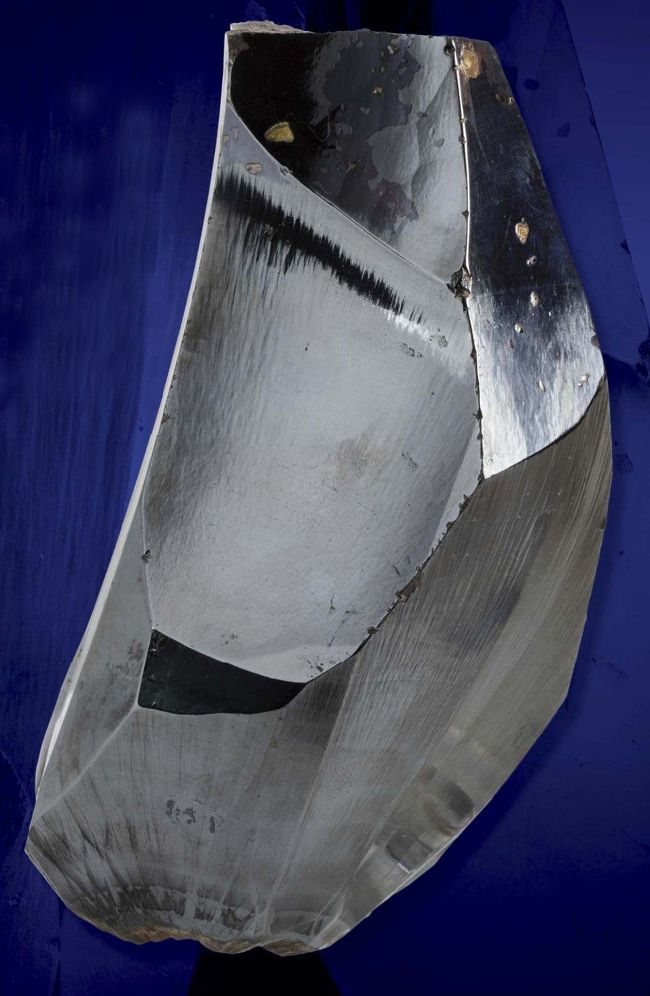
Sculpture piece of hematite in the ‘horsetooth’ style and terminated at both ends, found in Mefis, Morocco. (THE ARKENSTONE,
IROCKS.COM)