Miniatures Conversion
Players are putting their own touch on the worlds of Warhammer and more by crafting custom miniatures at home – and it’s easier than you’d think to get started
Words by James Dyson
GLUE IT YOURSELF THE WORLD OF MINIATURES CONVERSION
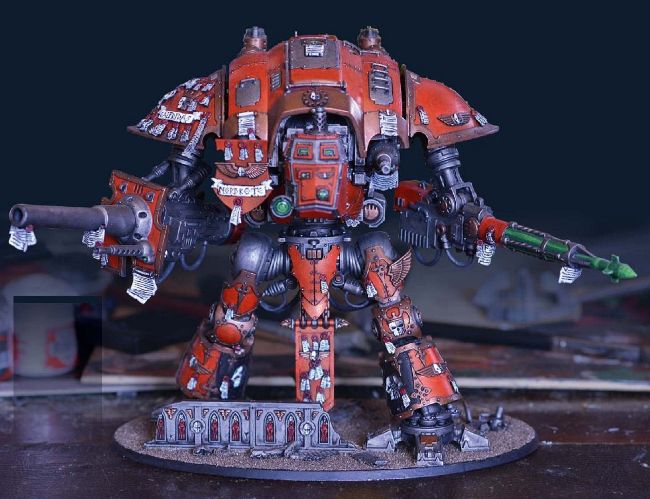
The vast universe of Warhammer 40,000 makes it easy for custom models, like this Imperial Knight, to fit right in
Photographs by Mitey Heroes
There’s a good reason why wargaming in all its guises – Warhammer, Warmachine, Infinity, Kings of War, Bolt Action et al. – is often called a hobby, rather than simply a game. For one thing, unlike many standalone board or card games, rarely is wargaming a simple matter of opening a box, playing what’s inside and putting everything away again. Rather, it’s something that’s planned around, organically expanded and requires an investment of attention that stretches out beyond each individual playthrough. More accurately, it might properly be said that wargaming is really a trinity of three hobbies all rolled into one: the game system itself, painting and modelling. It’s this last one we’ll be looking at here – in particular, the curious world of miniatures conversion.
Talk about converting miniatures cannot help but focus principally on Games Workshop. The obvious reason for this is the company’s size; in an industry as small as the tabletop games space, something with the kind of monopolistic market share that Games Workshop has is bound to influence hobbying trends. However, it’s also because, perhaps more than any other wargame, converting miniatures has always traditionally been an integral part of the game systems.
Most of this comes from the sheer scale of the settings. In both Warhammer Fantasy Battles (the precursor to Age of Sigmar) and Warhammer 40,000, Games Workshop had two fictional worlds of enormous size, covering between them nearly every fantasy and science-fiction trope in the book. As a result, both offered a world (or worlds) where the creators and players alike could envision nearly any scenario or type of army they wanted. To take one concrete example, in Warhammer 40,000, the bulk of humanity’s armed forces are the Imperial Guard (since rebranded as the much more copyright-friendly ‘Astra Militarum’), regiments conscripted from over a million inhabited planets of wildly varying cultures and conditions. With a scope this large, one basically has free rein to create any given aesthetic one cares to imagine – Games Workshop’s own range, for example, has included pith-helmet soldiers straight from colonial-era Britain to steampunky, gas-mask-wearing cossacks in space. With little limit on the imagination, the only thing holding players back from customising their armies to their own whims was the miniatures at their disposal.