FISHING REPORTS
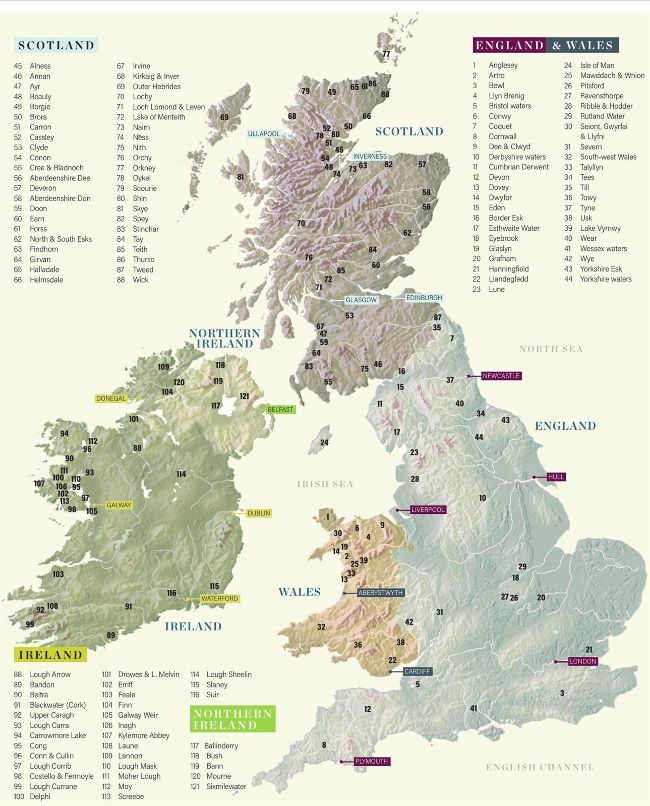
All the latest news from our local experts. The only monthly record of catches and news from the major fisheries of England, Wales, Scotland and Ireland
OPENING PAGE: PETER GATHERCOLE
England & Wales
BORDER ESK
DURING the winter period, the Border Esk and its tributaries had more than their fair share of water, with the riverbed again well scoured out. As I write on March 5, river levels are settled.
The early season focus will be on the lower beats of the river. Burnfoot is always likely to get very early fish given settled conditions, though no salmon have been caught yet. A few well-mended kelts have been caught by the few keen rods that have been out.
Try Burnfoot, Longtown Bridge Fishing, Westalls, and Netherby beats for an early salmon or sea-trout. Areas such as the Willow Pool, Canonbie, and the Lower Liddel are also likely to produce some early fish given water.
By the time this report is read, salmon and sea-trout will be moving into the river, while the Esk tributaries the Liddel and Lyne should see odd fish moving in during May.
– BORDER ROD
BRISTOL WATERS
FISHING opened on Chew Valley Lake for boat anglers on March 6. There was a full fleet on the lake, and plenty of fish were caught. As usual with early season fishing, the areas close to where stocking takes place were the hotspots. Many boats also anchored up in these areas, with anglers wishing to maximise their chances of catching a lot of fish. This did mean, however, that those wishing to stick with traditional drifting had to do quite a lot of manoeuvring.
The best areas were Oak Tree in Heron’s Green – always reliable for the opening few weeks – Woodford and Walley Bank, and then along the eastern side of the fishery. Spring Bay was, as it often is, a good place to start the season. Several boats reported catches of over fifty fish.
Season ticket holders had their special pre-season day on March 4. Anglers reported catching well on Walley, Woodford, and in Heron’s Green Bay. As season-ticket holders may fish both Chew and Blagdon on their tickets, quite a few anglers caught a few at Chew and then headed over to Blagdon – and caught fish there too.
On Blagdon Lake season ticket holders were permitted to fish the banks on March 4. As usual, hot spots were Pegg’s Point and Green Lawn, and anglers were soon into fish at those two areas. Several fishermen made the reverse journey to the Chew anglers by heading over to that lake to see what was happening there.
Boat fishing commences on Thursday, March 13.
– MARTIN COTTIS
CONWY
THE season for trout in the Conwy catchment opened on March 3 and the season for migratory fish does not open until March 17. Unfortunately, I have no fishing to report.
At last, our winter storms appear to have abated, and snowfall has been very light. All anglers in the Conwy catchment area are looking forward to a much better season than last, when, according to information supplied to me, there were only around 25 salmon returned, and I have no accurate figure for sea-trout.
I have had a report from retired NRW Fishery Officer Pierino Algieri regarding the situation with the redds. He counted redds on the upper Lledr on December 4 last year, and on December 7, storm Darragh arrived. He has informed me that the high water levels will have caused some damage to the redds, as it was only three days after the redd count. He did another redd count on the upper Conwy below Pentrefoelas to the confluence of the Conwy, in November and saw fewer redds than usual. He commented that this could be due to the fish pass not working properly or perhaps the fish spawned more towards Ysbyty Ifan, as the Afon Conwy water quality has improved since the ditch blocking on the Migneint, which has resulted in fewer acid flushes and a more constant pH level. He also informed me that the recent NRW juvenile salmonid electrofishing surveys have shown increased numbers of juvenile salmon and trout at the Ysbyty Ifan monitoring site. This could be due to the Migneint ditch-blocking programme, which has possibly reduced the acid spikes that historically occurred after heavy rain flushes from the upland moor.
A meeting was held at the Betws y Coed Memorial Hall on 10 February, arranged by Nathan Owen of NRW and Emily Payne of Dwr Cymru, with representatives from all angling associations in the Conwy catchment area. Emily Payne, River Quality Liaison Manager for Dwr Cymru, gave a very interesting and informative presentation on the water quality in the Conwy, including future investment in several water treatment works along the River. Sarah Aubrey, Senior Environment Officer at NRW, gave a presentation on the work being done in the upper catchment area in partnership with the National Trust to improve the habitat. 16.4 km of fencing had been installed, together with some tree planting on the Afon Machno. The last presentation was by Bregan Brown, Senior Fisheries Environmental Assessment Officer at NRW. He told the meeting that salmonids are declining, while juvenile trout are increasing.
After all the presentations, there was an opportunity for all present to take part in discussions. These included: The focus of NRW is to improve the spawning habitat of the migratory fish; A commitment from NRW and Dwr Cymru (Welsh Water) to work closely with the angling community; discussions on the appetite for the clubs in the Conwy Valley to form an organisation similar to the Conwy Valley Riparian Owners Association. And finally, now that we are halfway into the 10-year catchand-release programme, and salmon stocks do not appear to be improving, will there be any more restrictions introduced? On the latter, it was felt that this would be unlikely, but nothing could be guaranteed.
At the end of the meeting, Nathan Owen said he was pleased to see such a good attendance and thanked everyone for coming. He said that the meetings should continue, and a date and venue would be fixed for the next ones. Garry Davies, Secretary of Plas Madoc Anglers, thanked Nathan, Emily, Sarah, and Bregan for their presentations, as well as all NRW and WW staff who support us on a day-to-day basis and made time to attend the meeting.
– DAVID FOSTER
COQUET
FINAL fish count figures for 2024 (courtesy of the Northumberland Rivers Trust) show a total run of 9,302. Runs to date for 2025 stand at 16 for January.
February once again proved to be fishless on the Northumbrian Anglers Federation waters, despite reasonable fishing pressure on the tidal stretch at Warkworth and some of the areas above. Some well-mended kelts were carefully released. River levels have been low, and this is still the case as I write. Coquet needs a lift of water to entice spring fish in from the North Sea. March should see the first salmon being caught, with the above area likely to produce the first fish of the season.
As I write, we are experiencing some very settled weather, along with temperatures that provide a pleasant environment to fish in. I have not heard of any fish caught on other beats. Spinning is now allowed on certain Northumbrian Anglers Federation beats.
The Federation is offering students and apprentices in the 16-25 age group reduced permits. To qualify, one must be living in Northumberland, Tyne and Wear, or Durham. For more information, contact: info@northumbrian-angler.co.uk.
The brown trout season on the Coquet opens on March 22. Northern spider patterns such as Greenwell’s Glory, March Brown, Black Spider, Black and Peacock Spider, Partridge and Orange, Partridge and Yellow, and Snipe and Purple in sizes 12 and 14 remain popular early-season choices. Goldhead Hare’s Ear and Pheasant Tail Nymphs are also favoured, fished on the point.
Thrunton Trout Fishery produced some excellent sport during late February and early March. Bloodworms and Buzzers proved to be the most consistent fish takers, though strong winds made for unpleasant conditions at times. A well-known Hardy fly-dresser celebrated his 80th birthday with invited friends at his Birthday Competition. Peter McEwan won on the day with a fish of 4.52lb.
Among the big catches was Matty Devine with 20 fish on Long Crag using lures. Simon Shaw caught 29 over two visits using Top Hats and Buzzers. Andrew Keenan released 17 while fishing Apps, Buzzers, and Minnows. Moving into March, David Murray released 15 on Coe Crag using Zonkers. Matty Devine had 14 on lures and Buzzers while fishing Long Crag. The welcome warmer weather enhanced the fishing in early March.
Top flies were Buzzers, Diawl Bachs, Lures, App’s Bloodworms, Dancers, Top Hats, and Nymphs.
The Jack Charlton Disabled Anglers Association is holding its Northumbrian and Cumbrian Trout Cup at Sweethope Loughs on Wednesday August 13.
– DAVID CARRICK
CUMBERLAND DERWENT
AT the time of writing, it really does feel like spring is in the air. After endless chilly days and cold winds, we have a gentle breeze, frogs busy spawning, and daffodils appearing across the Lake District. With opening day for trouting just a few days away, this mild weather has many anglers checking their kit and equipment in readiness. Reports from the lakes tell of a few early-season trout being encountered by pike anglers trolling and lure fishing. The lakes are often a fair bet for an early-season, bigger-thanaverage trout, as we do see some excellent specimens caught, which are always returned by experienced local anglers in the know. It is a pity we don’t see these fish on the surface over the warmer months, as they would provide great sport on the fly.
Elsewhere, the West Cumbria Rivers Trust has been busy with plans for enhanced habitat improvements in several areas of the catchment and, in conjunction with the River Corridors Group, are doing a great job on the whole river.
The recent Derwent Owners AGM was well attended. Mark Hasting, the DOA Chair, highlighted the salmon action conservation plan and encouraged the efforts of all anglers in promoting effective catch-and-release techniques while we continue to do all we can to manage the everpresent avian predators on the river. Overall, the aim is to both increase the numbers of returning salmon and sea-trout while ensuring as many juveniles as possible make it to the sea.
Otherwise, we look forward to the arrival of the first salmon and sea-trout and the longer days and warmth of late spring. Time to tie a few salmon patterns and some Jinglers and Large Dark Olive patterns in readiness for the trout.
– ERIC HOPE
DEE AND CLWYD
AS is usual at this time of year, there are very few rods visiting the river, with an equally low number of fish running. Spinning is not permitted, so conditions must be ideal for the fly if even the most dedicated rods are to be expected to venture forth.
I joined the combined Dee and Gwynedd Local Fisheries Advisory Group meeting last week and was delighted to hear that even Natural Resources Wales is coming to the view that restarting hatcheries is necessary to counter the rapid declines in salmon and sea-trout numbers. It is my belief that the “debate” which led to the closure of the hatcheries was the principal reason anglers and angling clubs ceased to collaborate or even communicate with NRW, as is evident from the current situation. Such was the agreement on this subject that it was decided to hold an intermediate meeting to discuss the issue further. Let’s hope for unanimity!
The North Wales Rivers Trust held its first ticketed-only open day this past week in Bangor. The event was well attended, albeit there was a general lack of awareness that the Trust was started by anglers and that the great majority of board members are also anglers. There was also a lack of understanding about how the Trust operates, which I hope will be addressed when a meeting takes place to clarify matters, hopefully in the near future. I should add that the Trust is supported by funds that it must bid for competitively, and the target areas are not determined by the Trust itself.
I urge you to consider joining either or both of the above: your contributions will be most welcome and highly valued.
I apologise for the brevity of this month’s contribution – it’s that time of year.
– ALLAN CUTHBERT.
DERBYSHIRE WATERS
AN old friend used to say that he never bothered going out with the fly rod until the leaves were on the trees. There is no doubt that once the bankside alders are in leaf, we can expect an explosion of fly life in general and, hopefully, a proliferation of Alder Leaf Beetles in particular. Both the beetle and its larva have a pleasing tendency to drop into the river, where the trout will be waiting. So will I.
Our Derbyshire rivers, including the Cressbrook & Litton day-ticket water on the Wye, open on March 18, although the Peacock Fly Fishing Club and the Chatsworth Derwent wait until April 1. By the time you read this, most of us will have wet a line.
The team at Ladybower has developed an admirable connection with the British Disabled Angling Association and recently supported their SEND Schools Fishing Project. They welcomed the pupils of three schools from Bradford, Chesterfield, and Sheffield to learn about water safety and fish management. The children were shown how to set up fly rods and tie flies, and later in the season, they will be invited back to try their hand at fly fishing for trout with the flies they created.
In other news from the venue, Pete Eville has been appointed to run the fishery and is overseeing a new, increased rearing and stocking policy together with increased boat availability. His objective is to create a superb large water boat fishery, along the lines of Clywedog and Lake of Mentieth.
High pressure brought sunny and calm conditions for Opening Day at Ladybower, a far cry from the snow, rain, and howling winds that usually greet us at the start of the season. I couldn’t fish myself, but I did have a little look around at lunchtime. By that time, it seemed that many anglers must have had their limits and gone home, or to the pub. The banks were deserted, probably because the sun had brought out hordes of tourists from Sheffield and Manchester, making it virtually impossible to find a casual parking spot. The boats seemed to be concentrated in front of the Fishery Office. As you would expect on opening day, some beautiful, hard-fighting fish had been caught, including a 6-pounder by a young lad, despite the bright sunshine. The rod average for opening day was 6.63.
Press Manor Fishery has also been producing good bags for the regulars, averaging 4-6fish per visit. Fish have been close in, between 2-6feet down, with most methods producing, apart from the dry-fly. Best areas have been to the right and left of the boat dock and in the corners of the dam.
During the warm spell at the beginning of March, the jungle drums were telling me that the Large Dark Olives were on the wing, so I was persuaded to end my grayling season on the Derwent Flyfishing Club’s water at Grindleford. A couple of hours one afternoon produced three nice grayling to the Baetis Nymph and a similar number of rises to an Olive Klinkhåmer which proved too fast for me.
PROSPECTS
AS the weather improves, we should start to see an increase in insect activity on our rivers, mainly spring olives, together with that early caddis, the Grannom. My Club water on the upper Wye doesn’t enjoy a particularly good showing of this tempting morsel, but as you go further down the Wye & Derwent catchment, they become more numerous. The Grannom hatch is one of those events where it pays to be aware of the stage of the hatch in order to exploit its potential.
– DAVID MARRIOTT
DEVON
THE first Devon salmon to be reported in 2025 was caught on the Torridge at Madiera on the second morning of the season, March 2. The successful angler was Reg Lawton, who was using a brass tube while the river was still running fairly high. Since then, the rivers have dropped to very fishable levels, but at the time of writing (March 6), there have been no reports of any other catches of salmon in Devon. More settled weather has made it possible for bank clearing parties on a number of rivers to press on with clearing up after the named storms of the past winter. Brown trout fishing opens on Devon rivers on March 15. On the Exe, the last flood resulted in the collapse of Pynes Weir, two miles upstream of Exeter. Ian Cook, who has known this stretch of river for 45 years, observed that this could improve the fishing there and is likely to improve the passage of salmon upriver. Members of the Dulverton Angling Association have continued to catch grayling on the Exe and Haddeo. Although often on the small side, the odd fish up to 14in has been caught. At its recent AGM, the DAA decided to keep membership open, with the annual subscriptions remaining at £35 and £1 for juniors up to the age of 16. Details of membership can be found on the website, www.dulvertonanglingassociation.org.uk.
The past month at The Arundell was very mixed, with a short spell of dry weather when a bit of grayling fishing was just about possible, then several days of extremely heavy rain which put all rivers into full spate yet again and inundated the flood plain. The Tamar peaked at well over 11ft, leaving the ground totally saturated, with very high-water levels which persisted for a long time. The rivers have only now just dropped to a fishable state, so overall grayling fishing has been difficult, if not impossible. The total grayling catch for the last month stands at only 20 fish, a reflection of the difficult conditions. The best grayling was a fish of 15in for Jon Barnard on The Arundell’s Sydenham beats on the Lyd, which took a Duracell nymph. Most grayling came from the Lyd beats, with just a handful from the Ottery. The hotel’s Tinhay Lake has been stocked with excellent quality chalkstream brown trout, which are already doing well. Trimming on the river beats has been largely hampered by high water and very wet ground, but The Arundell team are hard at work and most beats should be in good order for the new trout season. The huge floods have taken down more trees and washed away some ladders, so there is still plenty of work to be done.