SLY & THE FAMILY STONE
TAKE ME HIGHER
It is 1969 and SLY STONE is on the brink of superstardom. Ensconced in his Bel Air mansion, he has begun work on a new album. But surrounded by dealers, groupies and gangsters, it takes over two years to finish the record – during with time the life-affirming utopianism of his music is replaced by darkness, drugs and isolation. Fifty years on, band members recall the turbulent making of a masterpiece: There’s A Riot Goin’ On. “Fame attracts wonderful people,” hears Michaelangelo Matos. “But fame also attracts guns and dogs.”
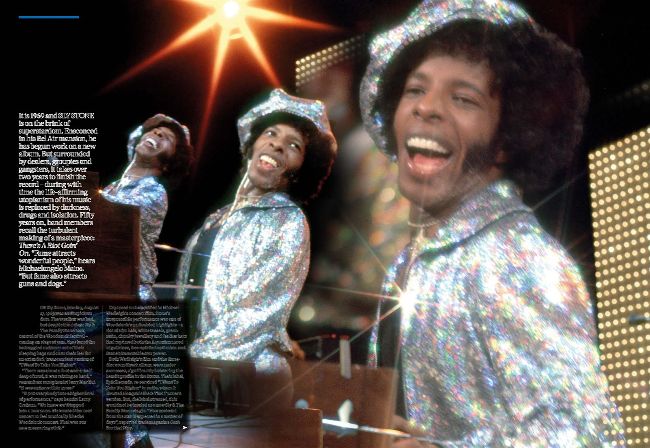
Sly Stone on TV show The Midnight Special, Burbank, California, 1971
MICHAEL OCHS ARCHIVES/GETTY
IMAGES
FOR Sly Stone, Sunday, August 17, 1969 was an auspicious date. The weather was bad, but despite the deluge Sly & The Family Stone took control of the Woodstock festival – coming on stage at 3am, they lured the bedraggled audience out of their sleeping bags and on to their feet for an extended, transcendent version of “I Want To Take You Higher”.
“There was about a foot-and-a-half deep of mud, it was raining so hard,” remembers saxophonist Jerry Martini. “It was an incredible mess.”
“It put everybody into a higher level of performance,” says bassist Larry Graham. “We knew we’d tapped into a new zone. We wanted the next concert to feel musically like the Woodstock concert. That was our new measuring stick.”
Captured and amplified in Michael Wadleigh’s concert film, Stone’s irrepressible performance was one of Woodstock’s undoubted highlights –a riot of afro hair, white tassels, green satin, chunky jewellery and feather hats that captured both the Aquarian mood of guileless, free-spirited optimism and Stone’s immutable star power.
Both Wadleigh’s film and the threedisc soundtrack album were major successes, significantly bolstering the band’s profile in the States. Their label, Epic Records, re-serviced “I Want To Take You Higher” to radio, where it charted alongside Ike & Tina Turner’s version. But, the label stressed, this would not be treated as a new Sly & The Family Stone single. “New material from the star is expected in a matter of days”, reported trade magazine Cash Box that May.
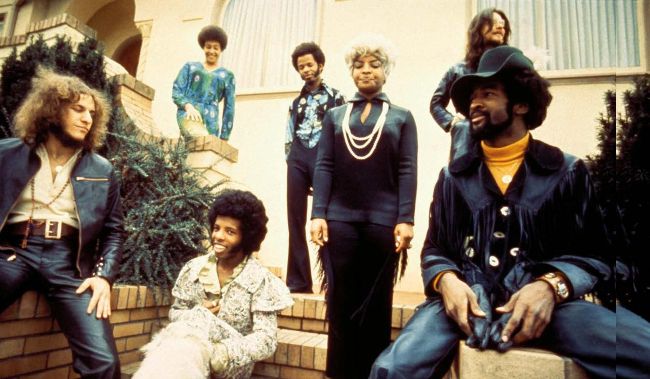
“We would always havea bunch of people around”:
Sly & The Family Stone circa 1971
GAB ARCHIVE/REDFERNS; WARNER BROS/MICHAEL OCHS ARCHIVES/GETTY IMAGES
It was an optimistic statement for an optimistic band. Certainly, after Woodstock, you could be forgiven for thinking that Stone had it all. And then, inexplicably, he began to throw it all away. A further two years followed before Sly & The Family Stone finally emerged with a new album. By which time the mood surrounding the band – and the nation – had darkened considerably. Released in November 1971, There’s A Riot Goin’ On stripped away the joyful, inclusive quality of Stone’s earlier music and replaced it with something more intense and restless. Here is a collection of songs that are neither life-affirming nor are they irrepressible, but rather constructed in a manner that seems both obsessive and haphazard, full of twitchy avant-funk arrangements and awash in a narcoleptic haze. Stone’s most storied album, There’s A Riot Goin’ On documents both the burnout of the hippie dream and Stone’s own disillusionment with his post-Woodstock fame. “I don’t want to say, ‘Look what happened,’” says drummer Greg Errico. “But the challenges being a rock’n’roll star could bring you, whether it be the drugs or all the attention – it felt like it could turn out to be not necessarily a good thing. The price? I don’t know if it was worth it.”