GB
  
You are currently viewing the United Kingdom version of the site.
Would you like to switch to your local site?
20 MIN READ TIME

SHARON VAN ETTEN AND THE ATTACHMENT THEORY

BURNING FROM THE INSIDE

From heartbreak to heroine, journey has been characterised by candour and insight. With her new band to make their debut, this devastatingly intimate songwriter reveals how she found fresh inspiration in collaboration. “How can I keep doing what I’ve been doing, but try new things?” she wonders to Laura Barton SHARON VAN ETTEN’s musical THE ATTACHMENT THEORY set
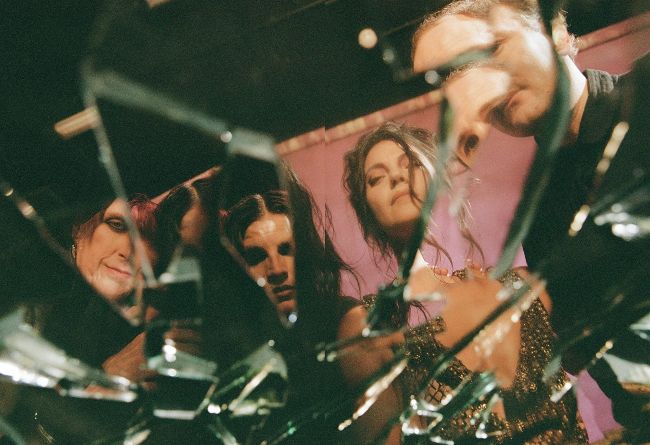
Here’s hoping it’s not seven years’ bad luck: Sharon Van Etten (second right) and her current band
Photo by SUSU LAROCHE

ARK Chapel is a former congregational church on the soft slope of Crouch Hill in north London. Today, one half of the grey stone building is home to Mount Zion Cathedral, part of the Eternal Sacred Order of Cherubim and Seraphim. The other half houses

Church Studios, a recording complex that over several decades has hosted many of the music world’s great dignitaries: Dylan, Adele, U2, Depeche Mode, Annie Lennox, Nick Cave.

On a sweltering day in midsummer, Sharon Van Etten & The Attachment Theory are in the cool of the Church’s main studio, finishing a vocal take. From a small anteroom outside, Van Etten’s voice is just about audible through the glass: a swan-necked, reedy sound, given to sudden flashes of strength and luminosity.

A few minutes later, the singer and her bandmates are clustered around the computer with producer Marta Salogni. They listen back to the morning’s work, each quick with their opinions: where a vocal starts and ends, how a bassline rises. Salogni makes the relevant adjustments. They listen back again.

At this point in the recording process, the songs have acquired a strange tangibility. A couple of days earlier, they had tried out the new material at a secret show at London’s 100 Club, running through nine previously unheard songs and two crowd-pleasers: “Every Time The Sun Comes Up” and “Seventeen”. They wore twinkling goth attire. Van Etten, in tight black trousers and a long-sleeved mesh top, piled her long dark hair atop her head and, for a moment as she faced the crowd, looked elegantly nervous.

The 100 Club show felt a suitable crescendo for their time in London. For the past three weeks, Van Etten and her band have been here at the Church, working diligently. Today, the singer ducks out before the rest of her band – it is the graduation screening of her son’s summer film camp and she is eager to make it across the city. But there is something else in her early departure. This self-titled record is credited to Sharon Van Etten & The Attachment Theory – the songs all written together with the band. Accordingly, the singer is keen to indicate that she is no longer the music’s only focus.

For more than 15 years, Van Etten has occupied a singular place in alternative music, releasing six albums, from 2009’s Because I Was in Love to 2022’s We’ve Been Going About This All Wrong, via 2012’s Aaron Dessner-produced Tramp. Her music is droned and resonant and sinewy, imbued with an emotional heft that has long inspired a level of possessiveness among her fans, many of whom queue for hours after live shows to speak to her at the merch table.

This deep sense of connection undoubtedly stemmed from the confessional nature of Van Etten’s material – she has, for instance, spoken openly about the way her early attempts at a music career were crushed by an abusive partner, about the difficulties of leaving that relationship and beginning again. She has a particular skill for conveying emotional complexity, the nuances of love, the darker feelings.

But even beyond her songs’ lyrical content, the texture of her voice and the skill of her delivery can communicate something similar. “I first heard Sharon’s music from friends in Chicago,” recalls Angel Olsen, who collaborated with Van Etten on the 2021 single “Like I Used To”. “What really struck me was how real it was. Her voice and music wasn’t affected in any way, it was just raw.”

Angel Olsen: “a sisterly connection”
DEVIN OKTAR YALKIN; ANGELA RICCIARDI

The challenge for Van Etten has been to find ways to evolve her sound while still retaining that rawness. To some extent, this has been a cumulative process – the steady labour of growing as a songwriter, gaining ground with the years. Along the way, she has found her voice changed by motherhood, her sound evolved by the discovery of synths. But Van Etten has also made several creative decisions that have sent her music in unexpected directions – writing film scores, studying psychology and mental health counselling, acting in a Netflix series and feature films, as if wilfully aiming to subvert the path of her music career.

To now rethink her approach to songwriting, to throw herself into creative collaboration with a band, is arguably another example of what Van Etten says her husband, manager and former drummer Zeke Hutchins likes to refer to as “the anti-career campaign I constantly run”. But from her own perspective it is a choice that meets the governing question of her career: “How can I keep doing what I’ve been doing, but try new things within that realm?”

A sense of attachment: (c/wise from front) Sharon Van Etten, Devra Hoff, Jorge Balbi and Teeny Lieberson

SPEAKING to Van Etten ahead of the release of Remind Me Tomorrow in 2019, she lit up talking about the joy of singing in a choir in her younger years: “I remember the feeling when we’re all together,” she said.

“There’s no other feeling like that. When you’re all holding the chord and you’re all resonating together.”

That Van Etten should now desire to be “resonating together” with a band was unsurprising in many ways. In recent years she has appeared to take much from the experience of writing with others. Her hit “Seventeen” grew from one of her earliest experiences of co-writing – with a young New York musician named Kate Davis. In Van Etten’s mind, “Seventeen” was something like a Lucinda Williams number. She had the choruses set, a little of the verses, a rough pass of guitar, bass and drums. In many ways, it was not so much the writing session with Davis that changed the nature of the song, but the way she approached the vocal when Van Etten encouraged her to sing – screaming out the lyrics with such gusto she blew her vocal cords. “I just about had a heart attack,” says Van Etten. “It was so good.” She carried Davis’s approach into the finished recording.

The co-writing sessions had largely been intended as a way for Van Etten to mentor younger songwriters, but they gave the singer a valuable new perspective on her own work, too. “I was learning to let go of a song,” she says. “Also, watching somebody younger listen to me and care how I feel, and what my style of writing is, that was another level of seeing change in myself.”

On the road again: Van Etten at the 100 Club, London, July 17, 2024
SUSU LAROCHE

There have been other collaborations, too – contributions to the second Big Red Machine album, Local Natives’ “Lemon”, and a lockdown cover of “(What’s So Funny ’Bout) Peace, Love And Understanding?” with Josh Homme.

It was while Van Etten and Olsen were working on a cover of “Femme Fatale” for a Velvet Underground & Nico tribute album that the idea to write together came up. “Sharon and I have very different approaches to music but we share a lot in common too,” says Olsen. “Over the years I’ve just felt a very sisterly connection with her, creatively and personally.” The idea of exploring those musical differences and that connection intrigued them both.

Van Etten took the lead, sending the backbone melody and lyrics to Olsen. “I was immediately lured in,” she says. “We went back and forth with lyrics morphing over email.” Olsen felt her scope was widened by the experience, by the realisation that two songwriters can hear the same thing so differently. “I think she can be really inspired and motivated by a beat or rhythm, or at least that’s one way things can begin. I’ve never done things that way, but it really can bring energy into the room right away.”

IN the muddy post-pandemic days, Van Etten assembled a band ahead of touring We’ve Been Going About This All Wrong. Bassist Devra Hoff had been a mainstay since 2018, while drummer Jorge Balbi joined the following year. This time, there was a new addition to the lineup: Teeny Lieberson, formerly of Teen and Here We Go Magic. “She just wrote me a DM on Instagram,” Lieberson recalls. “I was at my friend’s house, at a barbecue, and I was like, ‘Guys, I just got this really cool message!’”

We are speaking via Zoom, the day after the US election, and the members of The Attachment Theory, variously stationed in LA, Nova Scotia and New Jersey, appear to be reeling. When Van Etten joins us, sitting in her home garage studio,her face looks pale and bewildered across the screen. We talk about the news, but after a while it feels more hopeful to talk about music.

SHARON FRUIT

Three SVE albums that lead to the new one

TRAMP

JAGJAGUWAR, 2012 Working with The National’s Aaron Dessner, and summoning collaborators from Wye Oak’s Jenn Wasner to Beirut’s Zach Condon, Van Etten pushed the boundaries of Americana and her own songwriting on her third record. The songs seemed dark intimations, carried on organic instrumentation that grew propulsive and drone-like. 8/10

ARE WE THERE

JAGJAGUWAR, 2014 Van Etten’s gift for heart-swelling and anthemic songwriting flourished on her fourth album, which included fan favourites “Every Time The Sun Comes Up” and “Afraid Of Nothing”. To match these new dynamics, the range of her voice also seemed to grow more pronounced, finding increasing light and shade and new angles across its 11 tracks. 10/10

REMIND ME TOMORROW

JAGJAGUWAR, 2019 In the late 2010s, Van Etten was sharing a practice space with the actor Michael Cera and his large collection of synths. It was through experimenting on his Roland Jupiter 4 that she began to write the songs for her fifth LP, ushering in a new sonic era for Van Etten. The Attachment Theory’s first record ventures even further into the possibilities of synths and electronica. 9/10

For Van Etten, the sense of distance still left by lockdown meant she was keen for rehearsals to reforge the bond of a touring band. “I felt: why not make it more humane and communal and rent a house that had a detached studio and a couple of trailers,” she says. “We would wake up, have breakfast, go into the studio and workshop songs and how to create them live; break for lunch, check in with our families or whatever, and then go back into the studio and work on the songs. And then stop at dinner, have dinner, watch a movie together.”

The band worked this way for a solid week. “It was the last day, we had done all the songs and I felt really happy with where we were,” Van Etten says. “I was really excited by the instrumentation that we were all honing for that record, so I asked everyone’s permission if we could pause from that and just jam.” She looks amused. “Never in my wildest imagination would I ever think that would be something coming out of my mouth.”

“I hate even saying the word,” she continues. “I’ve never played in that way. I’ve always written the song, and then for the instrumentation, I communicate my ideas and other people play them.” It was an approach that had previously satisfied Van Etten, but lately she had begun to wonder what it might be like to collaborate in real time with her band. “I started solo because I was afraid to have a band!” she says. “It had been one of my biggest fears, because I always feel inadequate because I wasn’t trained, I don’t know keys, I’m not a shredder. But I just felt in such a safe space with everything that we were playing together, that I was curious what we would make.” In just a couple of hours, they wrote “I Can’t Imagine” and “Southern Life”. “It was so immediate and so natural, I just remember thinking: OK, I think this is what’s next,” Van Etten says. “But we have a tour to do!”

On tour, Van Etten gradually began to introduce the idea of writing and recording a record together. There were further writing sessions in Joshua Tree and Los Angeles. “It was really concise and coherent,” remembers Hoff. “Instead of jamming we were really just writing songs. For me, that’s the interesting thing – how that flow started and then how it evolved. This record is less than half of what we’ve written together. So I’m kind of like, ‘What happens if we do it again?’”

All the band members have their own projects – Hoff’s third solo album Solve, Coagula is released this January; Balbi works as an engineer; Lieberson’s solo release as Lou Tides arrives in the spring. They all also have their own individual relationships with Van Etten’s music.

Hoff remembers how taken she was by Tramp, describing the new record as connecting the threads between that album and Remind Me Tomorrow – the organic qualities of the former meeting the more structured electronica of the latter. Balbi recalls hearing “Every Time the Sun Comes Up” playing on his car radio and feeling so struck by the song he had to pull over to listen. Growing up in Peru, the drummer had listened largely to British bands – The Cure, New Order, Joy Division, Cocteau Twins. “And even though there’s some deep roots in Americana in Sharon’s music, she had this flavour of that. It was raw, it was dark, it had this emotion that reminded me of things that I love, especially PJ Harvey.”

For Lieberson, who had long known and loved Van Etten’s music, the rehearsals and jamming sessions were particularly insightful. “I was coming around to understanding Sharon’s style of songwriting,” she says. “It’s a little hard to explain outside of dorky musical terms, but I feel there’s something about the way that Sharon writes cyclically, or the sense of where she moves harmonically that I understand, and it feels natural to me even if I don’t know the songs.”

As they worked, they developed something of a structural pattern. “Most of the time the songs started with Devra with a bassline and then I joined in with a beat,” says Balbi. “It was like, ‘Oh, that’s the bassline I hadn’t heard but I want to hear, and that’s the beat that will go with it.’” It felt automatic and instinctive. “Then Sharon would start playing some beautiful chords and trying to make sense of a progression,” he continues. Slow down, she would tell them, let’s find a chorus. “And then eventually she would say, ‘I’m going to go to the other room and write the lyrics.’ I was like, ‘How can you do this so fast?!’ That was kind of an incredible discovery for me. And already such deep things. The words were already great.”

Writing in this way, among her bandmates, also allowed Van Etten to view her lyric writing afresh. Shapes and sounds and ideas emerging, their meaning shifting over time. “It always tends to come from a deep emotional place that I don’t always have the words for,” she says. “Even the more meditative songs like ‘Fading Beauty’ are kind of exploratory: as the words are coming out I’m discovering what I’m feeling as I’m hearing myself. I don’t always know how to explain that feeling. At the time, ‘Fading Beauty’ was about my father-in-law, then it was about my parents and then about being a mom.” She describes the difficult caring responsibilities of the sandwich generation.

“She makes her songs feel universal and ingrained”: golden girl Van Etten
SUSU LAROCHE; FRANCESCO PRANDONI/GETTY IMAGES

“IT TENDS TO COME FROM A PLACE I DON’T ALWAYS HAVE WORDS FOR”

SHARON VAN ETTEN

“I didn’t realise I was holding that inside,” she says. “I tend to express what I’m feeling even though I don’t know I’m feeling that. Then I’m confronted by the subject matter as I’m putting the mirror up to myself.”

Producer Marta Salogni: already a fan

MARTA Salogni was in California working on a Depeche Mode record when she received a last-minute invitation to a wedding. At the reception dinner, she found herself seated opposite Van Etten, and during the conversation told her about a trip she had taken to an LA delicatessen frequented by Brian Wilson. “I thought, ‘I’m going to have a banana split and if he’s there, great. If not, I’m going to leave $30 behind the counter and a little note saying, ‘Thank you for all you’ve done for me, please have an ice cream on me.’” Van Etten was charmed. The pair stayed in touch, and sometime later the singer asked Salogni if she might send her some demos. The producer was already a Van Etten fan. “I think she’s one of the finest voices I’ve encountered,” she says. “She has a beautiful sensibility to melody and elegant songwriting; she makes her songs feel universal and ingrained.” When the demos arrived, Salogni listened immediately. “Oh my God, these are amazing,” she thought. “Fully formed songs. Anthems already.”

She was in Germany, driving in the Black Forest, through the pitch dark. She remembers particularly listening to the track “Trouble”, feeling that something in the music seemed to match her surroundings. “I thought, ‘I can’t wait to deconstruct it and reconstruct it.’ It’s a delicate balance to the percussive elements that gives it that groove. It was the reverb coming in at the drum beats, to open it up and close it down again to give it this push-and-pull feeling within the beat. And that’s what’s expressed in the lyrics. That duality.”

With “the right people” to explore a more synth-driven sound

“Producer roles are so interesting to me,” Van Etten says. “What I loved about Marta is that she asked me my goals going into it and this being the big objective of it being a band record and that we’re all making it together, we’re producing it together and I didn’t want to lose sight of that.” Salogni suggested The Church – the producer is based in London and knew that the studio was the best place to capture the live band sound they wanted. Van Etten was intrigued by the idea. “I’d never recorded overseas,” she says. “I knew that I wanted to leave my comfort zone for this record. “The history of The Church is a big reason I wanted to work there, too,” she adds. “To conjure those spirits and that energy. Annie Lennox is one of my favourite singers and performers, so I really liked that attitude that that brought to it. And a lot of our influences are from the UK.”

Although they cite a flurry of influences, from Siouxsie Sioux to Nine Inch Nails via, somewhat unexpectedly, musical theatre star Elaine Stritch, the band describe the Venn diagram of their tastes as Kate Bush, PJ Harvey, Cocteau Twins and The Cure.

“I love how a lot of music of the [early ’80s], the synthesisers really bring a different flavour to the songwriting,” says Lieberson. “It can still be tough, while also being a lot more expansive. So I was thinking about that as far as my approach to the songs. How to dress up the music a little bit is always what I’m trying to do.”

Overlapping influences: Kate Bush, PJ Harvey, Cocteau Twins, The Cure

She points out that several songs begin with an arpeggiator. “I think Sharon and I both enjoy sounds that are beautiful,” she continues. “I know this is true for Devra and Jorge as well. It’s beautiful, but it also has to have a toughness to it. So I think synths are pretty good at doing that, and if you have an arpeggiator it can go from being sharp and angular into something wide and expansive while still playing the same melody.”

Van Etten is aware that those drawn to the more skeletal early albums might be surprised by her move towards synth-driven music in recent years. “As I’ve developed my sound I know there are some fans that are freaked out, or they’re like, ‘Where is this coming from?’” she says. “But I’ve always loved this kind of music, I just wanted to come from a place where I knew I could do it, honestly. I finally got to this place where I just felt like I had the right people around me to feel confident, to throw paint at the wall.”

THERE was a long list of band names, says Van Etten. “The art of finding a band name is really tricky because you want it to describe you as people, you want it to describe you as a sound. It’s also like, how tough you want it to be, how soft you want it to be? Everyone has different feelings and you start analysing it to death.”

A BUYER’S GUIDE TO THE ATTACHMENT THEORY

DEVRA HOFF DEVIN HOFF – VOICES FROM THE EMPTY MOOR 2021

Bassist and composer Hoff’s solo debut (recorded as Devin Hoff) was cited by Laurie Anderson as one of her favourite albums of all time. This extraordinary follow-up explores the work of Anne Briggs. Acoustic, bass-heavy, there are guest turns from Julia Holter, Jim White, Emmett Kelly and Van Etten.

JORGE BALBI PAULINA RUBIO – GRAN CITY POP 2009

As a drummer and mixer, Balbi has worked with everyone from Olivia Rodrigo to Harper Simon. This record by Mexican superstar Paulina Rubio was nominated for a Best Latin Pop Album at the Grammys, marrying a striking number of styles, from electropop to ranchera and hip-hop.

TEENY LIEBERSON TEEN – THE WAY AND COLOR 2014

The group Lieberson formed with her two sisters (and various friends) released four albums before disbanding in 2019. The Way And Color, their second record, feels their most fully realised – a sleek, sensual R&B pop realm that showcases Lieberson’s remarkable voice.

The Attachment Theory quickly felt right. “The way it sounds, the way it looks, the energy of it, because it’s very open to interpretation, but it still has some connectivity to it,” she explains. “For me, the main idea was that we all come from different places, different backgrounds, other projects and different family styles, different parts of the world. And somehow the universe brought us all together to make music. Somehow we found each other. Regardless of where we came from, we’re meeting in this place.”

It is easy of course to connect the name to Van Etten’s interest in psychology. She still speaks of songwriting in therapeutic terms: “It’s just to be able to express it and share it and try to phrase it in a way where it feels relatable to other people,” she says. “I think that is my job but I always feel a sense of release.” Her decision to study the subject some years ago was prompted by those long queues at the merch table, by the intensity of the conversations with fans, by feeling she was not qualified or equipped for those connections.

“For my own wellbeing I haven’t gone to the table in a while,” she says now. “Which I hate for many reasons, but I think the human part of me is like I can’t do that any more.” It is also, she says, the realisation that she has a responsibility to her family, her band members, her crew. “We have to show up every day and do a good job and be present for everyone,” she says. “If I exhaust myself in situations then I feel like I won’t be able to be present enough and be able to meet everybody equally on stage. But I hope fans know that I still care and I still write in the same way and share ideas in the same way and still hope people find support through what we choose to write about. But for me, this creative juncture is more about honing my friendship and my creative relationship with the band.”

SUSU LAROCHE; GETTY IMAGES

Sharon Van Etten & The Attachment Theory is released on February 7 by Jagjaguwar

Unlock more great articles with
You can enjoy:
Enjoy this edition in full
Instant access to 750+ titles
Thousands of back issues
No contract or commitment
Try for 99p
SUBSCRIBE NOW
30 day trial, then just £9.99 / month. Cancel anytime. New subscribers only.


Learn more
Pocketmags Plus
Pocketmags Plus

This article is from...


View Issues
Uncut
Feb-25
VIEW IN STORE

Other Articles in this Issue


In This Issue
UNCUT
FEBRUARY 2025 TAKE 335
Got back!
THIS MONTH’S REVELATIONS FROM THE WORLD OF WITH...
Pop hits in heaven
Giving you The Chills: the singular legacy of NZ indie legend Martin Phillipps
“It’s just songs I like to sing”
Southern soul star Candi Staton on country music, champagne and covering The Rolling Stones
A Quick One
Every step they took, we were watching them.
Just a shutter way
New photos emerge from the archive of Rolling Stones fixer, Spanish Tony
Ticket to Ryde
Meet Echolalia: the new Nashville supergroup getting it together on the Isle Of Wight
Greg Mendez
I’M NEW HERE
Uncut Playlist
On the stereo this month...
Take A Load Off
15 tracks of the month’s best music
AN AUDIENCE WITH... GARY KEMP
The Spandau Ballet songwriter turned Saucerful Of Secrets frontman talks Soho, Black Midi, Ronnie Kray and kilts
Introducing... Bad Touch
A new series in partnership with Marashall
Norwich
Bad Touch sing the praises of the city’s busy live scene
CHRIS ECKMAN
THE UNCUT GUIDE TO THIS MONTH’S KEY RELEASES
ESSENTIAL ECKMAN
Three highlights from a singular Americana voice
Q&A
Chris Eckman: “A sense of place has always been part of my songwriting”
BONNIE “PRINCE” BILLY
The Purple Bird DOMINO
AtoZ
This month…
YAZZ AHMED
A Paradise In The Hold NIGHT TIME STORIES
Q&A
Yazz Ahmed: “You can hear everyone laughing and joking”
JIM GHEDI
REVELATIONS
AMERICANA
Album of the month
SONGHOY BLUES
Héritage TRANSGRESSIVE
Q&A
Garba Touré: “Exile still animates me”
THE DELINES
The Delines: a knife-edge performance Mr Luck &
Q&A
Willy Vlautin: “Desperation is steeped into the lyrics”
KEVIN FIGES & JULIE TIPPETTS
Figes and Tippetts: revelling in creative curiosity Happy
Q&A
Kevin Figes: “The sense of play is hugely important”
JEAN CLAUDE VANNIER
REVELATIONS
Archive
LOTTI GOLDEN
GOLDEN WONDERS
Three more lucky Lotti winners
Q&A
Lotti Golden: “It’s large and it’s bold and it’s unapologetic”
TELEVISION PERSONALITIES
Tune In, Turn On, Drop Out: Radio Sessions 1980-1993
Q&A
Jeff Bloom : “We treated it as a gig and that’s what I love”
AtoZ
This month…
BRIDES OF FUNK ENSTEIN
REDISCOVERED
DOUG SAHM & THE SIR DOUGLAS QUINTET
The Complete Mercury Recordings FLOATING WORLD
THE SPECIALIST
VERONIQUE CHALOT J’ai Vu Le Loup/ A
Chords of pure delight
After a rollercoaster decade, the stars finally seem to have aligned for New Zealand singer-songwriter NADIA REID. As she prepares to release her fourth album, Enter Now Brightness, she explains how magic, motherhood and Manchester have fed into her boldest work yet. “The whole thing’s been mad,” she tells Stephen Troussé
REBEL SOULS
Championed by Bob Marley and lauded by early punk audiences, ASWAD were UK roots reggae pioneers, battling prejudice to share their message of antiracism, Rastafarianism and community. Here, band members past and present chart their rise from the Jamaican music scene in west London to the brink of stardom, via cameos from Peter Tosh, Burning Spear and Eddie And The Hot Rods. “We weren’t out to make pop records,” co-founder Brinsley Forde tells Peter Watts. “We wanted to fight for what we believed was right.”
TYRANNY AND MUTATIÖNS!
From hippie communal living to sold-out arena tours via heavy licks and eldritch mythologies, Patti Smith, Death, Godzilla, capes and an umlaut, one of ’70s rock’s biggest – and strangest – bands. BLUE ÖYSTER CULT were “We had no concept of being commercial,” learns Peter Watts. “We didn’t know what we were doing except pouring our hearts out.”
Sean O’Hagan
Career highlights from Microdisney to the High Llamas via Stereolab and (almost) the Beach Boys
A PERFECT STORM
Before Urban Hymns briefly made them the biggest band in Britain, The Verve summoned some of the most rapturous rock music of the ’90s, fuelled by a prodigious diet of booze, drugs, Rosicrucianism, home-delivered lasagne and lashings of self-belief. Luckily, they lived to tell the tale. “We wanted that rock’n’roll life,” hears Sam Richards. “It was all that mattered.”
“A new kind of rock’n’roll”
Together, ROBBIE ROBERTSON,RICK DANKO, GARTH HUDSON, RICHARD MANUEL and LEVON HELM forged a vision of American music, one steeped in its rich cultural history, and whose profound and far-reaching influence can still be felt today. Fifty years on from the release of The Basement Tapes, Uncut invites compatriots, aficionados and heads – including JASON ISBELL, RICHARD THOMPSON, LUCINDA WILLIAMS, ELVIS COSTELLO, VAN MORRISON, MARGO PRICE and STURGILL SIMPSON – to celebrate THE 30 GREATEST SONGS OF THE BAND
MARK LANEGAN: A CELEBRATION
Roundhouse, London, December 5
WE JAZZ FESTIVAL
Helsinki, November 28-30
SCREEN
A Greenwich Village-era Dylan biopic; anger issues in the London suburbs; a real-time restaging of the first Saturday Night Live…
THE YARDBIRDS: IN THEIR OWN WORDS SKY ARTS/NOW TV
7/10
BOOKS
THERE is a ghost in David Browne’s history
The pick of the latest hi-fi upgrades
CAMBRIDGE AUDIO EVO ONE Price: £1,299 THE Evo
Not Fade Away
Fondly remembered this month...
Feedback
Send your brickbats, bouquets, reminiscences, textual critiques, billets-doux and all forms of printable correspondence to letters@uncut.co.uk
Crossword
One LP copy of Chris Eckman’s The Land
Eddie Chacon
The second-chance soulman on the records that bring him pleasure, joy and happiness: “I learned that imperfections can be beautiful”
Musthead
“Question”
Their dual-speed No 2 hit thrilled festival crowds
UNCUT
Kelsey Media, The Granary Downs Court, Yalding Hill,
Chat
X
Pocketmags Support