ALBUM BY ALBUM
Sean O’Hagan
Career highlights from Microdisney to the High Llamas via Stereolab and (almost) the Beach Boys
SEAN O’Hagan enjoys looking back, if only for the unique perspective it provides. “You always hate the music that you made 10 years after you made it – ‘Oh, what was I doing?!’ But it’s really nice when you live to be 30 or 40 years older than it, because that’s when you really appreciate what was going on. At the time it’s purely instinctive.”
The singer, songwriter, composer and arranger is talking to Uncut about the highlights of his career, from his early work with Microdisney to creative breakthroughs with Stereolab and The High Llamas, and even the record he was supposed to write and produce for The Beach Boys.
As we talk, he’s in his music room at home in Peckham, surrounded by a host of instruments: nylon-stringed guitars, a Danelectro electric, a Korg Minilogue synth, a Juno 6 keyboard, a Wurlitzer and even a rare Vox dual-manual organ he’s thinking of selling.
“I’m not really into gear,” he explains, “and I don’t use the Vox as much as I should. It’s worth a lot of money, and I’m a big believer in selling stuff so you can make other stuff. I remember touring with all this vintage gear, and every three days you’d be soldering…”
TOM PINNOCK
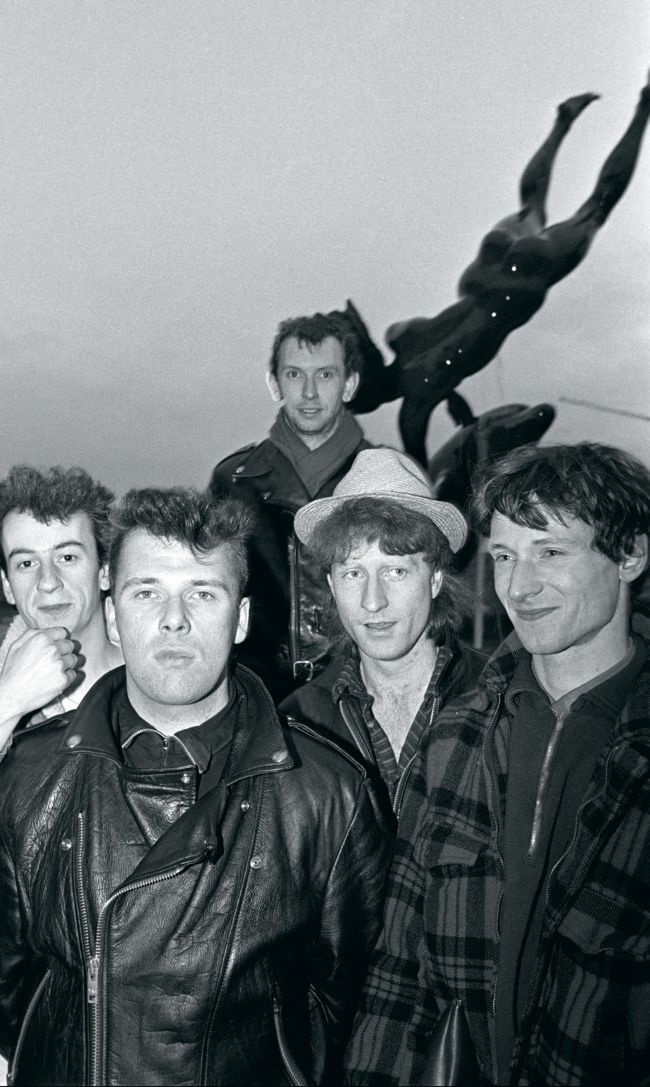
Small victories: Microdisney at St Katherine’s Dock, London, March 26, 1987 (O’Hagan second right)
DAVID CORIO/REDFERNS
MICRODISNEY THE CLOCK COMES DOWN THE STAIRS
ROUGH TRADE, 1985
The second LP by O’Hagan and Cathal Coughlan’s group, which hit No 1 on the UK Indie Chart
Everything I did in music, and in the way I live my life, would have been absolutely impossible if I hadn’t met Cathal. We met on New Year’s Eve 1980 and the next 10 years we spent together, really. In Cork, I was opened up to culture and art, because working classes and the middle classes mix a lot in Ireland and ideas are exchanged. Cathal was the only other person who I met who knew who, like, the Gang Of Four or Scritti Politti were. His desire to work with words and work with ideas matched my desire to somehow get myself involved in music, because I was just working in a food factory at the time. I could play and I had ideas, but I had no direction, and Cathal provided the confidence and the direction, so massively important. Some of the backing tracks for this were done in Hoxton Square in London, and then we went into Jamie Lane’s studio in Balham. People weren’t making records like that in 1985 – the indie bands were quite jangly and quite messy, and we were making this
slightly shiny pop which had elements of The Beach Boys, and elements of Scott Walker: we were making these songs with really tight harmonies and quite intricate little guitar parts. It was very exciting, because the ideas just raced along. We were writing quite ambitiously, mainly because of Cathal’s great grasp of iconoclastic things. It was slightly uncharted – even though we were making very listenable pop music, it was, for its time, a real shapeshifter. But Microdisney weren’t successful at all – most people just didn’t understand. We just confused the bejesus out of everybody.