General Interest


Free Sample Issue
Try a FREE sample of Astronomy Now
Try a FREE sample

Astronomy Now Magazine

12 issues per year   |  English
0 Reviews   •  English   •   General Interest (Astronomy)
From $2.58 per issue
The wonders of the Universe explained for everyone to understand.
read more read less
Astronomy Now Preview Pages Astronomy Now Preview Pages Astronomy Now Preview Pages Astronomy Now Preview Pages Astronomy Now Preview Pages Astronomy Now Preview Pages Astronomy Now Preview Pages Astronomy Now Preview Pages

Astronomy Now

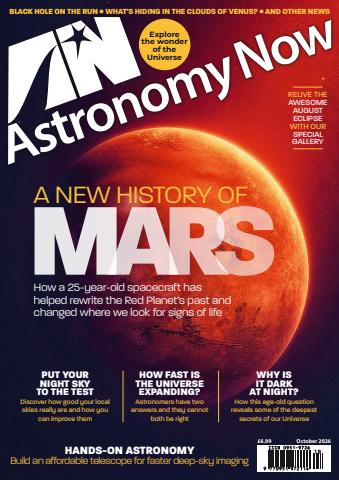
August 2026 The August 2026 issue of Astronomy Now is led by the biggest UK solar-eclipse event for many years. On 12 August, a deep partial eclipse of the Sun crosses the country, with much of the UK seeing around 90 percent of the Sun covered by the Moon. Our full guide explains when to look, where the eclipse will be best seen, what to expect from your location and, most importantly, how to view it safely. And that is only the beginning of a remarkable month for skywatchers. Two weeks later comes a dramatic partial eclipse of the Moon, while the annual Perseid meteor shower enjoys especially favourable conditions, with no moonlight to spoil the show. Also in this issue, we mark 20 years since Pluto’s demotion and ask what really makes a planet. Should a world’s status be decided by its orbit and gravitational dominance, or by its geology and character as a world? It is a debate that reaches far beyond Pluto itself. We also look to the Moon’s future and ask whether lunar astronomy can survive the human return. The lunar far side could be astronomy’s greatest refuge from Earth’s radio noise, but as landers, bases, satellites and rocket debris begin to crowd the Moon, astronomers are racing to protect its most precious observing sites. In the news pages, discover evidence that Mars once hid a vast underground magma system, why the Bullet Cluster still matters in the dark-matter debate, how SETI researchers are updating the rulebook for first contact, and why two newly confirmed planets are lighter than candy floss. Plus, Colin Stuart explains how stars form, Martin Howe shows how to take astrophotos on holiday with a digital camera, Jamie Gregory-Macdougall tests Acuter’s Solarus 80 and Sky-Watcher’s SolarQuest, Nik Szymanek reviews new AI-assisted noise-reduction software, and our observing section guides you through the August night sky, from Vulpecula’s Dumbbell Nebula to the month’s eclipses, planets, comets and deep-sky highlights.


SELECT FORMAT:
Instant Access

Available Digital Offers:

Single Digital Issue August 2026
 
$6.99 / issue
Annual Digital Subscription SPECIAL OFFER: Now $30.99 Was $44.99 Billed annually
Save
63%
$2.58 / issue
Monthly Digital Subscription $4.99 billed monthly
Save
29%
$4.99 / issue
Available with
Pocketmags Plus
Unlimited Reading Subscription
 
99c
Get unlimited access to Astronomy Now and over 750+ other great titles. Renews at $9.99 / month after 30 days. Cancel anytime. Learn More
Savings are calculated on the comparable purchase of single issues over an annualised subscription period and can vary from advertised amounts. Calculations are for illustration purposes only. Digital subscriptions include the latest issue and all regular issues released during your subscription unless otherwise stated. Your chosen term will automatically renew unless cancelled in the My Account area upto 24 hours before the end of the current subscription.

Astronomy Now issue August 2026

Astronomy Now  |  August 2026  


The August 2026 issue of Astronomy Now is led by the biggest UK solar-eclipse event for many years. On 12 August, a deep partial eclipse of the Sun crosses the country, with much of the UK seeing around 90 percent of the Sun covered by the Moon. Our full guide explains when to look, where the eclipse will be best seen, what to expect from your location and, most importantly, how to view it safely.

And that is only the beginning of a remarkable month for skywatchers. Two weeks later comes a dramatic partial eclipse of the Moon, while the annual Perseid meteor shower enjoys especially favourable conditions, with no moonlight to spoil the show.

Also in this issue, we mark 20 years since Pluto’s demotion and ask what really makes a planet. Should a world’s status be decided by its orbit and gravitational dominance, or by its geology and character as a world? It is a debate that reaches far beyond Pluto itself.

We also look to the Moon’s future and ask whether lunar astronomy can survive the human return. The lunar far side could be astronomy’s greatest refuge from Earth’s radio noise, but as landers, bases, satellites and rocket debris begin to crowd the Moon, astronomers are racing to protect its most precious observing sites.

In the news pages, discover evidence that Mars once hid a vast underground magma system, why the Bullet Cluster still matters in the dark-matter debate, how SETI researchers are updating the rulebook for first contact, and why two newly confirmed planets are lighter than candy floss.

Plus, Colin Stuart explains how stars form, Martin Howe shows how to take astrophotos on holiday with a digital camera, Jamie Gregory-Macdougall tests Acuter’s Solarus 80 and Sky-Watcher’s SolarQuest, Nik Szymanek reviews new AI-assisted noise-reduction software, and our observing section guides you through the August night sky, from Vulpecula’s Dumbbell Nebula to the month’s eclipses, planets, comets and deep-sky highlights.
read more read less
The wonders of the Universe explained for everyone to understand.

As a subscriber you'll receive the following benefits:


•  A discount off the RRP of your magazine
•  New issues delivered to your device on the day of release
•  You'll never miss an issue
•  You’re protected from price rises that may happen later in the year

You'll receive 12 issues during a 1 year Astronomy Now magazine subscription.

Note: Digital editions do not include the covermount items or supplements you would find with printed copies.

Your purchase here at Pocketmags.com can be read on any of the following platforms.


You can read here on the website or download the app for your platform, just remember to login with your Pocketmags username and password.

Apple Pocketmags Online Pocketmags Google Pocketmags
The Pocketmags app runs on all iPad and iPhone devices running iOS 15.6 or above, Android 8.0 or above, and Amazon Fire Tablets from 2018 onwards, though owners of earlier Fire models can check the Amazon Appstore directly on their device to confirm compatibility.

For iOS users, we recommend using a device capable of running the latest version of iOS for optimal performance and stability, as older hardware with lower processing power and RAM may experience slower page rendering or occasional stability issues due to device memory limitations. Alternatively, our web-reader works with any modern, HTML5-compatible browser, though we recommend Chrome or Firefox for the best experience on PC and Mac.
N/A
Based on 0 Customer Reviews
5
0
4
0
3
0
2
0
1
0
View Reviews

Articles in this issue


Below is a selection of articles in Astronomy Now August 2026.

Free Sample Issue
Try a FREE sample of Astronomy Now
Chat
X
Pocketmags Support