CA
  
You are currently viewing the Canada version of the site.
Would you like to switch to your local site?
General Interest


Free Sample Issue
Try a FREE sample of Astronomy Now
Try a FREE sample

Astronomy Now Magazine

12 issues per year   |  English
0 Reviews   •  English   •   General Interest (Astronomy)
From $5.25 per issue
The wonders of the Universe explained for everyone to understand.
read more read less
Astronomy Now Preview Pages Astronomy Now Preview Pages Astronomy Now Preview Pages Astronomy Now Preview Pages Astronomy Now Preview Pages Astronomy Now Preview Pages Astronomy Now Preview Pages Astronomy Now Preview Pages

Astronomy Now

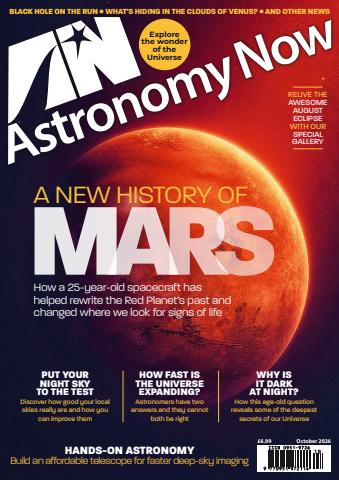
October 2026 The October issue of Astronomy Now rewrites the history of Mars. For decades, we pictured the young Red Planet as a warm, wet world of rivers and lakes that gradually became the cold desert we see today. But a wealth of new evidence is revealing a far more complicated story. Elizabeth Howell explores our changing view of Mars and asks what really happened to the planet’s water, atmosphere and potentially habitable environments. Back on Earth, how dark is your night sky? We show you how to put your own skies to the test, discover what the results reveal about light pollution and find out what you can do to help protect the night. Meanwhile, Colin Stuart takes a different tack and asks a deceptively simple question with profound implications for cosmology: why is it dark at night? Elsewhere, cosmology has a problem. Different ways of measuring how fast the Universe is expanding stubbornly refuse to agree, even as the measurements themselves become increasingly precise. Thomas Villa explores the Hubble Tension and asks whether astronomers are still being misled by hidden uncertainties, or whether the discrepancy could be pointing towards a deeper rethink of our understanding of the Universe. For observers, October brings the autumn skies into their own. Our Night Sky section guides you through the best sights of the month, including the beautiful Triangulum Galaxy, M33, for Smartscope users, while our practical project shows how you can put together a photographically fast telescope on a budget without sacrificing performance. Plus, we bring you the latest astronomy and space news, equipment, imaging, books and stories from our community of readers. Discover a new Mars, test your own night sky and explore the autumn Universe only in your October copy of Astronomy Now.


SELECT FORMAT:
Instant Access

Available Digital Offers:

Single Digital Issue October 2026
 
$9.99 / issue
Annual Digital Subscription $62.99 billed annually
Save
47%
$5.25 / issue
Monthly Digital Subscription $6.99 billed monthly
Save
30%
$6.99 / issue
Available with
Pocketmags Plus
Unlimited Reading Subscription
 
$1.39
Get unlimited access to Astronomy Now and over 750+ other great titles. Renews at $13.99 / month after 30 days. Cancel anytime. Learn More
Savings are calculated on the comparable purchase of single issues over an annualised subscription period and can vary from advertised amounts. Calculations are for illustration purposes only. Digital subscriptions include the latest issue and all regular issues released during your subscription unless otherwise stated. Your chosen term will automatically renew unless cancelled in the My Account area upto 24 hours before the end of the current subscription.

Astronomy Now issue October 2026

Astronomy Now  |  October 2026  


The October issue of Astronomy Now rewrites the history of Mars. For decades, we pictured the young Red Planet as a warm, wet world of rivers and lakes that gradually became the cold desert we see today. But a wealth of new evidence is revealing a far more complicated story. Elizabeth Howell explores our changing view of Mars and asks what really happened to the planet’s water, atmosphere and potentially habitable environments.

Back on Earth, how dark is your night sky? We show you how to put your own skies to the test, discover what the results reveal about light pollution and find out what you can do to help protect the night. Meanwhile, Colin Stuart takes a different tack and asks a deceptively simple question with profound implications for cosmology: why is it dark at night?

Elsewhere, cosmology has a problem. Different ways of measuring how fast the Universe is expanding stubbornly refuse to agree, even as the measurements themselves become increasingly precise. Thomas Villa explores the Hubble Tension and asks whether astronomers are still being misled by hidden uncertainties, or whether the discrepancy could be pointing towards a deeper rethink of our understanding of the Universe.

For observers, October brings the autumn skies into their own. Our Night Sky section guides you through the best sights of the month, including the beautiful Triangulum Galaxy, M33, for Smartscope users, while our practical project shows how you can put together a photographically fast telescope on a budget without sacrificing performance.

Plus, we bring you the latest astronomy and space news, equipment, imaging, books and stories from our community of readers.

Discover a new Mars, test your own night sky and explore the autumn Universe only in your October copy of Astronomy Now.
read more read less
The wonders of the Universe explained for everyone to understand.

As a subscriber you'll receive the following benefits:


•  A discount off the RRP of your magazine
•  New issues delivered to your device on the day of release
•  You'll never miss an issue
•  You’re protected from price rises that may happen later in the year

You'll receive 12 issues during a 1 year Astronomy Now magazine subscription.

Note: Digital editions do not include the covermount items or supplements you would find with printed copies.

Your purchase here at Pocketmags.com can be read on any of the following platforms.


You can read here on the website or download the app for your platform, just remember to login with your Pocketmags username and password.

Apple Pocketmags Online Pocketmags Google Pocketmags
The Pocketmags app runs on all iPad and iPhone devices running iOS 15.6 or above, Android 8.0 or above, and Amazon Fire Tablets from 2018 onwards, though owners of earlier Fire models can check the Amazon Appstore directly on their device to confirm compatibility.

For iOS users, we recommend using a device capable of running the latest version of iOS for optimal performance and stability, as older hardware with lower processing power and RAM may experience slower page rendering or occasional stability issues due to device memory limitations. Alternatively, our web-reader works with any modern, HTML5-compatible browser, though we recommend Chrome or Firefox for the best experience on PC and Mac.
N/A
Based on 0 Customer Reviews
5
0
4
0
3
0
2
0
1
0
View Reviews

Articles in this issue


Below is a selection of articles in Astronomy Now October 2026.

Free Sample Issue
Try a FREE sample of Astronomy Now
Chat
X
Pocketmags Support