Rewilding the blue
Florida’s warm, turquoise waters are home to marine marvels, including the world’s largest gathering of West Indian manatees, but human activity is taking its toll
It’s our first meeting and he’s eyeballing me intensely, small, star-like eyes trying to figure me out, wondering what kind of creature I could possibly be. Inspection complete, I assume my curious companion will move on, but instead he comes in closer, nuzzles my shoulder and tickles my neck with his wiry whiskers. It’s a bold approach by a stranger, but one that I don’t mind a bit, as the whiskers belong to a juvenile manatee. Even more special is the fact that this is happening in the wild. Unlike the captive animals in aquariums or theme parks, my new manatee friend hasn’t been trained to perform for tourist selfies: he’s gloriously free, and one of the hundreds of wild manatees that find refuge in the year-round balmy waters of Kings Bay in Crystal River.
Wildlife haven
This incredible freshwater inland bay on Florida’s Gulf Coast is one of the best places in the world to see these giant, gentle marine mammals. Crystal River National Wildlife Refuge was established in 1983 to protect the West Indian manatee. Fed by over 70 natural springs, which pump more than 600 million gallons of freshwater a day from the Florida aquifer and maintain a constant temperature flow of 22.2C (72F),the refuge’s warm waters provide a critical sanctuary for manatees in winter when the water temperature around Florida’s coastline drops. While the manatees’ huge size – they can weigh more than 500kg – gives the impression that, like whales and dolphins, they’re insulated with thick blubber, they have just an inch of body fat, which leaves the warm-blooded mammals susceptible to cold stress and hypothermia.
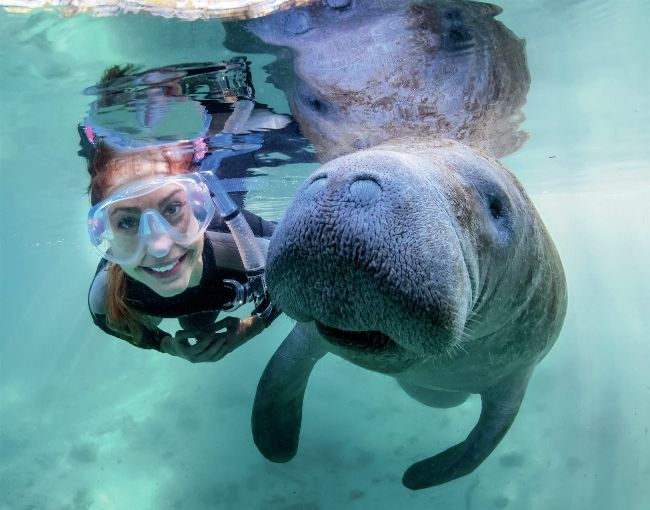
Joining a guided snorkel tour from Plantation on Crystal River Adventure Center, wearing my own toasty layer in the shape of a wetsuit, I head out to explore the 80-acre refuge and meet its most famous residents. Captain Laura Ruettiman, a manatee conservationist and the guide for my snorkel safari, points out manatee signs as soon as we leave the dock: two round nostrils surfacing to breathe in the early morning air, and large manatee ‘footprints’ – smooth pancake shapes on the surface, made by the slap of the animals’ distinctive paddle-shaped tail. Pulling out into Kings Bay, we pass residential houses with waterfront gardens and moorings, as the channels around the bay start to come alive with kayakers, boaters and cormorants diving for their first fish of the day.