Self-Harvesting Feed
column & photos by Frank Hyman
It would make me so happy to set up a system for raising black soldier fly larvae (BSFL) to feed our hens, but my wife has vetoed anything with the word “fly” in it. Calling them by their Latin name, Hermetia illucens, didn’t help one bit. So this will be the first column about something I haven’t actually done, but I called on a couple of BSFL experts to help me out.
Not All Flies are Houseflies
Black soldier flies don’t look like houseflies. BSF are technically a “fly” because they only have two wings. They actually look like very small wasps. (Wasps have four wings - sorry, entomology nerd here). OK, “look like wasps” probably doesn’t help my case much either. They do look like the kind of insect that is technically a wasp, but it’s not the kind of wasp that stings people. They look like a nonstinging wasp. Is that better? OK. Never mind all that. Take a look at these important differences:
• Black soldier flies have a scent that displaces houseflies;
• Unlike houseflies, they are not disease carriers and actually eliminate harmful bacteria; and
• They self-harvest at their optimal stage for feeding chickens.
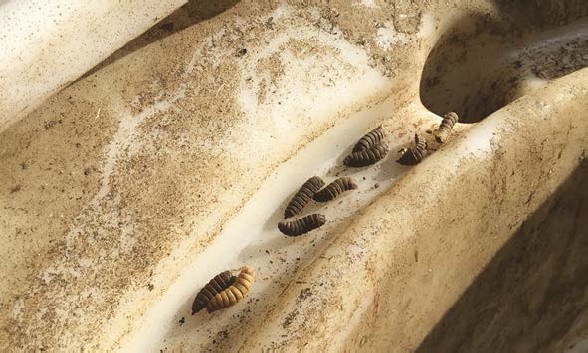
At a certain stage of growth, black soldier fly larvae feel compelled to wiggle up The Ramp of Death inside a Biopod. The hole at right drops them into a harvesting bucket. This self-harvesting compulsion makes them a great candidate for high-protein, organic, homegrown chicken feed.