5 WAYS TO TRANSFORM YOUR FISH BUYING
By CJ Jackson, principal of The Seafood School at London’s Billingsgate Market
1. Shop seasonally
The Marine Conservation Society (MCS) has a chart showing when species are spawning or producing roe, which is when you should avoid them. Generally speaking, autumn is a good time to eat fish.
2.
Buy
–
and
cook
–
on
the
bone We need to get away from a ‘no eyes, no gills, no skin’ attitude. It’s much easier to tell if fish is fresh when it’s on the bone (bright eyes, deep red gills). And if you cook fish on the bone, you have a much lower chance of overcooking it.
3.
Look
for
the
ASC
label Around half the fish we eat is farmed, which comes with issues around the pollution of the surrounding environment and the sustainability of fish feed.
The ASC (Aquaculture Stewardship Council) label indicates feed can be traced back to sustainable sources and sets requirements around protecting and improving local ecosystems.
4.
Go
for
frozen If you’re buying fish to keep in the freezer, you’re better off buying it already frozen – it’s frozen faster and at lower temperatures than you can get with a home freezer.
Look out for the FAS (Frozen At Sea) label, meaning fish is frozen within two hours of being caught. 5. Store it carefully Wrap white fish carefully, then place it on ice blocks in the fridge – that will keep it fresh for 2-3 days. Oily fish such as sardines and mackerel spoil sooner, so eat within 24 hours. →
“This sweet, spicy sambal is one of my favourite things. And combined with butter it’s even more delicious. I like to serve it with mussels as a broth with loads of fresh herbs.”
CHANTELLE NICHOLSON, CHEF/OWNER TREDWELLS, LONDON
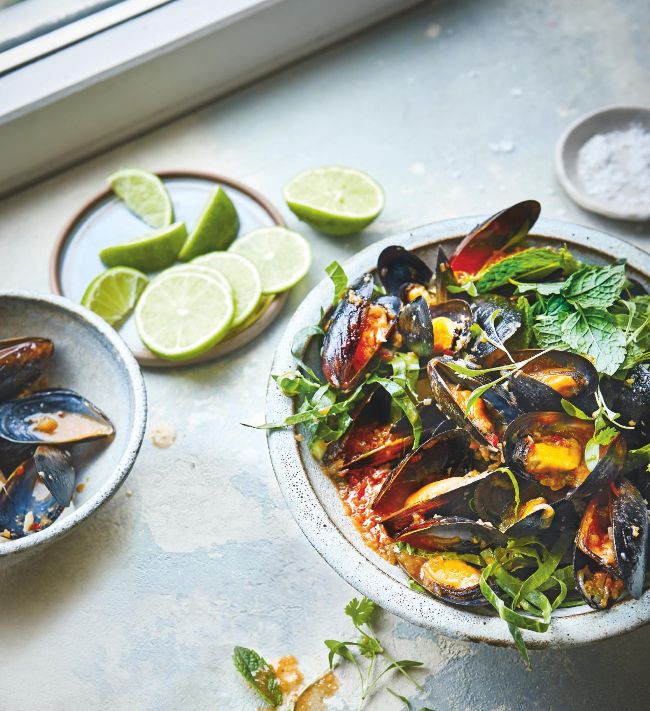
Mussels with sambal butter & fresh herbs
THE BIG FISH SWAP
It’s hard to get a sense of the scale and diversity of fish landed in Britain because so much of our catch is exported. The past year has seen some rebranding – “Megrim sole doesn’t sound very sexy, so that’s Cornish sole now,” laughs Katie Toogood, who owns fishmongers and restaurants in Cornwall and London – and here are some fish you can choose instead of overfished favourites...
If you like cod…
Hake, pollock and coley are “all really nice, white, flaky fish,” says Toogood – and in good supply. Find MSC-rated hake in Waitrose and Morrisons.
If you like lemon sole…
Cornish sole (megrim) is a good replacement, though not so firm. Another alternative is plaice, says Ben King of Pesky Fish: “Since cod stocks have been so low, there’s been an explosion of flatfish because cod eat flatfish eggs.”
If you like prawns…
The first sustainable prawn farm in the UK collapsed this year due to Covid pressures.
Another is in the works; in the meantime look for wild-caught Cornish prawns, Scottish langoustines or crayfish.
If you like seabass…
“Populations are recovering in some areas, so check where your seabass is from,” says the MCS. Opt for line-caught if available, or consider sustainably farmed seabass.