60 Objects, 60 Years
1968 to 1972: UNIT Beret to Sonic Screwdriver
JAMIE LENMAN catalogues one Doctor Who object for every year of the show’s existence – including historical props, desirable collectables, personal mementos and more…
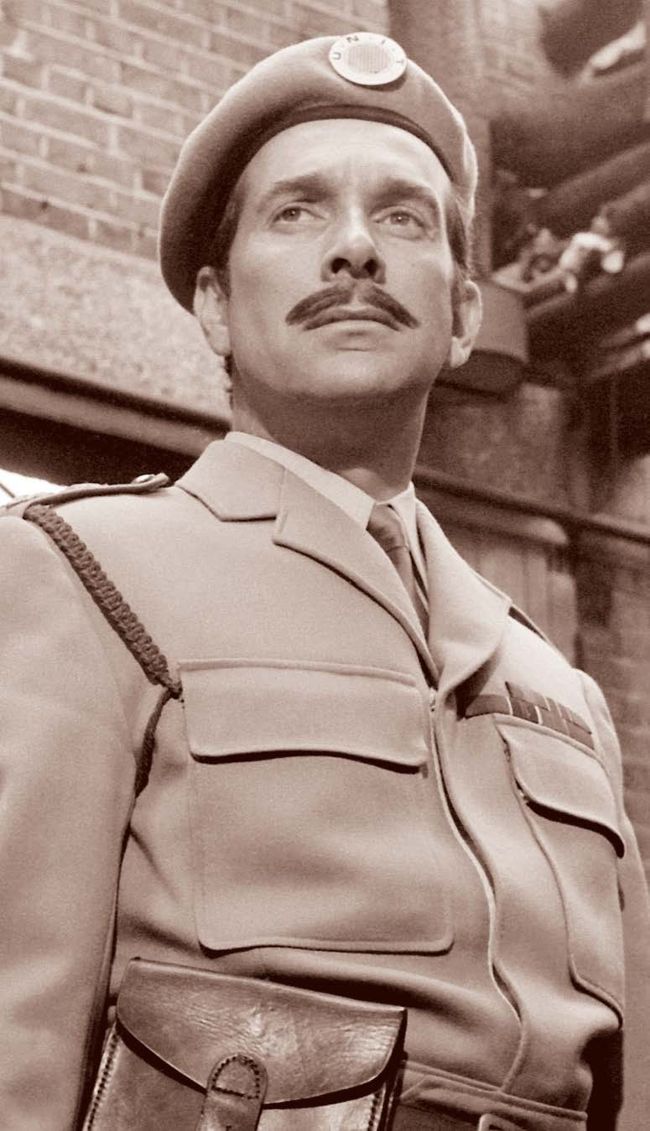
Brigadier Lethbridge-Stewart (Nicholas Courtney) wearing his UNIT beret in The Invasion (1968).
1968
UNIT beret and badge
Despite functioning in much the same way, and despite being led by the same man, the group of soldiers encountered by the Doctor in 1968’s The Web of Fear was not UNIT. The organisation originally known as the United Nations Intelligence Taskforce made its official debut several months later in The Invasion, an eight-part Cybermen epic that served as a test-run for how Doctor Who might look if it was constrained to Earth in the then-present.
The most striking visual signifier of UNIT’s emergence (and indeed his own promotion from Colonel to Brigadier) was Alistair Gordon Lethbridge-Stewart’s swapping of his Glengarry cap for a smart new sand-coloured beret, adorned with the UNIT emblem. Speaking to David J Howe and Stephen James Walker in their book Talkback: The Sixties, costume designer Bobi Bartlett remembered, “When I came to design the UNIT uniform, I tried to keep in mind the fact that it was for an organisation that was supposed to be an international taskforce under the command of the United Nations. It had to have an international look about it, and not resemble too closely the established uniform of any particular country. It also had to be very up-todate and maintain the traditional macho, masculine image of the military.”
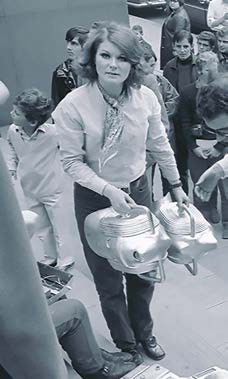
Costume designer Bobi Bartlett on location for The Invasion.
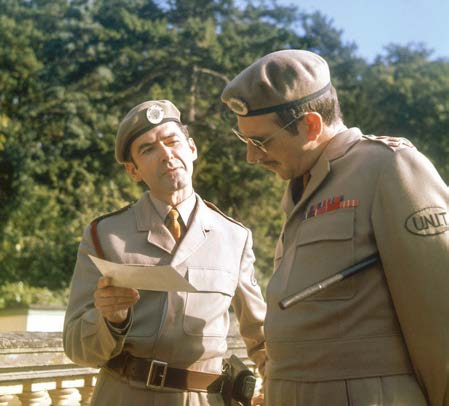
John Breslin (as Captain Munro) and Nicholas Courtney rehearse a scene for Spearhead from Space (1970).
Bartlett had a keen interest in history and had undertaken significant research in preparation for the job, meaning that even the fabric colour was carefully chosen. The ‘beige beret’, as it’s officially designated by the Special Air Service, is used around the world to denote distinct factions of the army which undertake specialised assignments. If UNIT really was a secret paramilitary organisation, then it was exactly the kind of thing its recruits would wear. Indeed, members of the SAS still wear the beige beret in order to distinguish themselves from other regiments.
“I tried to keep in mind the fact that it was for an organisation that was supposed to be an international taskforce. ”
BOBI BARTLETT
But it wouldn’t have been complete without a badge bearing one or two specific details, and it fell to Bartlett to design this too. “I based this around a grid of lines within a circle, which was supposed to symbolise the world under the protection of the United Nations,” she recalled. “It was quite a simple idea but read very well from a distance on television.”