THE FINAL ANALYSIS
1989’s Survival was the last Doctor Who story produced by John Nathan-Turner. On the day it began airing, he talked to Dean Cooper, reflecting on his tenure and some of its controversies… Here at last is that never-before-published interview.
In 1989, Dean Cooper was reading literature and history at Staffordshire University. His final-year dissertation was titled Cognitive Estrangement: is Science Fiction a Genre? The subject was Doctor Who. Dean thought that Doctor Who wasn’t actually science fiction, but fantasy, and that it had become increasingly self-aware about its political subtext. Who better to put his ideas to than the programme’s then producer?
On Wednesday 22 November, Dean was granted a two-hour interview with John Nathan-Turner in the Doctor Who production office at Shepherd’s Bush. Start time: 3.30pm. “I went to the pub before my meeting, all nerves,” he remembers. “I had written to him expecting no reply, but got a telephone call three or four days later. In the interview he was very friendly, and we both smoked until his cigarette tray was a hillock of ash and butts.”
Although he didn’t let on to Dean, by then Nathan-Turner knew that the contracts for the show’s leads, Sylvester McCoy and Sophie Aldred, hadn’t been renewed, that there wouldn’t be another season in 1990, and that the intention was to tender Doctor Who for independent production.
It was the end of an era.
Dean Cooper:
Doctor Who was originally an educational programme, in part. Do you still take a responsible attitude? For example, The Visitation [1982], with the burning down of London, and The Mark of the Rani [1985], with the Luddite riots caused by the Rani – do you make very sure that it’s shown to be purely science fiction, without confusing issues?
John Nathan-Turner: Yeah, we try not to confuse. I’m sure that in some schools a few years back some children were saying that the Terileptils caused the Great Fire of London. Yes, we try and be informative. We try also, hopefully, in each story to make some sort of message. That sounds awfully pompous, and I don’t mean it to sound so!
DC: Are particular stories aimed at a particular age group?
JNT: What we try to do is build stories up on three levels, so that there’s a runaround aspect with monsters on one level, and a more mature version which we hope appeals to almost everyone from the age of 11, I guess. And then, above that, there’s this thin layer of message, so we hope that by doing that we are appealing to a whole range. Certainly our research seems to indicate that we have an extremely wide cross-section of viewers, so I guess we’re successful on that.
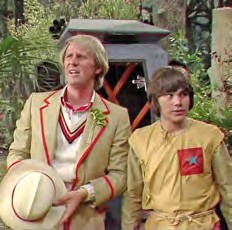
The Doctor (Peter Davison) and Adric (Matthew Waterhouse) in Kinda (1982).
DC: In the 19th season you had a story called Kinda, which is very grown-up, with a lot of Buddhist symbolism and one of the characters going slowly mad. It just seemed to me a very adult concept.
JNT: Yes, very adult themes, but I’m sure the younger viewers enjoyed it at that time, too, because there were lots of very striking visuals… That’s the good thing about the freedom of the show, in that we can do what you call a very adult story, and at the same time it would appeal to the younger viewers in the middle bracket – 13 or so. I don’t think that the involvement of the Buddhist fable, and all the things that you’ve mentioned about Kinda – I don’t think that they necessarily went over the heads of the younger viewers, but at the same time there was enough there in the adventure for them not to feel cheated.