GRAVE NEW WORLD
Firewatch meets Alien Isolation in Starward Industries’ adaptation of a vintage science-fiction novel
By Alex Spencer
ONLY THE ROBOTS ARE ACTIVE, CARRYING OUT OLD ORDERS; EVERYTHING ELSE IS ABANDONED AND COATED IN A FINE LAYER OF SAND
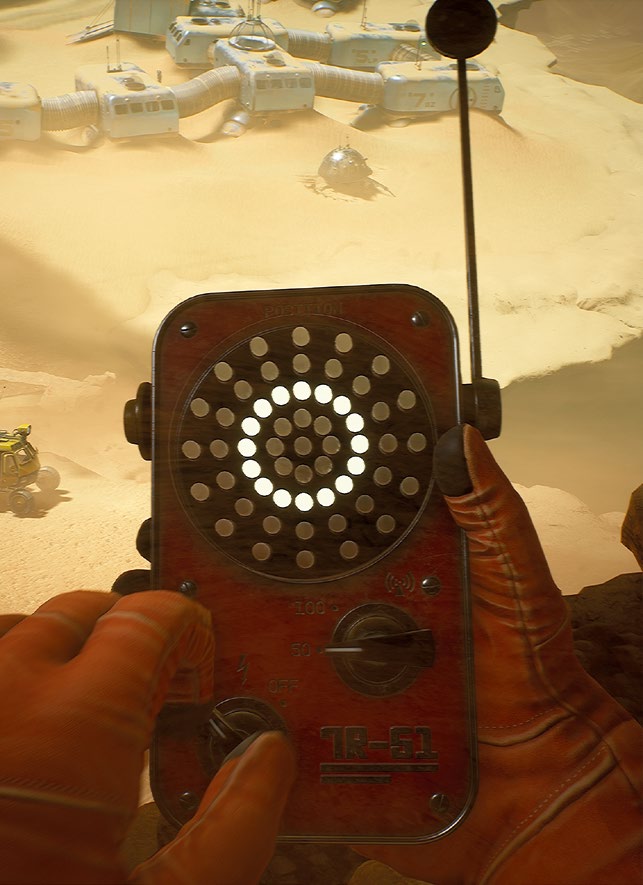
Yasna’s delightfully retro-styled LED-bearing tracker device in action.
If Bethesda is leaning into a ‘NASA-punk’ aesthetic for Starfield, The Invincible takes inspiration from the other side of the Space Race
Game The Invincible
Developer/publisher Starward Industries
Format PC, PS5, Xbox Series
Release 2022
Welcome to Regis III. A desert planet orbiting a red dwarf star, it is fairly benign by all the traditional metrics of space exploration. Gravity is roughly Earth-like; radiation levels are manageable; even the air here is breathable, at least for a while. Nonetheless, the planet proves to be completely deadly to human visitors, for reasons first explored in The Invincible, a 1964 novel by Polish author Stanisław Lem. Now, almost 60 years on, a crew assembled from talent from Poland’s most high-profile studios – CD Projekt Red, Techland, Bloober Team – is returning to Regis to plant the flag of newly formed studio Starward Industries.
In Starward’s hands, Regis is a desolate but rather beautiful place. Its sandstone formations are rendered in crisp detail, obscured only by the wisps of dust that dance constantly across the planet’s surface. Overhead, twin moons hang in a murky blue sky, as if noon and midnight are happening simultaneously. Most distinctive of all, though, are the things left behind by human expeditions: transports huddled together and connected by ribbed tunnels to form a makeshift base; spherical BB8-meets-Sputnik probes that bob along on jets of blue flame; enormous domed things that skitter crablike through the desert; and bright yellow rovers with balloon-like tyres, looking as though they could have been designed by Gerry Anderson. Only the robots are active, carrying out old orders; everything else is abandoned and coated in a fine layer of sand. As in the original novel, what awaits us on Regis is effectively a planet-sized Mary Celeste.
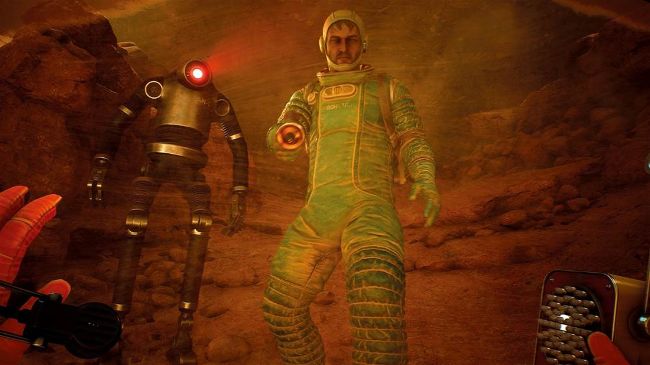
Still, there are signs of life to be found here, as you’ll know if you saw the teaser trailer Starward released in November. That introduced the world to this version of Regis and to Dr Yasna, our protagonist, as she explored its surface. By the trailer’s end, we’d met another human too, a grizzled astronaut with a robot companion by his side, who points a raygun in Yasna’s face and asks with audible disgust: “What have you done?” It’s an efficient introduction not only to the setting and mystery but to some of the biggest changes being made in this adaptation.
They begin with Yasna herself. She’s an entirely new character and represents a third expedition, sneaked in between the two established in Lem’s book: the Condor and the Invincible, the latter sent to investigate the disappearance of its sister ship on Regis. Where those spacecraft are enormous, heavily armed and thoroughly manned (in the latter case, anyway), Yasna’s Dragonfly is small and underequipped by comparison. With just six people aboard –a number that rapidly depletes when it arrives on Regis – the stakes here are very different than in the book, which is concerned with scientific councils and chains of command. As game director Marek Markuszewski explains: “We wanted a small crew so we can better show relationships and tell a more intimate story from the perspective of the individual, not the group.”
The astronaut with the raygun and the robot, though, harks from one of the bigger expeditions. And this brings us to the other major addition Starward is making to Lem’s original story: the idea of opposing human factions. Yasna and the Dragonfly belong to the Interplanetary Commonwealth; the Condor and Invincible – and this stranger – to the Cosmosolidary Alliance. This addition isn’t arbitrary, Markuszewski assures us, but inspired by the wider context of the source material.
Most of Lem’s books were written in Soviet-ruled Poland, against the backdrop of the Cold War and the accompanying Space Race. And likewise, here you’ve got two factions that are not in open conflict but are deeply suspicious of one another. There are more explicit nods too, such as the mention of a technology being developed “behind the curtain” and the stranger at one point referring to Yasna’s group as “the Reds” – though Markuszewski is keen to clarify that this isn’t a direct continuation, and that the factions aren’t drawn along all-too-familiar geopolitical lines.