INFR ARED
Make a model train scale-speed monitor
Sean Conway feels the need for scale-model speed! So, he prototypes a Raspberry Pi-based measuring device with a few basic sensors.
OUR EXPERT
Sean Conway is a former IT security specialist from a national telecommunication company who implements Pi-based projects to get his muchneeded technology fix after retiring.
YOU NEED
Raspberry Pi 3 B+
16GB SD card
Raspberry Pi OS Lite (used: 4 April 2022)
GPIO Zero 1.6.2
IR sensors
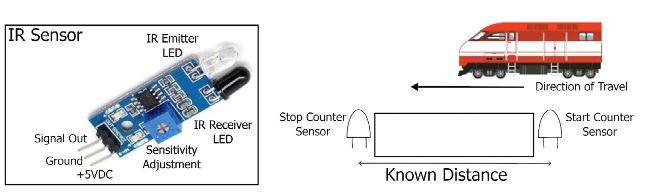
Two IR sensors are use d to generate the all-important start and stop count.
H ave you ever seen something and thought, “I can do that”? This writer’s inspiration came after using a commercial device to determine the speed of a model train. The speed limit posted for a real train entering a siding is 16kph. So let’s use a Raspberry Pi, with some external infrared (IR) sensors mounted to a block of wood of known dimensions, to establish the scale speed of a model train entering the siding on a model railway layout.
Typical full-size trains in the UK run at up to around 100kph, depending on limiting factors. The class or track quality determines the maximum running speed and the ability to carry passengers. Other factors, such as curvature, signalling, track condition and level crossings, may also influence the speed. Model train sets take the full-size train and scale it down to a specific model train scale. In the UK today, OO and N are the most popular scales. The letters represent ratios – the fraction that is used to scale or model the environment. Scale not only applies to the train size but also to scenery, so that everything in a layout is in proportion to its real-life size.