GB
  
You are currently viewing the United Kingdom version of the site.
Would you like to switch to your local site?
21 MIN READ TIME

PHOTOREALITY CHECK

Real-time photorealism is the holy grail of gaming. And it’s coming to the PC sooner than you think , says Jeremy Laird

Today’s games can already achieve photorealism, but in fleeting moments.
© ELECTRONIC ARTS

FROM THE VERY DAWN of computer graphics, there has been one overarching goal. An end game for PC gaming, a final destination. We’re talking of course about real-time photorealism. In experiential terms, graphics rendered in real-time that are indistinguishable from reality, at least as shown on a 2D screen. Achieve this goal and the observer will not be able to pick rendered computer graphics from real-life motion video. Of course, deciding when any given example of computer-generated graphics has achieved photorealism is always going to be a subjective call. We can all surely agree that the best CGI in movies and TV achieves that at least some of the time. But has any PC or console game yet achieved even fleeting photorealism? That’s debatable.

Just occasionally, you get a snippet of gaming, maybe something with an ultra-high detail texture pack installed, that momentarily breaches the photorealism barrier. If you’ve seen the Star Wars: Battlefront Real Life Mod in action you’ll know what we’re talking about. Occasionally, just for a moment, it can look photorealistic.

But here’s the thing. As you read these words, the PC graphics industry is taking what promises to be the last few steps towards what you might call sustained photorealism. Not photorealism all the time in every game. But sustained passages in certain games that can deliver what almost everyone would agree is photorealism. A huge array of technologies encompassing both hardware and software are currently aligning towards that end result. So get ready. Photorealism is coming to the PC, and sooner than you think.
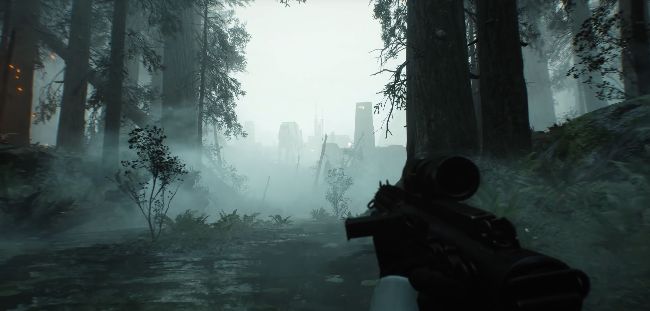
Pre-rendered or in-game? Can you tell?

ONE WORD. PERFORMANCE. Ultimately, that’s what stands between gamers and truly photorealistic graphics. Since the first computers capable of rendering pretty much any graphics at all, it has all been about performance. Any computer capable of processing general-purpose instructions can render a graphical scene of any complexity you throw at it. Even a full ray-traced 8K vista rendered on an old 286 CPU, all 33 million pixels in ultra-high photorealistic quality, is doable—the only question is how long it takes to get the job done. It might take a few months to spit out a single frame but it’s still doing it.

Of course, exactly how long is acceptable for real-time gaming is what matters here. These days, most gamers don’t get out of bed for less than 60 frames per second. That means the full game scene is rendered and outputted to the display 60 times each second. Maybe you can live with lower frame rates. Maybe you prefer higher. But something in the region of 60fps is a decent rule of thumb.

If a single frame takes a second, a minute, maybe even an hour to render, it doesn’t matter how good it looks—you’re not going to be gaming. Performance is everything and the solution to that problem is twofold. Either add more performance in hardware. Or make a given rendering task easier and faster.

This brings us neatly to perhaps the most superficially straightforward way to improve performance and achieve that photorealistic end game, namely upscaling. There’s nothing new about the basic principle of taking a low-resolution image and mapping it to a larger resolution. It’s just that, historically, the results have been less than impressive.

That’s especially true in the digital era, where flat panel displays are unforgiving of generic spatial upscaling algorithms that average out data from a single pixel in a source image over several pixels in an upscaled one. The results in terms of image quality are typically soft and blurry, but from a performance perspective, the boost from upscaling can be huge.

To take an example, upscaling from 1080p to 4K is a quadrupling of pixel count. Using old-fashioned spatial upscaling approaches that have the advantage of adding little to no additional time to the image output process, that means a quarter of the rendering work for the GPU compared with native 4K rendering and far higher frame rates.

Unlock this article and much more with
You can enjoy:
Enjoy this edition in full
Instant access to 600+ titles
Thousands of back issues
No contract or commitment
Try for 99p
SUBSCRIBE NOW
30 day trial, then just £9.99 / month. Cancel anytime. New subscribers only.


Learn more
Pocketmags Plus
Pocketmags Plus

This article is from...


View Issues
Maximum PC
August 2022
VIEW IN STORE

Other Articles in this Issue


editorial
LOUNGING AROUND
BEING A PC USER IS GREAT, but it
QUICKSTART
Qualcomm aims for your desktop
Another ARM-based processor to enter the frame
NEW BABY SURFACE
FASTER, LONGER-LASTING AND STILL AS THIN
WIN11 WITH NO MINIMUM
New preview build shows how easy it is
Tech Triumphs and Tragedies
A monthly snapshot of what’s good and bad in tech
APPLE LAUNCHES M2 CHIP
4bn more transistors for second-gen silicone
INTEL SHOWS ITS NODES
Gelsinger’s grand plan starts to take shape
Zen 4 will be 35 percent faster
AMD’S ANNUAL FINANCE DAY may sound irredeemably dull,
Supercomputer goes exascale
The Dept of Energy at the Oak Ridge
Goodbye Internet Explorer
Microsoft has pulled support for Internet Explorer and
AMD’s FidelityFX Super Resolution 2.0
LAST YEAR, AMD launched FidelityFX Super Resolution (FSR), an upscaling algorithm promising improved performance, possibly inspired by Nvidia’s DLSS (Deep Learning Super Sampling). Rendering at a lower resolution then upscaling can boost performance, and is almost a requirement to play games at 4K and maxed out settings, especially with ray tracing.
THE LIST
THE TOP FIVE CAPTURE CARDS
GPU prices come back down to Earth
WHEN IT COMES TO PRICES, good news stories are hard to come by right now. Ironically, the one exception is graphics cards, which are now returning to RRP—albeit the recommended pricing is still pretty painful. But contrar y to expectations of higher prices, there is reason to think that trend could be reversed. Cheap GPUs for ever yone? If not this year, then maybe next
LETTERS
DOCTOR
THIS MONTH THE DOCTOR TACKLES...
LETTERS
WE TACKLE TOUGH READER QUESTIONS ON...
LIVING ROOM LEGEND
LIVING ROOM LEGEND
Want to play your Steam librar y from the sofa on a console-sized PC? Guy Cocker has all the components, accessories, and build info you need for leaned-back bliss
WHAT’S IN THE BOX?
CPU INTEL CORE I5-12600K “The new gaming champ”
HEAD IN THE GAME
BUILD YOURSELF A COMPACT, CONSOLE-LIKE LIVING ROOM GAMING PC
SOFA, SO GOOD
WE’VE BEEN eager to build inside the NZXT
8 BEST COUCH GAMING ACCESSORIES
XBOX WIRELESS CONTROLLER The PC supports most controllers
AMD ZEN 4 UNWRAPPED
AMD ZEN 4 UNWRAPPED
Welcome to the modern age
CENTERFOLD
Sonos Ray
PERFORMANCE GEAR LAID BARE
PI-POWERED MEDIA CENTER
BUILD A PI-POWERED MEDIA CENTER
Make your own home entertainment hub with a Raspberry Pi, free software, and a few programmable LEDs. Jonni Bidwell shows you how
KODI ACADEMY
New versions of Kodi and LibreELEC are out, but only for recent Pi owners
SETTING UP KODI
LibreELEC is probably the easiest Linux distro you’ll have ever installed, and Kodi will be ready for action in no time
HI-FIDELITY KODI
Integrate the world’s most popular streaming site into Kodi and see how the Pi fares at high-resolution
TRIPPING THE LIGHT FANTASTIC
Add a touch of pizzazz to your media center with a border of colorful, picture-reactive LEDs
R&D
HOW TO
STEP-BY-STEP GUIDES TO IMPROVING YOUR PC
Clean Out Windows 11
YOU’LL NEED THIS
Machine of the Month: Oric-1 & Oric Atmos
YOU’LL NEED THIS
3D map effect with GIMP
YOU’LL NEED THIS
AMD’s refreshed mid-tier machine
Is the new Radeon RX 6650 XT worth adding to your rig?
LAB NOTES
Playdate Netflix meets handheld retro gaming? NETFLIX AND
IN THE LAB
Asus RX 6750 XT ROG Strix
An incremental improvement worthy of the price?
Asus Zenbook Pro 14 Duo OLED
Two screens better than one?
Razer Blade 15 Advanced (2022)
Be careful what you wish for…
Acer Predator GD711
A solid projection selection
Samsung M8 Smar t Monitor
Care for some SmartTV and 4K monitor fusion?
PowerColor RX 6650 XT Hellhound
A case of style over substance?
computer-1
And Now For Something Completely Different
Corsair K70 RGB Pro
Premium price tag for a premium keyboard?
Logitech Lift Vertical Ergonomic Mouse
Vertical wireless mouse with compact size and price
Warhammer 40,000: Chaos Gate – Daemonhunters
Grey Knights vs. the forces of Chaos in XCOM-alike
NordVPN vs. ExpressVPN
The battle to protect internet security and privacy
BLUEPRINT
THE BUILDS
THIS MONTH’S STREET PRICES...
Chat
X
Pocketmags Support